


Strategy Stock Struggles to Match Bitcoin’s Surge as Valuation Debate Intensifies
We may earn commissions from affiliate links or include sponsored content, clearly labeled as such. These partnerships do not influence our editorial independence or the accuracy of our reporting. By continuing to use the site you agree to our terms and conditions and privacy policy.


Strategy (MSTR) stock faces pressure despite Bitcoin’s rally. Analysts debate fair value, risks, and whether ETFs and options are eroding its premium.
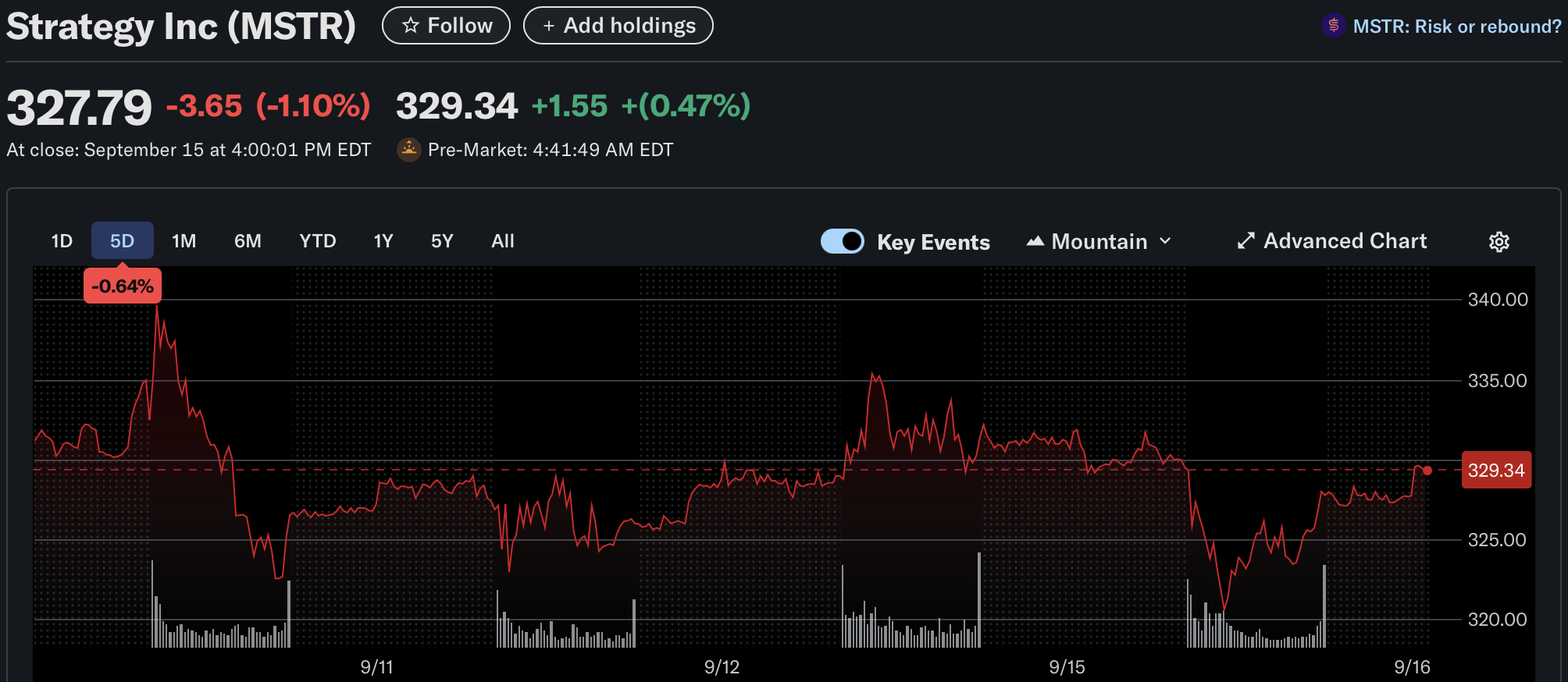
Strategy (MSTR) has become one of Wall Street’s most polarizing plays. Once a modest enterprise software company, it has now evolved into a corporate Bitcoin treasury under cofounder Michael Saylor. Investors who bought in early have enjoyed a staggering 146% gain over the past year, but recent price action tells a different story. Despite Bitcoin rallying to fresh all-time highs above $124,000 in August, Strategy’s stock has failed to keep pace,§ raising questions about whether it is undervalued or simply losing its premium status.
Adding to the intrigue, some analysts now view MSTR as a leveraged bet on Bitcoin with asymmetric upside, while others argue its unique role is being eroded by the rise of spot ETFs and alternative exposure methods. That shift has opened the door for investors to explore other equity-linked plays tied to the digital asset economy. In that context, it’s becoming increasingly relevant to check top penny stocks like HYLQ, as it positions itself as a regulated gateway to HyperLiquid’s rapidly growing DeFi ecosystem. While MSTR remains the headline name, HYLQ and similar crypto-related stocks highlight how equity markets are diversifying the ways investors can gain exposure to blockchain innovation.
Momentum vs. reassessment
The company’s latest earnings offered a mixed picture. Revenue growth was modest, yet net income improved substantially, a trend that gave bulls confidence. Still, the stock has cooled after hitting a peak near $543 in late 2024, now trading closer to $325.
Supporters argue the pullback is simply a breather after a year of explosive gains. They point to Strategy’s profitability momentum, its credibility as an institutionally recognized Bitcoin vehicle, and the possibility of S&P 500 inclusion as reasons for optimism. For long-term believers in Bitcoin’s trajectory, Strategy remains a high-risk, high-reward vehiclethat amplifies exposure to digital gold.
Analysts split on valuation
One of the most widely followed narratives comes from BlackGoat, which values Strategy at a base case of $663 per share, suggesting the stock trades at a 50% discount to fair value. This target hinges on continued Bitcoin appreciation and partial success of the company’s “42 42 Plan,” alongside potential boosts from favorable accounting changes and regulatory clarity.
Yet skeptics highlight a different picture. Discounted cash flow models struggle to provide precision given gaps in financial data. More critically, if Bitcoin stumbles or liquidity dries up, the company’s leveraged balance sheet could magnify losses. The valuation debate underscores the uncertainty: is MSTR still a bargain, or is it priced for perfection?
Competition and collapsing premium
One challenge facing Strategy is increased competition. With spot Bitcoin ETFs like BlackRock’s iShares Bitcoin ETF (IBIT) now widely accessible, investors no longer need to rely on MSTR as a proxy for Bitcoin exposure. This shift has dramatically reduced Strategy’s once-hefty premium.
At its peak, the stock traded at a 300% premium to its Bitcoin holdings, but that figure has now shrunk to around 40%. Meanwhile, other treasury-style companies are entering the market, eroding Strategy’s unique position. For some traders, this structural change explains why MSTR lags Bitcoin despite Saylor’s continued conviction.
Options emerge as a hedge
The underperformance has also pushed investors toward the options market. For instance, when shares traded around $325, the October $320 put option was priced near $17 per contract. Such structures allow traders to bet on further weakness while limiting downside to the premium paid.
Implied volatility in these contracts sits near 51%, below the long-term average of 80%, making them relatively affordable for hedging or speculation. With MSTR trading below both its 50-day and 200-day moving averages, technical pressure continues to weigh on sentiment.
The big picture: Bitcoin proxy or fading premium?
Ultimately, Strategy’s identity as a stock is inseparable from Bitcoin’s performance. For bulls, MSTR still represents an asymmetric bet on digital gold, with corporate leverage amplifying potential returns. For bears, the company’s fading premium, rising competition, and reliance on debt financing highlight its vulnerabilities.
The divergence between Bitcoin and MSTR has created a stark choice for investors:
- Hold Bitcoin directly through ETFs for purer exposure, or
- Stick with Strategy for its leveraged upside – while accepting the higher risk profile.
While that debate defines the Strategy narrative, it is not the only path equity investors are considering.
HYLQ: An Equity Gateway Into HyperLiquid
A parallel story is unfolding in the form of HYLQ Strategy Corp, which has positioned itself as “The Public HYPE Treasury.” Instead of mirroring Bitcoin’s trajectory like MSTR, HYLQ offers regulated exposure to HyperLiquid, one of the fastest-growing decentralized exchanges in the industry.
The company’s transformation is striking. Formerly known as Tony G Co-Investment Holdings, it abandoned its mixed portfolio in gaming and fintech to become a pure-play HyperLiquid proxy. Under the leadership of Antanas “Tony G” Guoga and Matt Zahab, HYLQ has steadily accumulated nearly 29,000 HYPE tokens at entry prices of $37–$39. Those holdings already reflect significant unrealized gains.
What makes HYLQ stand out, however, is its listing on the Canadian Securities Exchange. Unlike many speculative crypto vehicles, this structure enforces audited reporting, regulatory oversight, and institutional-grade access. HyperLiquid itself continues to post impressive metrics, from $2 trillion in lifetime trading volume to 200,000 transactions per second, all supported by zero-gas fees and sub-second settlement speeds.
For investors weighing MSTR against ETFs, HYLQ represents a different kind of experiment: not a leveraged Bitcoin play, but an equity-market bridge into a DeFi ecosystem that is rapidly scaling and carving out its own dominance.
Conclusion
Strategy stock embodies both the promise and the peril of corporate Bitcoin adoption. Its recent pullback has sparked a heated valuation debate, with price targets ranging from deep discounts to overextended risks. For Michael Saylor and long-term believers, the “digital gold” thesis is unchanged. For traders, however, the easier path may lie in ETFs or options, where exposure is cleaner and risk is capped.
Whether MSTR ultimately proves undervalued or overhyped will depend less on quarterly earnings and more on Bitcoin’s path ahead. Until then, Strategy remains a bold, and highly contested, proxy for the future of cryptocurrency. Yet as equity markets continue to evolve, new entrants like HYLQ Strategy Corp are showing how alternative models can also capture investor interest, providing a regulated pathway into DeFi’s momentum and hinting at how the next generation of crypto-linked stocks may take shape.


 Commentaries










Fill in necessary fields and publish