


Solana Futures Trading: Top SOL Futures Platforms
We may earn commissions from affiliate links or include sponsored content, clearly labeled as such. These partnerships do not influence our editorial independence or the accuracy of our reporting. By continuing to use the site you agree to our terms and conditions and privacy policy.



The Chicago Mercantile Exchange (CME) launched Solana (SOL) futures markets in Q1 2025, which provide institutional clients with exposure to the SOL price. Casual investors trade Solana futures on traditional crypto exchanges, since they offer lower account minimums and smaller margin requirements.
Before trading Solana futures, traders must understand how these derivative products work, including maintenance margin and liquidation risks. This guide explains how to trade Solana futures in 2026, and reveals which platforms offer the best service. Read on to explore SOL futures strategies and how to set up risk-averse trades.
The Best Solana Futures Platforms Ranked
We’ve listed and ranked the top Solana futures exchanges below:
- CoinFutures: No-KYC Solana Futures Platform With 1000x Leverage
- MEXC: Trade SOL Perpetual Futures via Linear or Inverse Contracts
- Binance: A Great Option for Solana Delivery Futures With Expiration Dates
- Kraken: Security-First Exchange With 350+ Available Futures Markets
- Margex: Top-Rated Mobile Trading App for 50x Perpetual Futures
Best Solana Futures Trading Platforms Reviewed
Key metrics to consider when selecting the right Solana futures platform include trading commissions, leverage limits, margin maintenance requirements, and liquidity depth. We cover these factors and more in the following platform reviews.
1. CoinFutures: Trade 1000x Solana Futures Without KYC Requirements
CoinFutures is a top-rated futures platform for desktop and mobile traders. It offers a broad selection of crypto futures markets, including Solana, Bitcoin (BTC), Ethereum (ETH), and Dogecoin (DOGE). The platform provides significant market exposure to those on a budget, as users can apply 1000x leverage on a $1 minimum trade requirement. This mechanism amplifies $1 positions to $10,000.
As CoinFutures doesn’t implement know-your-customer (KYC) processes, users register and trade anonymously. The only exception is when users deposit funds using fiat payment methods, such as debit/credit cards and e-wallets. Crypto deposits let users maintain their anonymity, as they make payments privately from a non-custodial wallet.
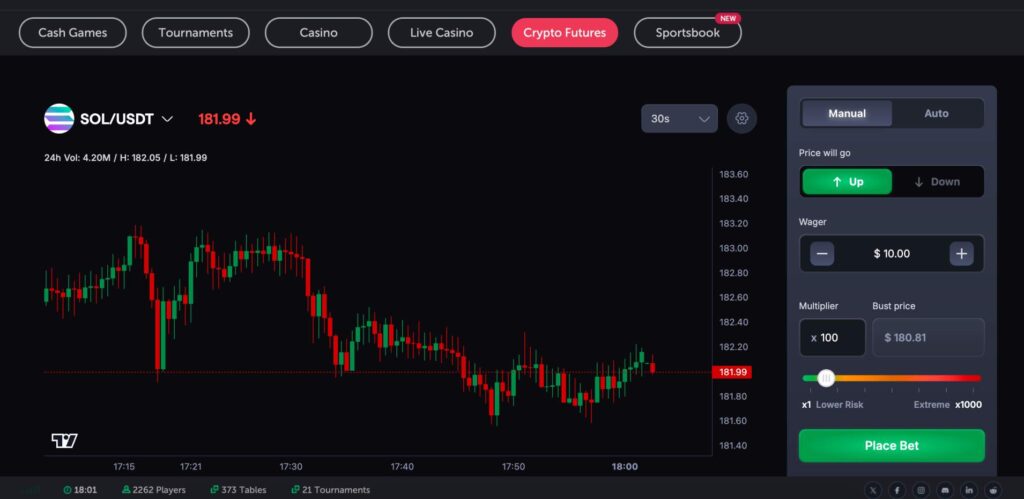
We also enjoy the platform’s user-friendly layout, which simplifies the typical futures trading process. Users select between “Up” and “Down” to trade long or short, and they specify stop-loss and take-profit levels in USD terms. CoinFutures displays the SOL/USDT liquidation price as users adjust their leverage, making it easy to assess the risks.
CoinFutures boasts an exemplary safety record, with no prior incidents of hacks or regulatory issues. CoinPoker, its parent company, has operated since 2017 and stores customer-owned cryptocurrencies in Fireblocks vaults. It’s one of the best crypto futures trading platforms for transparency, as the CoinFutures website offers proof-of-reserves with daily updates.
Pros
- Trade the SOL price with a maximum leverage of 1000x
- Avoid order book risks through simulated futures
- Get started with just $1
- Supports other futures markets like BTC and ETH
- Open an account without providing personal details
- Most crypto withdrawals are processed instantly
Cons
- Doesn’t offer copy trading or automated bots
- Lacks support for PayPal deposits
2. MEXC: Trade SOL Futures Contracts With Leverage of up to 300x
With over 900 markets, MEXC offers a highly extensive futures trading ecosystem for Solana, Bitcoin, XRP, and other top altcoins. Its linear futures markets offer leverage of up to 300x on the SOL/USDT pair. This market attracts substantial liquidity, so MEXC users enjoy industry-leading spreads.
The exchange also offers “Coin-M” Solana futures, which function as inverse contracts. As traders add margin in SOL, their margin collateral becomes more susceptible to increased volatility. While this dynamic heightens the risk of liquidation, it also boosts the upside potential. Perpetual futures back both linear and inverse contracts, and traders may choose between isolated and cross margin.
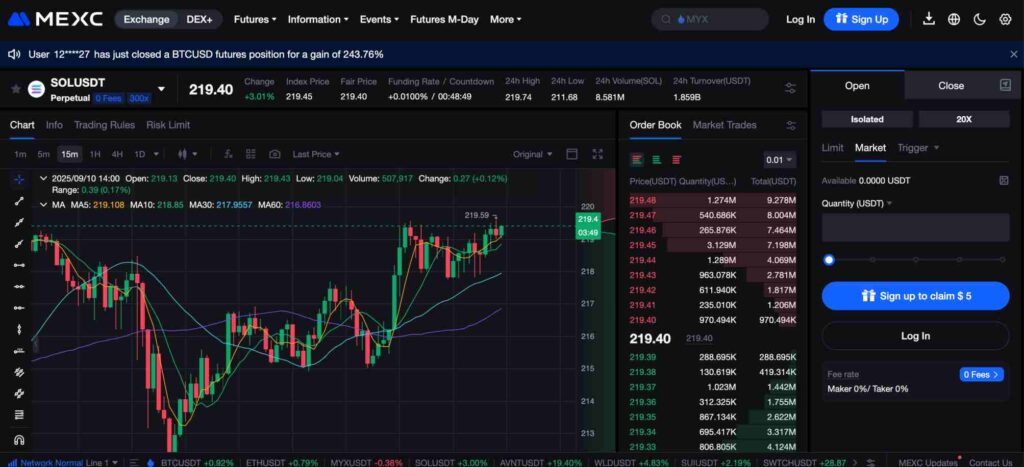
It takes just minutes to open an account with MEXC, as the no-KYC provider allows users to register using an email address or mobile number. Instant payment methods include debit/credit cards, and the exchange includes transaction fees in the final quote. Traders incur futures commissions of 0.01% or 0.04%, depending on whether they’re a maker or taker.
Pros
- Offers 300x leverage on Solana futures
- Choose between isolated or cross-margin contracts
- Low trading commissions
- Instant payment methods include debit/credit cards
Cons
- No support for delivery futures with expiration dates
- Operates without regulatory licenses
3. Binance: Trade SOL Futures With Quarterly and Bi-Quarterly Expiration
Binance lists traditional delivery futures on the SOL/USDT trading pair. These futures products cover two expiration periods: quarterly and bi-quarterly. They enable traders to enter medium-term positions without incurring funding fees, making them much cheaper to trade than perpetuals.
The world’s largest crypto derivative exchange offers perpetual contracts, too, including both linear and inverse settlement. In addition to Solana, these futures markets support hundreds of other cryptocurrencies, including the top meme coins like Fartcoin (FARTCOIN), dogwifhat (WIF), and Myro (MYRO).
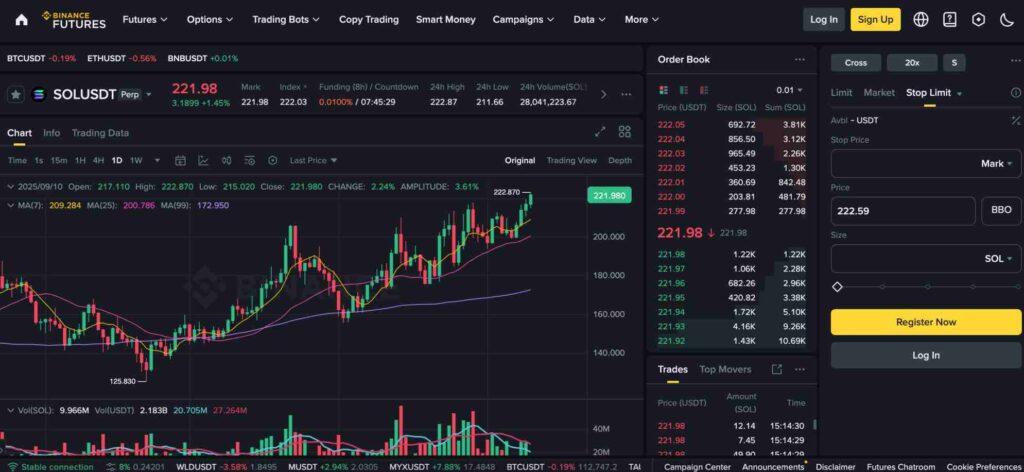
While Binance’s fee structure remains competitive, its high-level trading dashboard may not be suitable for beginners. Built for seasoned traders, it offers advanced analysis tools, charting timeframes, and eight different order types.
Irrespective of trading experience, Binance’s market dominance makes it a safe platform choice. It boasts deep liquidity on most markets, so futures traders reduce slippage risks even on lower-cap pairs.
Pros
- The best option for experienced traders seeking advanced tools
- Powerful charting features with customizable trading screens
- Offers delivery and futures contracts for Solana
- Substantial trading volumes help traders minimize slippage
Cons
- The exchange has mandatory KYC requirements
- Futures trading is restricted in the U.S., the UK, and several European countries
4. Kraken: Heavily Regulated Trading Platform With Lightning-Fast Order Execution
If you prioritize regulation and security over fees, Kraken is one of the best options to trade Solana futures. The tier-one exchange is licensed in multiple regions, including Europe, Asia, and the U.S. It provides account holders with cold storage solutions and two-factor authentication, as well as IP address whitelisting.
Kraken’s futures trading platform supports over 350 cryptocurrencies, including the SOL/USD market. Traders speculate on perpetual contracts with linear settlement and have access to leverage of up to 50x. While the platform also supports short-term delivery contracts for Solana, trading volumes are relatively low.
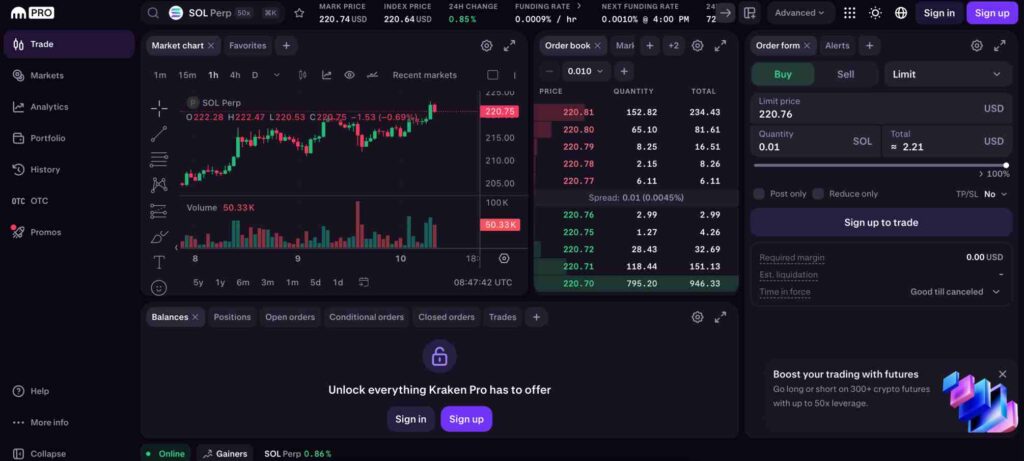
Regarding fees, Kraken’s compliant-heavy framework means payment charges are higher than on most centralized exchanges, particularly on debit/credit cards and e-wallets. Market takers pay futures commissions of 0.05%, which is reduced to 0.02% for takers. It discounts commissions further when 30-day volumes reach $2.5 million, and those trading over $250 million receive rebate fees.
Pros
- Multiple tier-one licensing bodies regulate the exchange
- Tier-one security features ensure client safety
- Supports over 350 futures markets
Cons
- Users report slow customer service response times
- Charges high trading fees
5. Margex: Trade SOL/USDT Perpetuals on a User-Friendly App for iOS and Android
Margex offers a top-rated mobile trading app for iOS and Android. The app supports over 55 perpetual futures markets, including SOL, XRP, and ETH. It offers 50x leverage on SOL linear markets, and while contracts settle in USDT, traders may use any account currency as collateral.
The platform has optimized its mobile app for seamless analysis and trading, and full functionality includes payments, staking, and instant token swaps. The same account also connects to the desktop version, which technical traders prefer for conducting in-depth market research.
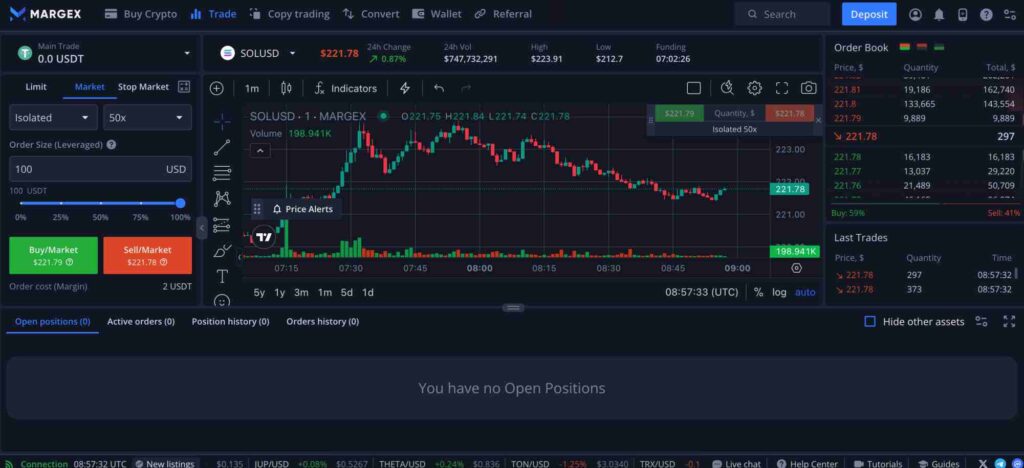
Margex offers an additional app for copy trading, where users pick a seasoned trader and copy their positions on autopilot. The feature ensures users execute trades at the same market price as the trader, eliminating slippage risks.
Our research confirms that Margex is suitable for complete trading beginners. It offers a free demo account with real-time market data, so novice traders may practice Solana futures trading with virtual funds. Users can refresh their demo balance without time restrictions.
Pros
- Trade SOL futures on an iOS and Android app
- Connect to the desktop platform for seamless technical analysis
- Platform features include copy trading, staking, and token swaps
Cons
- The exchange handles mid-tier trading volumes
- Doesn’t offer a peer-to-peer payment platform
Comparing the Top Solana Futures Exchanges
Traders may consider these factors to compare the best Solana futures trading platform:
| Type of SOL Futures | SOL Futures Leverage | Initial Margin | U.S. Friendly? | KYC? | Futures Trading Fees | |
| CoinFutures | Simulated futures | 1000x | 0.1% | Yes | No | Traders choose between a variable fee or profit commission |
| MEXC | Perpetual futures | 300x | 0.3% | No | No | 0.01% (limit orders) and 0.04% (market orders) |
| Binance | Perpetual futures and delivery futures | 100x | 1% | Not for derivatives | Yes | 0.02% (limit orders) and 0.05% (market orders) |
| Kraken | Perpetual futures and delivery futures | 50x | 2% | Yes (need to join the CME futures waitlist) | Yes | 0.02% (limit orders) and 0.05% (market orders) |
| Margex | Perpetual futures | 50x | 2% | No | No | 0.019% (limit orders) and 0.06% (market orders) |
What are Solana Futures?
Solana futures are derivative instruments that track SOL price movements. Traders speculate on futures for several reasons, including their low upfront requirements. Rather than cover the full trade value, traders pay a small percentage, known as the initial “margin”. While the terms vary by the exchange, most platforms offer at least 50x leverage on Solana futures markets, which converts to a 2% margin.
As derivative products, futures let traders speculate long and short. This feature enables traders to profit from rising and falling Solana prices and find tradable opportunities during sideways markets.
Solana futures exist in several forms. Perpetual futures are the most accessible, and they never expire. Delivery futures expire on a predetermined date, although traders may exit their positions early.
While futures offer high leverage and flexible trading conditions, they also present drawbacks. If the futures position falls below the maintenance margin, the exchange liquidates the position, and you lose the initial margin. Another disadvantage is that you don’t own SOL when trading futures, since you merely speculate on derivative prices.
How Does Solana Futures Trading Work?
Futures trading functions differently from investing in Solana on a spot exchange. It’s a short-term trading strategy that aims to profit from price volatility. Traders speculate on derivative contracts, so futures restrict actual SOL ownership. Instead, traders make gains when they correctly predict future price movements. They go long and short with buy and sell orders, and most exchanges settle contracts in a stablecoin, such as USDT.
Perpetual contracts are the most popular derivative for Solana futures. These instruments align with real-time market prices via funding cycles. Every few hours, longs pay shorts (or vice versa) depending on the price disparity. This process remains crucial, since it narrows the gap between spot and futures prices.
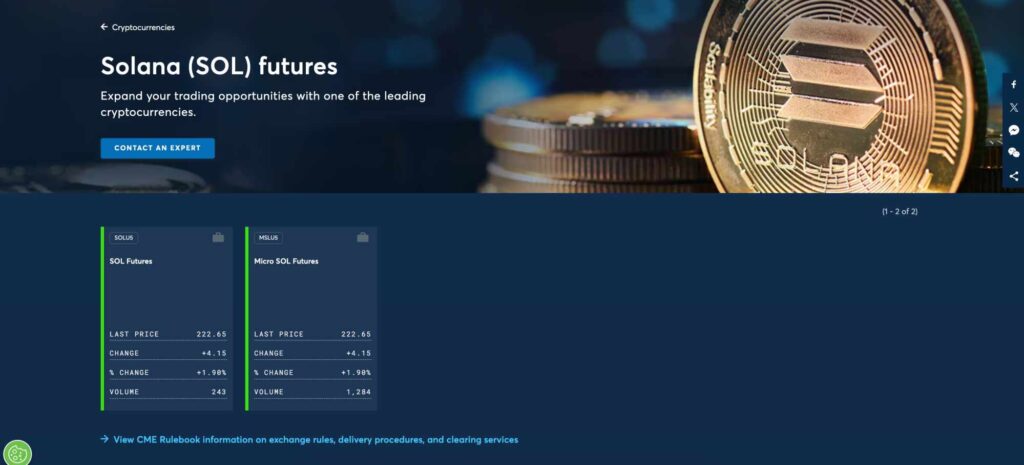
To place a Solana futures trade, exchange users select a leverage multiple to determine their required margin payment. If they enter a $500 long position with 20x leverage, their position amplifies to $10,000. This translates to a 5% margin requirement, so the trader needs just 5% of the total market exposure.
Futures trading platforms also implement maintenance margin requirements to mitigate exchange risk. Providers liquidate futures positions when their value declines below the maintenance threshold. This outcome means that traders lose their initial margin and are no longer able to remain in the market.
Although the CME launched a regulated futures market for institutional clients in 2025, retail traders have used standard crypto exchanges for several years. Platforms like CoinFutures, MEXC, and Binance offer much lower upfront requirements, faster onboarding, and a wide range of trading tools. Traditional exchanges also handle significantly higher SOL futures trading volumes, despite serving casual traders.
Solana Futures Example
Here is a practical example of how SOL futures work:
- A trader risks $100 on a SOL/USDT futures trade with 100x leverage. The market exposure amounts to $10,000. They place a buy order, as they predict the SOL price will rise.
- SOL/USDT rises by 9% over several days. The trader closes their futures trade with a sell order to secure their gains.
- Based on the $10,000 exposure and 9% gain, the futures trade delivers a $900 profit. The trader secures 800% returns on the original $100 margin, despite the SOL price rising by just 9%.
How to Trade Solana Futures
To trade Solana futures online, you need an account with a safe platform and some trading funds. After that, you set up a buy or sell order, input a stake and select the leverage multiple.
If it is your first time trading futures, read on for our step-by-step walkthrough. We explain the trading process with CoinFutures, a top-rated futures platform for beginners.
Step 1: Open a Futures Account and Download
The first step is to open a trading account. Visit the CoinFutures website and click “Register”. Complete the registration form by entering an email, nickname, and password. The platform requires no additional personal details, since it offers accounts without KYC demands.
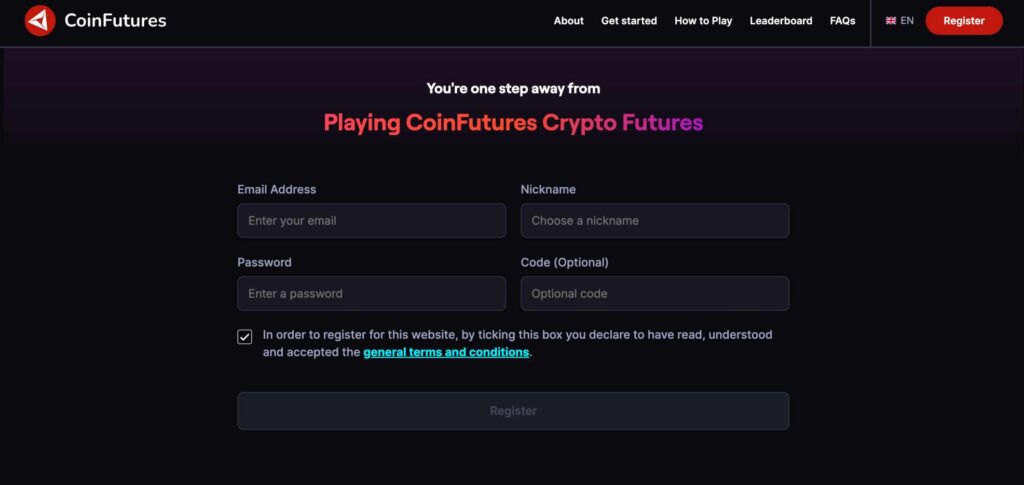
Next, download the CoinPoker software. CoinFutures’ parent company offers a mobile and desktop application for futures trading. Open the software and log in with your account credentials.
Step 2: Deposit Funds into the Futures Account
CoinFutures accepts various payment methods. To deposit digital assets like BTC, ETH, or USDT, select the coin or token to obtain your unique wallet address. Then make the transfer from a non-custodial wallet. Crypto deposits are anonymous and have no minimum requirements.
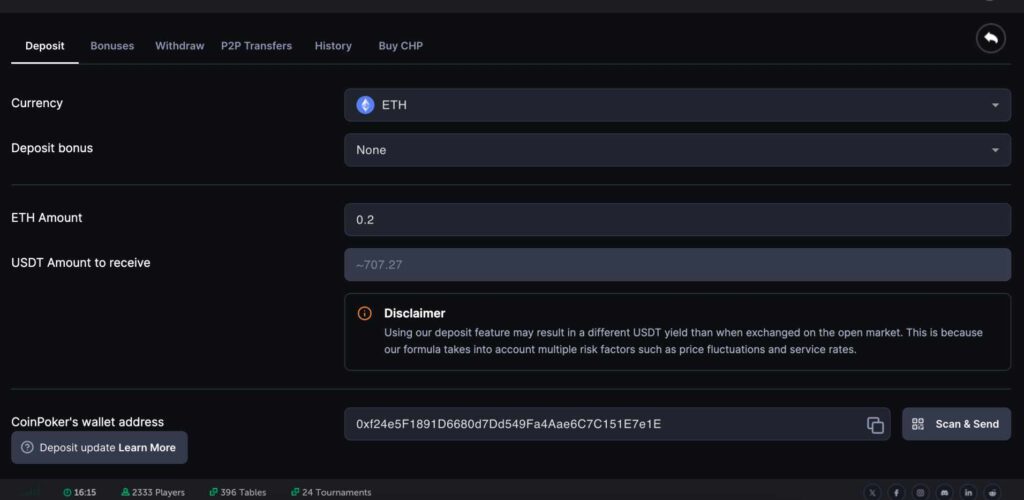
Alternatively, you can deposit fiat money if you prefer using debit/credit cards, or e-wallets like Google Pay or Apple Pay. The minimum deposit requirement is $10. Due to compliance requirements, CoinFutures collects basic personal information.
Step 3: Go to the SOL/USDT Futures Market
With a funded account, you can now trade Solana futures on the CoinFutures platform.
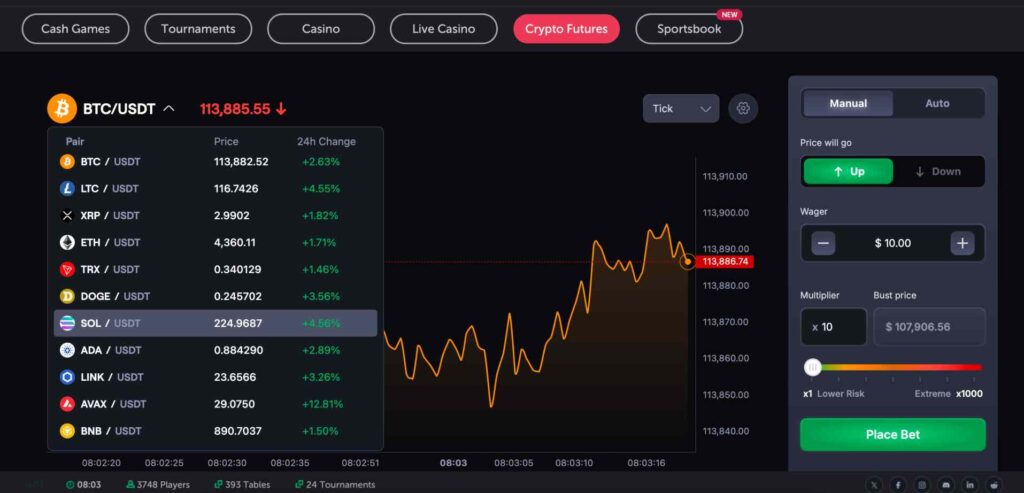
Click the “Crypto Futures” button and select “BTC/USDT” to populate the list of available markets. Then select “SOL/USDT”.
Step 4: Set up the Solana Futures Trading Order
Spend some time researching SOL/USDT price movements. CoinFutures offers a user-friendly chart with various timeframes. You can also explore the “Leaderboard” section to see what other platform users are trading.
Once you’re ready to trade, select the “Up” or “Down” button, depending on whether you’re long or short. Then, enter the initial margin, which, on CoinFutures, is referred to as a “Wager”. You can trade any amount from just $1, yet remember that the wager is at risk of liquidation. Therefore, avoid risking more than you can afford to lose.
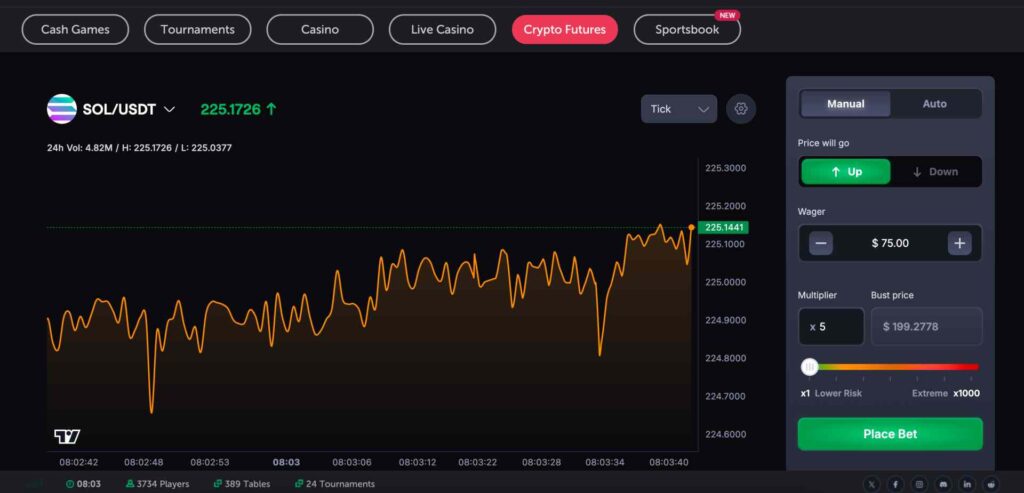
The order dashboard also requires users to state their leverage multiple. Input an amount between 1x and 1000x. Beginners can begin with low leverage limits to minimize the liquidation risks.
Note: As you adjust the trading parameters, CoinFutures updates the “Bust Price”. This is the price that forces the platform to liquidate the position, which means you forfeit the wager. As you reduce the leverage multiple, the bust price shifts further away from the entry price, so liquidation becomes less probable.
Step 5: Set Stop-Loss Level and Place Solana Futures Trade
Before placing your Solana futures trade, we strongly suggest setting some exit orders.
The stop-loss order closes losing trades before the liquidation price, while take-profits secure the target profit automatically.
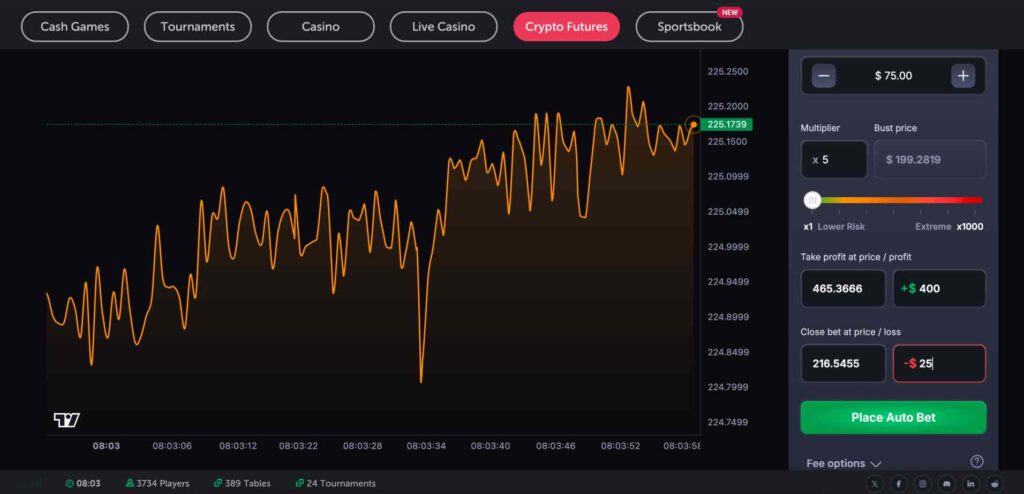
Click “Auto” and enter the maximum amount you’re prepared to lose on the futures position. You can also state the exact exit price based on your analysis. Then enter the take-profit levels.
In our example, the trader wagers $75 with 5x leverage, and they’ve set the stop-loss and take-profit values at $25 and $400. This SOL/USDT lets the trader risk $25 to make a $400 profit.
Click the “Place Auto Bet” button to place the order. The Solana futures trade remains active until the stop-loss or take-profit prices trigger.
Solana Futures vs Options
While most traders opt for futures, the best crypto options trading platforms support Solana markets. These derivative products share some similarities, including their high leverage, support for both long and short trading, and lack of asset ownership.
One difference is how traders enter positions. Solana futures require traders to deposit a small upfront margin. They’re obligated to buy or sell the asset on a future date, and risk liquidation if the trade value falls below the maintenance margin.
Options, on the other hand, rely on premiums. Options traders pay a premium for the right but not the obligation to buy or sell SOL on or before a certain date. If the trader predicts the SOL price incorrectly, the options expire worthless. They lose the premium only, which reflects a small percentage of the overall contract value.
As options also use “chains”, traders choose their preferred strike price. For the trader to profit, SOL must trade above or below the strike price when the contracts expire, depending on the market direction. Maturity durations range from a minute to a year, making options suitable for all trading or investment strategies.
Futures trades execute instantly once another trader matches the order, and when trading perpetual contracts, they may exit the position at any time. The derivative instrument provides more flexibility than options, as well as significantly more liquidity.
Key Things to Know About Solana Futures Trading
Read on to learn more about Solana futures, including the different contract types, settlement terms, and margin requirements.
Solana Futures Type
Traders choose a SOL futures product based on their experience level and trading strategy:
- Delivery Futures: This contract type has an expiration date. The most common duration is three months, although some platforms offer shorter and longer terms. Traders must buy or sell SOL coins if they hold the futures contracts when they expire. Before expiration, market forces determine the value of the delivery futures based on demand and supply.
- Perpetual Futures: The most traded Solana futures contracts are perpetual futures, or “Perps”. Traders go long or short on the SOL price without relying on expiration dates. The contracts stay open indefinitely until the trader exits the position. Perps incur funding fee cycles, which vary between one and eight hours depending on the exchange. Only longs or shorts incur those fees per cycle.
- Simulated Futures: The best choice for entry-level traders, simulated futures simplify Solana futures trading. Instead of trading against other market participants, traders place orders directly with the platform. An algorithm tracks the SOL price in real-time, eliminating the requirement for order books. The key benefit is instant execution, since traders do not rely on order matching.
Contract Settlement (USDT-M vs Coin-M)
Solana futures trading platforms typically let traders choose the contract settlement currency.
The most common option is USDT-M contracts. These are linear futures, and they margin and settle in USDT (and sometimes USDC).
The other option, Coin-M, requires futures traders to add margin in SOL, resulting in higher volatility swings for the collateral balance. The contracts also settle in SOL. This mechanism introduces an inverse relationship between the SOL price and profits/losses.
Experts recommend trading USDT-M futures to mitigate martket volatility risks and reduce the likelihood of liquidation.
Isolated Margin vs Cross Margin
Beginners should stick with isolated margin when trading Solana futures. The initial margin on the trade reflects the maximum loss potential, ensuring a limited downside. Isolated margin suits traders wanting to place high-leverage wagers in a more risk-averse environment.
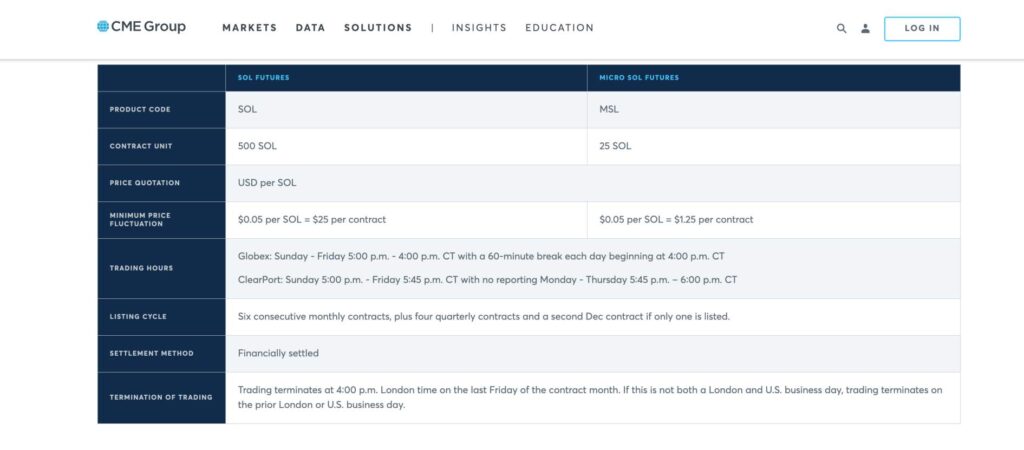
In contrast, cross margin lets traders open multiple futures trades with the same margin collateral. This structure can result in liquidation of the entire account from just one futures position. Without adequate risk management experience, cross margin is extremely risky, so it’s best avoided as a beginner.
Risk Management
To reduce the risk of trading losses, futures traders use various risk management strategies.
Before entering a trade, ensure you develop a clear exit strategy using stop-loss and take-profit levels. Stop-losses help traders avoid liquidation, since they close positions before they trigger the maintenance margin. Experienced traders set the stop-loss price at key support or resistance levels, depending on whether they go long or short.
SOL is a volatile asset, so taking profits ensures traders secure their gains at the target price. As the exchange executes the futures trade at the stated order price, you don’t need to actively monitor pricing charts.
We also suggest setting a maximum trade size based on a fixed percentage of the available trading capital. 1-2% of the account balance is common, as it provides sufficient room for growth and protects traders from extended losing runs.
To further reduce risk, avoid leaving futures trades open overnight. Closing the position before the trading session ends ensures you’re not exposed to unforeseen volatility or adverse news events.
What are the Benefits of Trading Solana Futures?
Here are the main advantages of Solana futures:
- High Leverage Limits: Solana futures are popular with casual traders who want to boost their available capital. Platforms like CoinFutures offer leverage of up to 1000x, which turns a $5 account balance into $5,000 in market exposure. Just one successful trade can generate sizable gains.
- Limited Downside: While futures are risky derivative products, they allow traders to cap the downside potential. Trading SOL futures with isolated margin ensures the maximum loss is capped at the initial margin. Linear contracts reduce risk further, as traders use stablecoins for margin and position settlement.
- Go Long or Short: Traditional crypto investments deliver profits only when prices rise, while Solana futures let traders speculate in both market directions. They enable traders to go long or short, making futures suitable for all trading conditions.
- Globally Accessible: The best no-KYC crypto exchanges offer Solana futures globally. Users register, deposit, and trade futures anonymously, allowing them to bypass ID verification. This perk is particularly useful for traders without government-issued ID, as well as those based in countries that prohibit crypto derivatives.
- Hedging Strategy: SOL holders often short-sell Solana futures to offset market risk. It enables them to temporarily step away from the market without disposing of their coins, potentially triggering capital gains tax. Once the market uncertainty passes, the trader exits the futures position with a marginal loss.
Pros & Cons of Solana Futures Trading
Consider these benefits and drawbacks before you trade SOL futures:
Pros
- Speculate on the SOL price with leverage of 100x or more
- Low-margin trades can generate significant gains
- Traders limit their downside potential on isolated margin contracts
- Go long or short on Solana during all market cycles
- Some platforms support minimum trade requirements of just $1
Cons
- You could lose money when trading SOL futures
- Liquidation means traders forfeit their initial margin
- Cross margin contracts put the entire account balance at risk
- Futures typically suit short-term strategies only
- Perpetual contracts incur funding fees every few hours
Conclusion
With billions of dollars traded daily, Solana futures appeal to traders seeking high leverage, low upfront requirements, and the option to trade long or short. Futures carry more risk than traditional Solana investing, yet when traded with risk management best practices, the potential profits can be significant.
If you’re new to SOL futures trading, consider the CoinFutures platform. It requires just $1 per futures trade, and traders may apply leverage of up to 1000x. It offers risk mitigation tools like stop-losses and take-profits, as well as a safe trading environment with audited proof of reserves.
FAQs
What are Solana futures?
What are the benefits of trading Solana futures?
Are Solana futures more risky?
What’s the minimum amount you need to trade Solana futures?
How do I trade Solana futures?
What is the best Solana futures trading platform?
References
- Derivatives practical law (Thomson Reuters)
- Definition of a futures contract (Chicago Mercantile Exchange)
- What is a stop loss order? How to manage risk in trading (Saxo Bank Group)
- The essential guide to Solana futures (Chicago Mercantile Exchange)