

The Best Penny Stocks to Buy Now for Maximum Growth Potential in 2026
We may earn commissions from affiliate links or include sponsored content, clearly labeled as such. These partnerships do not influence our editorial independence or the accuracy of our reporting. By continuing to use the site you agree to our terms and conditions and privacy policy.



Penny stocks will always be the ultimate high-risk, high-reward playground for retail traders who want 10x returns (and even more).
The current volatile market conditions create prime hunting grounds for disciplined investors who understand both technical setups and fundamental catalysts. While Bitcoin dominates headlines, smart money quietly accumulates undervalued micro-caps before institutional attention arrives.
The Best Penny Stocks to Buy in September 2026
Penny stocks are a subject of large interest, especially from risky investors.
We’ve highlighted 10 picks to watch this month in the context of low share price (<$5), access to new technologies, and chances to skyrocket in price.
1. HYLQ Strategy Corp (CSE:HYLQ)
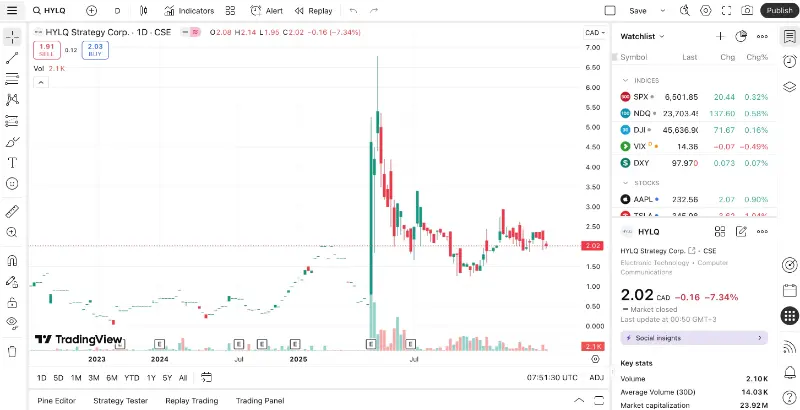
HYLQ Strategy Corp is one of the best crypto stocks and a good bet on the HyperLiquid DeFi exchange. The company rebranded into a pure HYPE token treasury, acting like the “MicroStrategy of altcoins.” With ~28,961 HYPE tokens on its books, it gives you direct exposure to one of DeFi’s fastest-growing ecosystems.
Trading near CAD $2, HYLQ has already seen a parabolic run, peaking at CAD $6.79 earlier this summer. The tiny CAD $24 market cap means sharp swings are the norm – you’re basically betting on HyperLiquid’s continued dominance in derivatives.
👉 Like the concept? Check out our how to buy HYLQ stock guide.
For traditional investors, the real value is regulated exposure. Unlike shady OTC plays, HYLQ trades on the Canadian Securities Exchange with audited reporting, providing a safer route to speculate on HYPE.
| Ticker | Current Price | ATH Price | Industry |
|---|---|---|---|
| HYLQ (CSE) | CAD $2.02 | CAD $6.79 | Crypto treasury |
2. Bitfarms (NASDAQ:BITF)
Bitfarms runs Bitcoin mining farms in Canada, Argentina, and the U.S., using mostly hydroelectric power. This lower-cost energy structure is key in a sector where power bills make or break profitability.
The stock currently trades around $1.32, well below its highs above $9 from the 2021 bull run. It’s a volatile name, but still one of the better-capitalized miners with long-term survival potential.
If Bitcoin pushes back toward previous ATHs, Bitfarms can deliver multi-X gains off its penny-level base. It’s the definition of a leveraged play on BTC cycles.
| Ticker | Current Price | ATH Price | Industry |
|---|---|---|---|
| BITF (NASDAQ) | $1.32 | $9+ | Bitcoin mining |
3. Bit Digital (NASDAQ:BTBT)
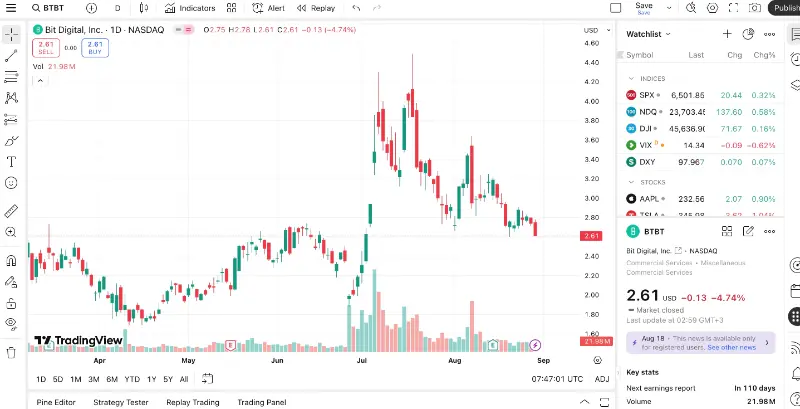
Bit Digital is another Bitcoin miner, but with a twist: it has aggressively diversified into Ethereum staking and AI data centers. This gives the stock some resilience if BTC mining margins shrink.
Trading at $2.61, BTBT is far off its $33 all-time high set in January 2021. That’s a brutal drawdown, but it also means heavy upside if sentiment swings back.
With a U.S.-listed presence and operations in both North America and Asia, Bit Digital remains a speculative but interesting pivot on both crypto and AI infrastructure.
| Ticker | Current Price | ATH Price | Industry |
|---|---|---|---|
| BTBT (NASDAQ) | $2.61 | $33.00 | Crypto mining + AI |
4. BTCS Inc. (NASDAQ:BTCS)
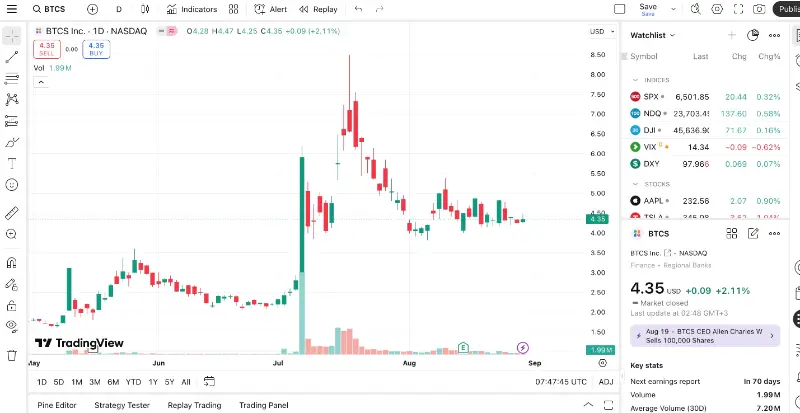
BTCS calls itself the “first blockchain public company” in the U.S. The firm focuses on staking Ethereum and running validator nodes across multiple proof-of-stake chains.
At around $4.35, BTCS sits far below its historical spikes. Macrotrends reports 52-week highs near $8.49, while stock splits distort older ATH numbers. Regardless, this is one of the few penny stocks giving you staking rewards exposure.
With proof-of-stake growing, BTCS offers a niche outside the traditional mining focus. Just expect volatility, as revenues depend directly on token price and staking yields.
| Ticker | Current Price | ATH Price | Industry |
|---|---|---|---|
| BTCS (NASDAQ) | $4.35 | $8.49 (52W) | Blockchain staking |
5. Argo Blockchain (NASDAQ:ARBK)
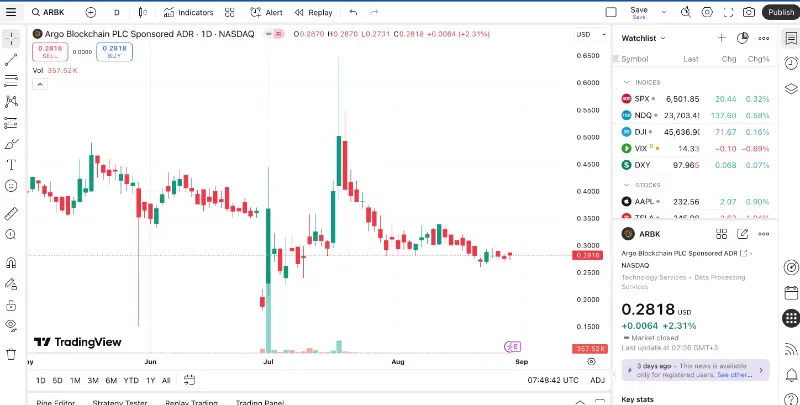
Argo Blockchain is a U.K.-founded Bitcoin miner now primarily operating in Texas. Like peers, it has battled debt and power cost challenges, but it managed to hold its own, and remains listed and active.
The stock trades around $0.28, with its all-time high above $130 (pre-reverse split). In penny stock terms, that history shows just how violent the swings can be.
For investors, ARBK represents a speculative turnaround story. Survival through the last bear market gives it a chance to thrive if BTC momentum returns.
| Ticker | Current Price | ATH Price | Industry |
|---|---|---|---|
| ARBK (NASDAQ) | $0.28 | $130+ | Bitcoin mining |
6. BTC Digital (NASDAQ:BTCT)
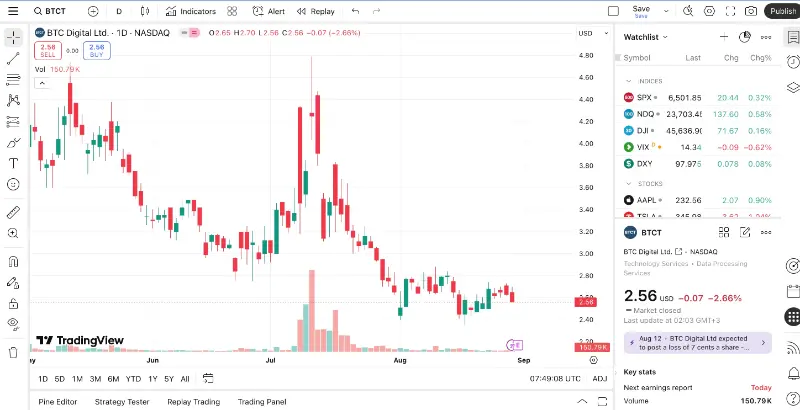
BTC Digital appears to be a smaller market cap, newer Bitcoin mining player with ambitions to expand capacity in North America. It remains one of the most thinly traded names on this list and a strong buy candidate for many.
The stock sits above $2.56, with highs closer to $36 back in 2021. That collapse in BTCT’s market cap illustrates both the risks and opportunities with micro-miners.
If BTC momentum improves, BTCT could see sharp speculative pumps. Liquidity is thin though. Use limit orders if you’re considering a position.
| Ticker | Current Price | ATH Price | Industry |
|---|---|---|---|
| BTCT (NASDAQ) | $2.56 | $36.00 | Bitcoin mining |
7. SOS Limited (NYSE:SOS)
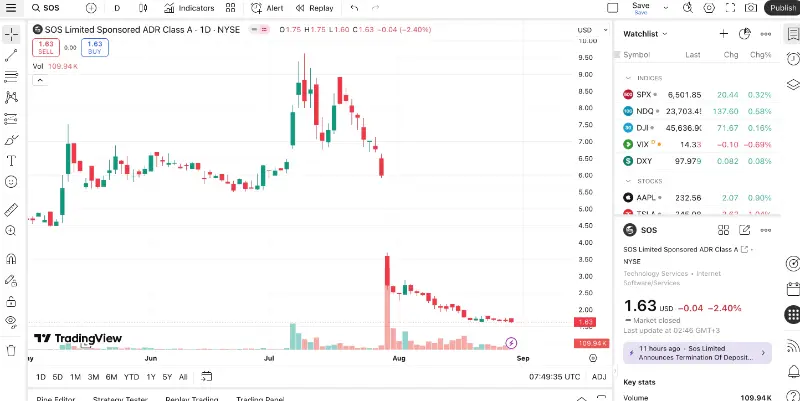
SOS Limited started as a Chinese telecom services firm but pivoted into crypto mining and blockchain services. The pivot drew controversy, with critics alleging weak fundamentals as a sale reason.
Today, the stock price trades around $1.63, with a 52-week high near $15. Historical ATHs are inflated due to splits, but it’s still a massive drop from early hype.
While risky, SOS remains a way to speculate on a turnaround or sudden crypto-driven hype cycle. Its penny valuation makes it prone to fast momentum trades.
| Ticker | Current Price | ATH Price | Industry |
|---|---|---|---|
| SOS (NYSE) | $1.63 | $15.51 (52W) | Crypto mining / services |
8. Canaan (NASDAQ:CAN)
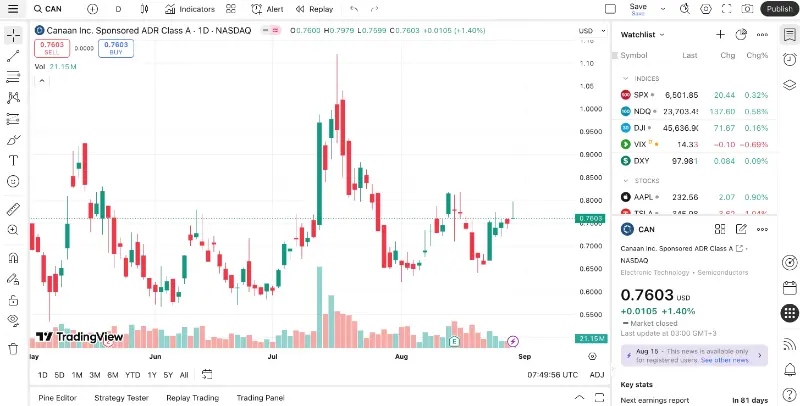
Canaan is the Chinese company behind ASIC chips and rigs for Bitcoin mining. Instead of running farms, it develops the hardware arms miners depend on.
CAN trades around $0.76, with a historical peak near $39 in 2021. Like Nvidia in miniature, its revenue moves with mining demand, though it lacks Nvidia’s brand exposure.
You still have to note that Canaan gives you exposure to the supply chain side of crypto rather than mining economics directly. That can smooth some volatility compared to pure miners.
| Ticker | Current Price | ATH Price | Industry |
|---|---|---|---|
| CAN (NASDAQ) | $0.76 | $39.00 | ASIC hardware |
9. HIVE Digital Technologies (NASDAQ:HIVE)
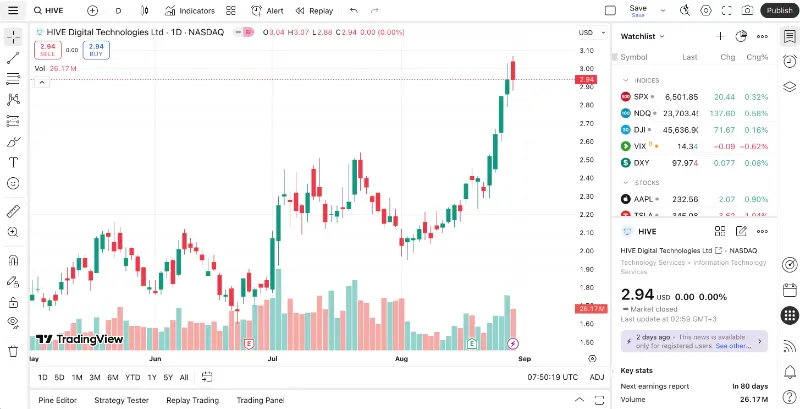
HIVE was one of the first public miners, branding itself as a bridge between traditional markets and blockchain solutions. It now focuses on BTC and ETH mining using green energy.
Currently priced at $2.94, HIVE has fallen dramatically from its $26.82 high in February 2021. Still, it has one of the longest track records in this space.
For investors, HIVE offers longevity, operational credibility, and exposure to both Bitcoin and Ethereum – all in a penny stock wrapper.
| Ticker | Current Price | ATH Price | Industry |
|---|---|---|---|
| HIVE (NASDAQ) | $2.94 | $26.82 | Bitcoin + Ethereum mining |
10. BitFuFu (NASDAQ:FUFU)
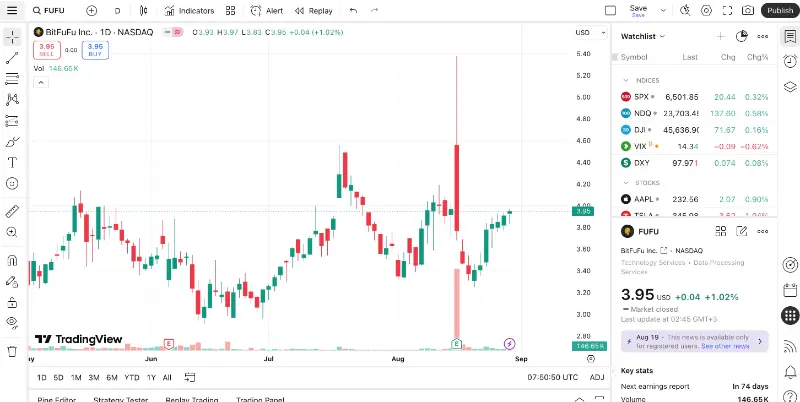
BitFuFu is a newer player but backed by Bitmain, the largest ASIC manufacturer. It offers cloud mining services, letting customers rent hashpower instead of owning rigs.
FUFU trades under $5, with highs around $14 in 2024. It’s early in its life as a public company, making it both exciting and uncertain.
Cloud mining is controversial, but with Bitmain’s support, BitFuFu has more credibility than typical offerings. For penny stock speculators, it’s a leveraged bet on mining demand.
| Ticker | Current Price | ATH Price | Industry |
|---|---|---|---|
| FUFU (NASDAQ) | $3.95 | $14.00 | Cloud mining |
What Are Penny Stocks?
Penny stocks technically trade below $5 per share according to SEC definitions, though purists argue true pennies trade under $1. These micro-cap companies typically sport market capitalizations below $300 million with limited institutional ownership creating explosive volatility. Most trade on OTC Markets or smaller exchanges like CSE rather than NYSE or NASDAQ, though listing requirements vary.
The appeal comes from asymmetric risk/reward potential – turning $1,000 into $10,000 happens regularly during penny stock runs. Low share prices create psychological advantages as retail traders prefer owning 10,000 shares at $0.10 versus 1 share at $1,000. This retail-driven momentum creates violent squeezes when shorts cover positions.
Risk factors include limited financial reporting, wider bid-ask spreads, and manipulation susceptibility. Many penny stocks operate pre-revenue with massive cash burn rates requiring constant dilution. SEC enforcement actions and trading halts occur frequently, potentially trapping investors. Yet disciplined traders who understand these dynamics generate life-changing returns when lightning strikes.
How to Invest in Penny Stocks?
Getting started with penny stock trading through Interactive Brokers requires methodical account setup and platform familiarity. Here’s the proven process our team uses for CSE and OTC access:
- Open Interactive Brokers Account
Navigate to Interactive Brokers website and select individual account type. Complete identity verification including SSN, employment details, and investment objectives. The process typically takes 1-3 business days for approval. - Enable Penny Stock Permissions
Access account management portal and navigate to trading permissions. Enable “Penny Stocks” and “Pink Sheets” trading specifically. Read risk disclosures carefully as these trigger additional margin requirements. - Fund Your Account
Wire transfer provides fastest funding (same day), while ACH takes 2-4 days. Start with $2,000 minimum to avoid pattern day trader restrictions. Consider keeping 50% cash reserves for averaging down positions. - Configure Trading Platform
Download Trader Workstation (TWS) for advanced features or use IBKR Mobile for simplicity. Set up watchlists with penny stock tickers and configure Level 2 data for order flow visibility. Enable real-time quotes for OTC markets ($10/month fee). - Place Your First Order
Search ticker symbols ensuring correct exchange selection (CSE, OTC, etc.). Use limit orders exclusively – market orders cause terrible slippage. Start with 100-share positions while learning execution dynamics. - Implement Risk Management
Set stop-losses at 15-20% below entry for damage control. Take partial profits at 50% gains, letting winners run with house money. Never average down more than twice on losing positions.
Are Penny Stocks Worth It?
Penny stocks make sense for specific investor profiles and portfolio allocations – not as core holdings. Allocating 5-10% of speculative capital toward high-quality penny stocks creates lottery ticket exposure without devastating losses. The key lies in understanding when these investments align with your goals versus when they’re simply gambling.
Young investors with decades until retirement can afford aggressive risk-taking that older investors cannot.
💡A 25-year-old losing $5,000 on penny stocks learns valuable lessons with minimal long-term impact. That same loss at 60 could delay retirement plans significantly.
Time horizon determines risk capacity more than account size.
Success requires treating penny stocks like venture capital investments – expect 90% failure rates while hunting for 10x winners. Professional traders use technical analysis, catalyst calendars, and position sizing to manage risks systematically. Casual investors buying random Reddit mentions typically lose everything. The difference between investing and gambling comes down to process discipline.
How to Pick Penny Stocks?
Successful penny stock selection combines fundamental screening with technical entry timing and catalyst awareness. Start by filtering for companies with actual revenue, not just “story stocks” promising future breakthroughs.
Revenue-generating companies survive market downturns while pre-revenue biotechs often disappear entirely.
Management quality matters enormously in penny stock land where corporate governance often lacks. Research executive backgrounds through SEC filings, checking for previous company successes or failures.
Insider buying signals confidence while constant selling suggests problems. CEOs with histories of reverse splits and dilution destroy shareholder value repeatedly.
Technical analysis identifies accumulation patterns before explosive moves occur. Look for tightening price ranges with decreasing volume indicating consolidation phases. When volume spikes 5-10x average on breakouts above resistance, momentum arrives. RSI readings below 30 during market corrections create oversold bounce opportunities.
Catalyst calendars drive penny stock movements more than fundamentals. FDA approvals, earnings releases, conference presentations, and regulatory decisions create binary events. Building positions 2-3 weeks before known catalysts captures anticipation runs. Selling before actual events often beats holding through “sell the news” reactions.
Pros and Cons of Penny Stocks
Every single stock has its advantages and disadvantages, and when we’re talking about penny stocks, investors are definitely in for a treat.
Penny stocks can look like a strong buy when prices are low, but they carry just as much risk as potential reward. Here’s a quick snapshot of the upsides and downsides.
Final Words
Penny stock investing demands respect for both opportunity and risk inherent in micro-cap markets. Success requires combining fundamental research, technical analysis, and psychological discipline while accepting that most positions will fail. The traders who consistently profit treat penny stocks as calculated speculation, not investment – there’s a crucial difference.
Position sizing remains the most critical factor separating survivors from casualties. Never trade more than you can afford to lose completely, because total loss happens regularly. Spreading capital across 10-20 positions creates diversification while maintaining meaningful upside exposure. When winners emerge, scaling out gradually captures profits while maintaining exposure to continued runs.
Penny Stocks FAQs
How do you make money off penny stocks?
How to trade penny stocks safely?
How do you research penny stocks?
Can you buy penny stocks on Robinhood?
How to buy penny stocks online?
Sources:
