https://solana.com
What is Solana?
Solana is a blockchain platform designed to support fast, low-cost transactions and scalable decentralized applications.
It was created to address some of the main limitations of earlier blockchains, such as slow transaction speeds and high fees, by combining proof of stake with an innovative time-keeping mechanism called Proof of History.
This design allows Solana to process thousands of transactions per second while keeping costs extremely low.
The Solana blockchain is commonly used for decentralized finance (DeFi), NFTs, gaming, and other Web3 applications that require high throughput and near-instant finality. Its native cryptocurrency, SOL, is used to pay transaction fees, stake for network security, and participate in governance.
Thanks to its performance-focused architecture, Solana has become one of the most widely used smart contract platforms.
Solana: Key Features
- High transaction throughput: Solana can process thousands of transactions per second, making it one of the fastest public blockchains.
- Low transaction fees: Fees typically cost a fraction of a cent, even during periods of high network activity.
- Proof of History (PoH): A unique time-stamping mechanism that orders transactions efficiently and improves scalability.
- Proof of Stake consensus: Validators secure the network by staking SOL, supporting energy-efficient operation.
- Smart contract support: Solana enables developers to build decentralized applications across DeFi, NFTs, gaming, and Web3.
- Growing ecosystem: A large and active developer community supports a wide range of protocols, tools, and consumer apps.
How Solana Works
Solana is built to achieve high speed and scalability without relying on layer-2 solutions. It does this by combining Proof of Stake (PoS) with a unique system called Proof of History (PoH), which acts as a cryptographic clock for the network.
Proof of History timestamps transactions before they are added to a block, allowing validators to agree on the order of events without constantly communicating with one another. This significantly reduces processing overhead and enables the network to handle large volumes of transactions efficiently.
Validators on the Solana network stake SOL to participate in block production and transaction validation. Together, PoH and PoS allow Solana to process transactions quickly, keep fees low, and maintain network security – making it suitable for applications that require high throughput and near-instant finality.
How to Buy Solana in 2026
Buying Solana is straightforward, especially when using a well-established cryptocurrency exchange like Binance. The platform offers high liquidity, multiple payment methods, and strong security features, making it a popular choice for purchasing SOL.
1. Create a Binance account
Sign up on Binance for free and secure your account with two-factor authentication. Complete the identity verification process to unlock deposits and trading.
2. Add funds
Deposit money using a bank transfer, credit or debit card, or another supported payment method available in your region.
3. Buy SOL
Search for SOL on Binance, choose the amount you want to purchase, and confirm the order. Your SOL will appear in your wallet shortly after the transaction is completed.
If you plan to hold Solana long term, consider transferring your SOL to a private wallet for added security.
Where to Store Solana
After buying SOL, you’ll need a secure crypto wallet to store your tokens. While you can keep Solana on an exchange like Binance, many users choose a dedicated wallet to gain full control over their funds and private keys.
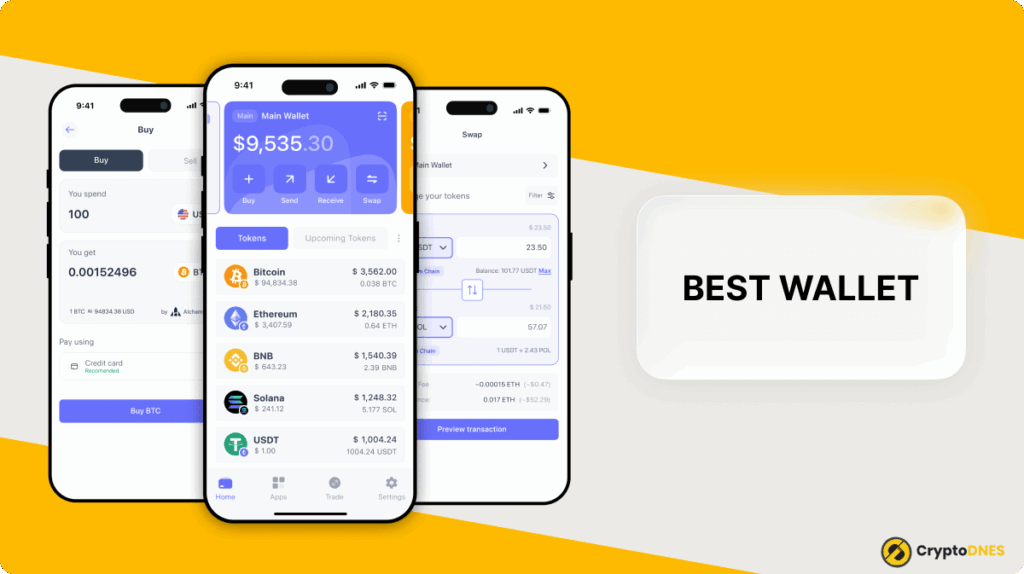
There is a wide range of crypto wallets that support Solana, each offering different levels of security and functionality. One beginner-friendly choice is Best Wallet, a non-custodial mobile wallet that supports Solana alongside multiple other cryptocurrencies, making it a practical option for users who want a simple, all-in-one solution.
How to Set Up Best Wallet
1. Download Best Wallet from the App Store or Google Play.
2. Create a new wallet and securely store your recovery phrase offline.
3. Enable security features, such as biometric login or a PIN.
4. Transfer SOL from your exchange by selecting Withdraw → SOL → Paste your Best Wallet address → Confirm.
Once transferred, your SOL will be available in your wallet almost instantly, thanks to Solana’s fast transaction speeds.
A Brief History of Solana
- 2017: Anatoly Yakovenko publishes the concept of Proof of History, proposing a new approach to blockchain scalability.
- 2018: Solana Labs is founded to develop a high-performance blockchain optimized for speed and low fees.
- 2020: The Solana mainnet beta launches, introducing Proof of History combined with Proof of Stake.
- 2021: Solana gains widespread attention during the crypto bull market, driven by rapid growth in DeFi and NFT projects.
- 2022: Network outages highlight scalability and reliability challenges, leading to protocol upgrades and infrastructure improvements.
- 2023–Present: Solana focuses on stability, performance optimization, and ecosystem expansion across DeFi, NFTs, gaming, and payments.
Pros and Cons of Solana
If you’re considering investing in or using Solana, it’s important to understand both its strengths and its limitations. Below is a balanced overview of the main advantages and disadvantages of the Solana network.
Advantages of Solana
- High transaction speed: Solana can process thousands of transactions per second, making it suitable for high-demand applications.
- Low transaction fees: Fees typically remain very low, even during periods of increased network activity.
- Scalable architecture: Proof of History helps the network scale without relying on layer-2 solutions.
- Strong developer ecosystem: Solana supports a wide range of DeFi, NFT, gaming, and Web3 applications.
- Energy-efficient consensus: The combination of Proof of Stake and Proof of History reduces energy consumption compared to proof-of-work blockchains.
Disadvantages of Solana
- Network stability concerns: Solana has experienced outages and performance issues in the past, raising reliability concerns.
- Higher hardware requirements: Running a validator node can be resource-intensive, limiting decentralization compared to some networks.
- Ecosystem concentration: A significant portion of activity is driven by a relatively small number of large applications and validators.
- Strong competition: Solana competes with other smart contract platforms, including Ethereum, Avalanche, and newer layer-1 networks
Solana Use Cases and Applications
Solana is designed for applications that require high throughput, low latency, and low transaction costs. Its performance-focused architecture has made it a popular choice for a wide range of Web3 use cases.
1. Decentralized Finance (DeFi)
Solana supports decentralized exchanges, lending protocols, and yield platforms that benefit from fast execution and low fees, enabling near real-time trading and liquidity provision.
2. NFTs and Digital Collectibles
The Solana blockchain hosts numerous NFT marketplaces and creator platforms, offering faster minting and lower costs compared to many other networks.
3. Web3 Gaming
Low latency and high transaction throughput make Solana suitable for blockchain-based games, in-game economies, and real-time interactions.
4. Payments and Micropayments
Solana’s fast settlement times and minimal fees enable peer-to-peer payments, microtransactions, and merchant payment solutions.
5. Tokenization and Digital Assets
Developers use Solana to issue and manage tokenized assets, including utility tokens, stablecoins, and other digital representations of value.