


Best Crypto to Stake: Coins & Tokens With Highest APY Staking
We may earn commissions from affiliate links or include sponsored content, clearly labeled as such. These partnerships do not influence our editorial independence or the accuracy of our reporting. By continuing to use the site you agree to our terms and conditions and privacy policy.



The best crypto to stake can deliver passive rewards while strengthening proof-of-stake blockchains that rely on token holders to validate and secure transactions.
Rather than trading or simply holding, staking typically involves locking tokens so they can participate in validation. From established ecosystems like Ethereum to newer chains, the menu of staking options continues to grow, making it a real challenge to choose the right assets and strategies.
In this guide, we present the best crypto to stake, along with the benefits and risks of staking. Let’s dive into it!

May 2025




November 2025


July 2025

April 2025

List of the Best Crypto to Stake in 2026
- Bitcoin Hyper – Bitcoin Layer 2 project offering high staking rewards. A balanced mix of speed and security.
- Maxi Doge – Dogecoin’s cousin on steroids. Ready to max your gains as the next big meme contender for the current altcoin season.
- LiquidChain – L3 network unifying cross-chain liquidity for seamless DeFi. Holders gain utility access, governance participation, and high-stakes rewards.
- SUBBD – Web3 platform token that merges content creation with blockchain monetization. Helps make meaningful connections with followers and makes the lives of creators easier.
- Ethereum – The largest proof-of-stake blockchain with steady yields. Secure and consistent, but it offers a pretty low yield compared to others on the list.
- Polkadot – Secure and flexible staking accompanied by a parachain ecosystem. Offers a fairly high APY while bringing the world Web3.
- Cardano – User-friendly staking with no lock-up periods on an established, research-driven blockchain.
Best Crypto Staking Coins & Tokens: Expert Reviews
Let’s take a closer look at the best cryptos to stake:
1. Bitcoin Hyper – Layer 2 Solution Offering Staking With High APY
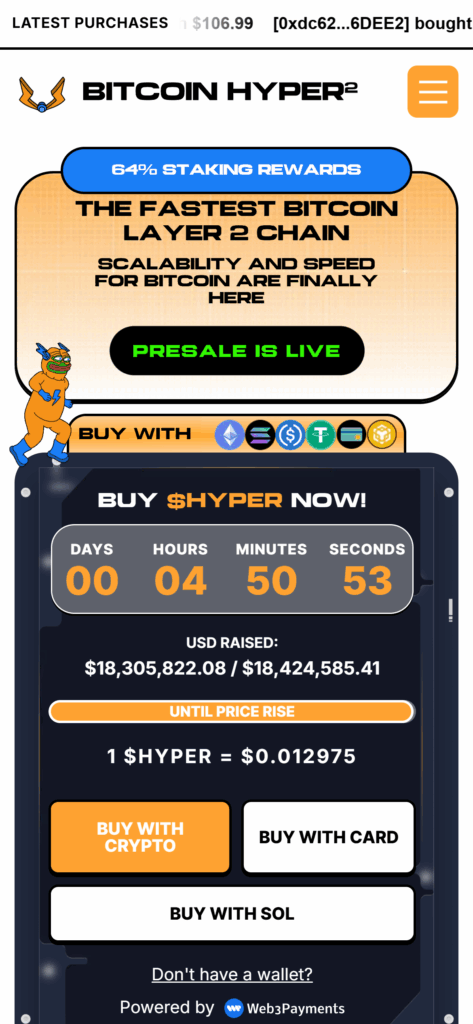
Bitcoin Hyper (HYPER) is a Bitcoin Layer 2 network designed to deliver faster, cheaper, and more scalable transactions than Bitcoin’s main chain. Built with a bridging architecture, it locks BTC on Layer 1 and mints wrapped BTC on Layer 2, ensuring secure transfers while maintaining Bitcoin’s underlying security. The network also allows developers to build decentralized applications with ease.
The project is currently in its presale stage and plans to launch 21 billion HYPER tokens, allocated across treasury, marketing, rewards, listings, and development. Holding HYPER provides access to staking rewards, ecosystem features, and community incentives.
By combining Bitcoin’s trust with modern scalability, Bitcoin Hyper aims to become a next-generation ecosystem for both users and developers.
2. Maxi Doge – Meme Power Meets High APY Crypto Staking
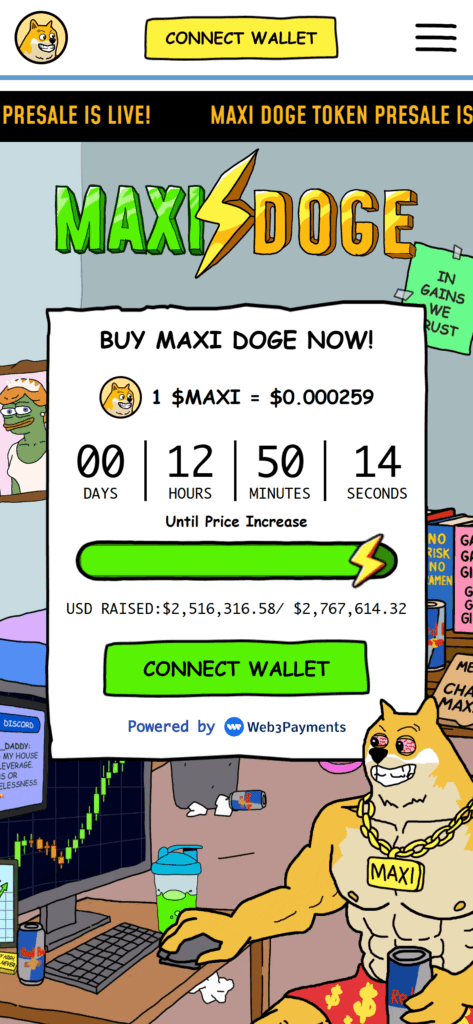
Maxi Doge (MAXI) is an Ethereum meme coin that blends high-volatility meme culture with staking incentives designed to reward early supporters. As a “best crypto to stake” contender, MAXI offers very high APY during its presale phase. Users who stake their tokens can reap in massive rewards, though the yield is designed to drop as more participants join the staking pool.
Early presale participants benefit from a lower entry price and higher staking rewards. The project has undergone security audits by Coinsult and SolidProof, which boosts confidence among buyers.
Stakers must lock their tokens during the presale to earn exceptional staking rewards. As of September 2025, the APY is 141% so no wonder over 5 billion $MAXI has been staked already, and can claim them once the Token Generation Event occurs. With such a high yield, $MAXI is one of the best crypto staking coins.
3. LiquidChain – High-Yield Staking Token Built for Cross-Chain DeFi
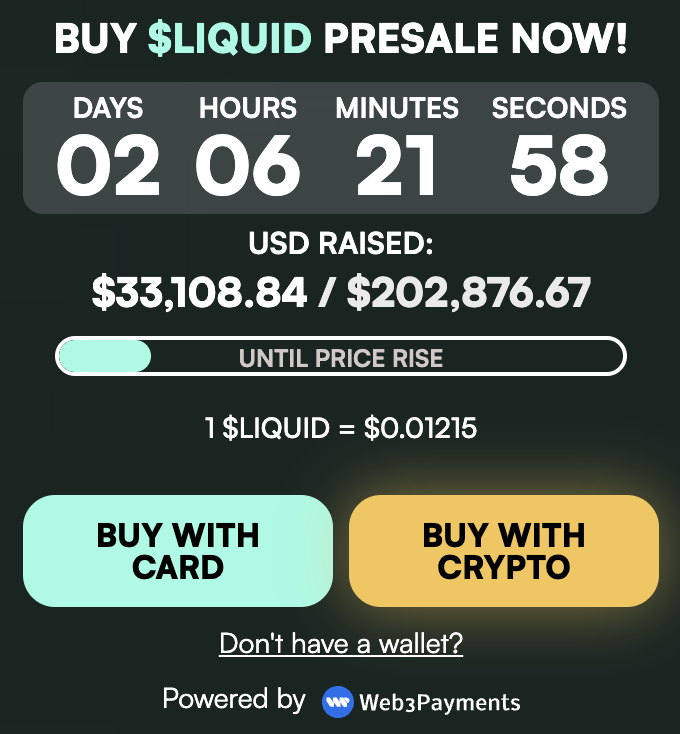
LiquidChain (LIQUID) stands out as one of the strongest new staking tokens, offering a massive live APY of 21,869% for early participants. The staking system has already launched (with more than 2.69 million LIQUID tokens locked up) and lets users access high yields from day one, even though the project is still in presale.
The LiquidChain crypto project brings a next-generation Layer 3 network that merges the liquidity of Bitcoin, Ethereum, and Solana into a single execution layer. This effectively streamlines DeFi to let users trade, bridge, and deploy across chains without the usual complexity.
With its presale raising over $33,000 in just a few days and token prices still at early-stage levels, LiquidChain stands as a promising option for investors seeking long-term yield.
4. SUBBD – AI-Powered Platform Focusing on Content Creators While Offering Fixed Staking APY

SUBBD (SUBBD) is a Web3/AI-powered content creator platform. SUBBD merges blockchain and AI, allowing creators to connect more directly with fans, monetize subscriptions, tips, pay-per-view content, and offer exclusive features.
During its presale, SUBBD offers fixed staking rewards: holders can stake SUBBD tokens for 20% APY. Staking rewards have different functions: they are meant to reward early buyers, encourage long-term holding, reduce circulating supply, and give access to perks. These can be discounts, priority content access, XP/loyalty boosts, and exclusive content.
As mentioned earlier, contrary to other presales, SUBBD offers a fixed 20% staking APY. This means you don’t have to worry about the APY decreasing if more people choose to stake their tokens. The creator industry is expected to boom by 2030, so getting in early could be a wise idea. Join now and secure a stable staking yield as well!
5. Ethereum – Reliable Staking From the Largest PoS Network
Ethereum is the most established proof-of-stake blockchain, powering thousands of DeFi applications. Staking ETH offers relatively stable rewards compared to smaller projects, though APY tends to be lower. Validators need 32 ETH to stake directly, but many exchanges and pools allow smaller holders to participate. This comes with rewards being shared as well, resulting in a lesser yield.
Thanks to its enormous ecosystem and broad adoption, Ethereum continues to serve as a cornerstone for staking. Mixing smaller projects that offer higher yield with large-cap coins such as ETH lets you boost your staking efficiency while keeping things stable. Should you need some guidance, this guide explains how to buy Ethereum.
6. Polkadot – A Combination of Fairly High Staking APY and Innovation
Polkadot is focusing on interoperability and filling the gap between Web3 and the world. Its staking mechanism lets users nominate validators, with rewards depending on validator performance. $DOT’s APYs are competitive, and the historical reward rate sits at 16.8% currently.
Between 48 and 58% of the $DOT supply is locked up, providing price stability. Despite that, $DOT’s price is far away from its 2021 high of $55 as it’s currently trading around $4. Over 600k validators are working on the security of the network, making it one of the most developed ones. The combination of high APY and flexible design makes DOT a strong candidate for both retail and institutional stakers.
7. Cardano – One of the Biggest Blockchains With a Research-Driven Approach
Cardano is one of the biggest blockchains, and with good reason. Staking $ADA is pretty easy, and you don’t need to lock up your tokens either – they stay in your wallet. What’s more, you can spend or transfer them at any time, even while they’re staked. This makes Cardano one of the most flexible staking systems available.
Staking rewards typically range from 3% to 5% APY, and are distributed every epoch (about five days). While these rewards are quite moderate, we can see why people choose to stake ADA: steady yield, liquid funds, low minimums, strong decentralization and ease of use.
What Is Crypto Staking?
Crypto staking is the process of locking digital assets into a blockchain network. These assets usually run on proof-of-stake (PoS) or similar consensus mechanisms. Instead of using energy-heavy mining, PoS relies on stakers to secure the network and validate transactions. In return, stakers earn rewards – often calculated as a percentage yield (APY).
What Can I Stake?
Staking is available on most proof‑of‑stake networks, including delegated or nominated variants, so native tokens such as ETH (Ethereum), ADA (Cardano), SOL (Solana), DOT (Polkadot), AVAX (Avalanche), and ATOM (Cosmos) can typically be staked directly with validators or via delegation.
Minimums, unbonding periods, and reward rates vary by chain, but the core idea is consistent: tokens are bonded to help secure the network and earn periodic rewards. Many ecosystems also support liquid staking tokens (LSTs) like stETH or mSOL, which represent a staked position and preserve on‑chain liquidity for trading, collateral, or additional yield strategies – while introducing extra smart‑contract and depeg risks.
With the rise of LSTs and restaking frameworks, staking has evolved beyond simple delegation, offering more flexibility for both long‑term holders and active DeFi participants.
How Does the Proof of Stake Consensus Work?
In PoS, validators are chosen to confirm transactions based on several factors, including node size, randomization and staking age. The more tokens staked, the higher the chance of being selected. Validators earn rewards but risk losing some stake if they act dishonestly. This mechanism encourages honest participation while keeping the network secure.
Proof-of-Stake staking comes with both benefits and drawbacks. On one hand, it allows investors to earn passive income by putting their tokens to work, while making the blockchain network more secure. Staking is far more energy-efficient than mining, doesn’t require expensive equipment, and is often easy to access. Some projects also offer additional perks, such as governance rights or extra bonuses, making staking even more attractive.
On the other hand, there are also disadvantages to consider. The biggest risk is price volatility – high APY rewards mean little if the token’s value drops sharply. Many staking programs also require lock-up periods, which limit liquidity and can leave you stuck during market swings. On top of that, some networks impose penalties (“slashing”) if validators fail, and staking via centralized platforms comes with custody risks. High rewards can also be inflationary, reducing long-term token value, which is obviously better to avoid.
Is Crypto Staking Profitable?
In short, yes, it should be. Crypto staking is designed to be profitable, but returns vary. Actual profits are influenced by factors like APY, token price movement, network stability, and lock-up terms. Some assets yield double-, triple- or even quadruple-digit APYs, but higher rewards often mean higher risks. Long-term profitability usually depends on whether the coin’s value holds steady or grows. That’s why it’s super important to carefully choose the best crypto to stake.
How to Choose the Best Crypto to Stake
Selecting the right coin isn’t only about chasing the highest APY crypto staking. You’ll need to weigh several factors that affect both rewards and risks. These are some of the most important:
Staking Rewards (APY)
APY determines how much you earn annually from staking. Higher yields can be tempting, but they may also signal higher risk or inflationary tokenomics. Finding a good balance is key.
Price Stability of the Coin or Token
A coin with volatile price swings can quickly erase any staking gains. It’s important to balance yield with confidence in the project’s long-term value. Choose tokens that you think have a bright future to maximize staking gains.
Lock-Up Periods & Liquidity
Some coins require you to lock tokens for weeks or months. Others, like Cardano, allow flexible withdrawals. Consider your liquidity needs before staking. Dividing your staking portfolio among flexible and less liquid options might be a wise decision.
Network Security & Credibility
Staking only makes sense if the network is secure. Established blockchains like Ethereum have proven their worth, while newer projects carry more risk. Because of that, make sure to consider diversification.
Benefits and Risks of Crypto Staking
If you made it this far, you might think crypto staking is a no-brainer for passive yields. It might be, as the best coins to stake have the potential to make you a fortune. However, while staking can be rewarding, it has its own challenges. Let’s take a look at the pros and cons of staking.
Benefits of Staking
- Passive Income – You can earn rewards without trading actively, occasionally with very high yield.
- Network Participation – You can contribute to blockchain security and decentralization, moving forward the ecosystem as a whole and helping blockchains develop.
- Accessibility – You can access many platforms that allow easy entry with low minimums, making it possible for the masses to join.
- Potential for Compound Growth – You may reinvest your staking rewards to grow holdings, resulting in an even higher yield.
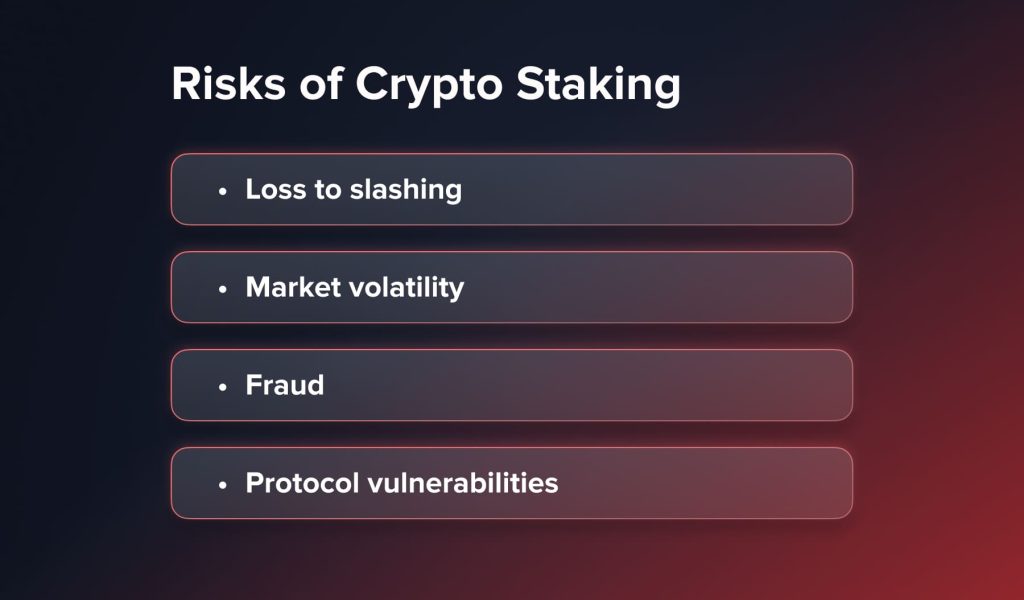
Risks Associated With Staking
- Price Volatility – It is quite common for token prices to drop, offsetting rewards. Make sure you buy low and sell high to maximize your gains.
- Lock-Up Risk – Locked tokens may be inaccessible during market dips. It is important to have a strategy, manage your risk properly and try to avoid panic selling.
- Slashing Penalties – Validators can lose funds if they break the rules. Always play by them and try to avoid misbehaviour.
- Project Risk – Newer projects have the chance of failing, leaving stakers with worthless tokens. Always manage your risk and don’t invest more than you can afford to lose.
Where to Stake? Best Place to Stake Crypto
Bear in mind, your crypto staking journey doesn’t start with picking a coin to stake but with finding the right platform. Centralized exchanges and non-custodial wallets are among the most popular options.
Centralized Exchanges
Anyone who follows crypto has likely come across major exchanges such as Binance, Coinbase or Bybit. Their staking services are designed to be simple and accessible, even for complete beginners. The trade-off is that you hand over control of your assets, which raises the risk should the platform run into trouble.
Non-Custodial Wallets
Non-custodial wallets, on the other hand, let you keep full control of your funds while staking directly. These are best for investors who prefer keeping their assets at hand and don’t trust third-party exchanges. Best Wallet stands out here, offering multi-asset staking with an easy interface and strong security features. What’s more, Best Wallet is not just a wallet but a whole ecosystem, providing different crypto-related services like presale buys, news and more.
Staking Pools and Delegation Services
Staking pools let smaller holders combine resources to stake together. This increases their chances of solving a block, but they also have to share rewards. Delegation services make staking accessible without requiring deep technical knowledge. Through these, stakers entrust a validator to stake on their behalf, which involves some risk.
How We Pick the Best Crypto for Staking: Methodology
Before we recommend any project, we follow a structured research process to ensure we provide you with the best opportunities. Here’s what we look at to identify the best crypto to stake:
- Staking rewards (APY) – We review actual returns, not just advertised numbers. High APY sounds great, but it also needs to be transparent and sustainable.
- Price stability – Our team checks historical price trends and market sentiment. The more data, the better.
- Examine lock-up periods and liquidity – We look at staking commitments and the level of liquidity. Flexible staking periods are always welcome, and liquidity is the foundation of growth.
- Evaluate network security – We assess validator performance and history of attacks. Again, high yield is useless when you can’t access your funds.
- Check ease of staking – We look at how simple it is to stake. Through exchanges, it’s pretty easy, even for beginners. On the other hand, non-custodial wallets like Best Wallet offer more security and flexibility, which makes them better for experienced investors.
- Research additional utility – We consider whether tokens have DeFi, NFT, or governance features that enhance value. Giveaways, airdrops or discounts are fairly common too.
Conclusion: Best Crypto to Stake
With that, we’ve come to the end of our article. It’s time to summarize what you’ve learnt. Staking is one of the easiest ways to earn passive crypto income while helping networks stay secure.
The best choice depends on your goals: established assets like ETH are great for long-term stability, while projects like Bitcoin Hyper or Maxi Doge may appeal to those chasing higher APY. Tools like Best Wallet make staking easy and safe.
Don’t forget: the best crypto to stake is the one that balances rewards, risk, and your personal investment strategy. Feel free to diversify, as it gives you exposure to more assets, making balancing your portfolio easier. A mix of large-cap altcoins and fast-growing meme coins may turn out to be profitable.
FAQ: Best Crypto for Staking
How can I choose the best crypto for staking right now?
Is ETH the best crypto for staking?
What’s the best place to stake crypto?
Is crypto staking profitable?
References
