


Strategy’s Bitcoin Bet Risks 50% Drop, Analysts Warn of Bearish Pattern
We may earn commissions from affiliate links or include sponsored content, clearly labeled as such. These partnerships do not influence our editorial independence or the accuracy of our reporting. By continuing to use the site you agree to our terms and conditions and privacy policy.


Strategy’s (MSTR) aggressive Bitcoin accumulation is once again under scrutiny after a sharp pullback in the stock and ongoing weakness in the broader crypto market.
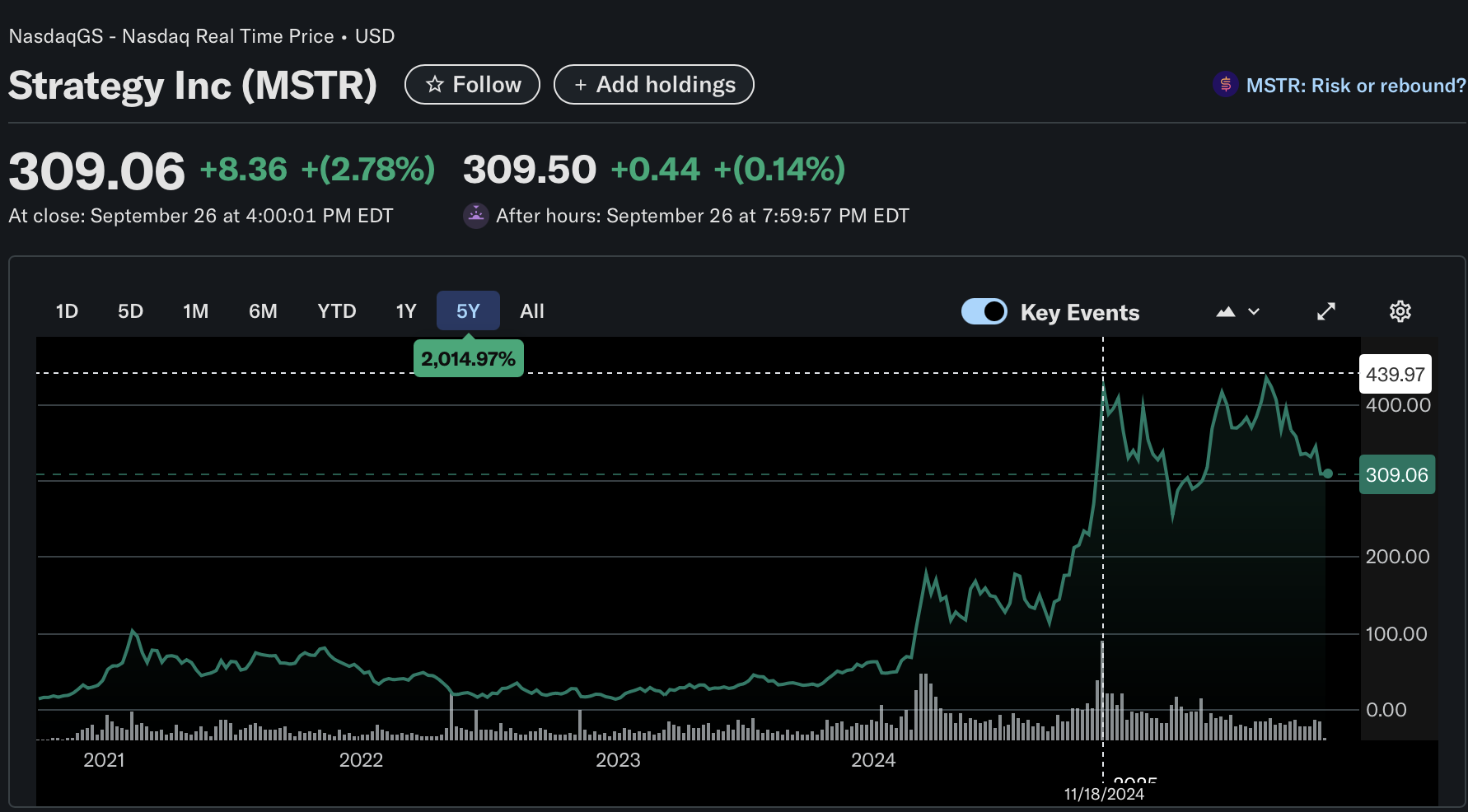
The software firm, which has become synonymous with corporate Bitcoin treasuries, has seen its shares slump almost 50% from their November 2024 high. This decline has reignited long-standing debates about whether Michael Saylor’s all-in approach to Bitcoin can endure the next stage of market turbulence.
As investors reassess how much risk they are willing to take on single-asset balance sheet strategies, attention is beginning to shift toward other equities experimenting with different models of crypto exposure. HYLQ Strategy Corpis one such name drawing interest, having tied its treasury to HyperLiquid’s HYPE token while maintaining the safeguards of a public listing on the Canadian Securities Exchange. Its hybrid approach has led some market watchers to mention it among the top cryptocurrency stocks, particularly for investors who want access to DeFi-driven growth without leaving the regulated equity market.
A fragile balance between conviction and risk
For now, Strategy holds around 640,000 BTC, valued at roughly $70 billion at current market prices. That war chest is a testament to Saylor’s conviction but also a looming risk. Should Bitcoin tumble, the company could face not only major paper losses but also the possibility of forced selling, an outcome that would put additional stress on the cryptocurrency itself.
Despite the skepticism, Saylor has shown no signs of retreat. In a post on September 28, he hinted at further purchases, doubling down on his belief that Bitcoin remains the ultimate treasury reserve asset. This unwavering commitment stands in sharp contrast to Schiff’s warnings, highlighting the polarized debate surrounding Strategy’s future.
Always ₿e Stacking pic.twitter.com/XMT5rA0DYL
— Michael Saylor (@saylor) September 28, 2025
Schiff renews his gold-versus-Bitcoin argument
One of the most vocal critics of Strategy’s Bitcoin experiment remains Peter Schiff. The veteran gold advocate argues the company is heading toward what could be a “brutal bear market” for Bitcoin treasury stocks. In a recent post on X, Schiff claimed that the Bitcoin model exposes firms like Strategy to risks far greater than they acknowledge, particularly through share dilution and the volatility of digital assets.
He further insisted that Saylor would have fared better with a strategy centered on gold. According to Schiff, Strategy’s Bitcoin purchases, roughly $47.3 billion in total, currently show a paper gain of about 47%. Had the company put the same funds into gold, the gain would have been closer to 30%. For Schiff, however, the crucial difference lies in liquidity: unloading tens of billions in gold would not disrupt its market, while trying to sell $70 billion worth of Bitcoin could spark a chain reaction of liquidations.
Technical warnings deepen the uncertainty
Macro criticism is now being reinforced by technical signals. Market strategist Peter DiCarlo highlighted that MSTR has broken below key support zones, leaving it vulnerable to further losses. He pointed out that institutional players are now dictating direction around what he calls the “smart money zone.” If the stock fails to hold the $290–$300 band, DiCarlo sees potential for a retreat toward $240.
Similarly, crypto analyst Ali Martinez noted that Strategy’s current price action is beginning to mirror the 2021–2023 fractal pattern. That earlier setup ultimately triggered a 50% crash once support gave way. Martinez identified $257 as the crucial floor, warning that a breakdown could set the stage for a slide as low as $120.
Institutional appetite cools as premium erodes
Institutional appetite cools as premium erodes. Strategy stock has historically traded at a premium relative to the value of its Bitcoin holdings. At its January peak, the premium approached 2×, but it has since shrunk to around 1.4× as net asset value compression and slower BTC accumulation reduce the gap. Some institutions still show faith, for example, the Royal Bank of Canada recently increased its position in Strategy by 16% last quarter, but the broader question looms: if MSTR can no longer reliably outperform the value of its Bitcoin stake, what incentive remains for equity investors?
With that in mind, some capital may tilt toward crypto-linked equities that carry less dilution risk and more structural clarity. HYLQ Strategy Corp (CSE: HYLQ) is asserting itself in that space. Just days ago, HYLQ closed its final tranche of a non-brokered private placement, issuing nearly 2 million units at CAD $1.50 each and bringing total gross proceeds close to CAD $8 million. Part of this capital is being directed toward new token accumulation, reinforcing the company’s commitment to its core thesis. In a parallel move, HYLQ purchased 5,000 additional HYPE tokens at approximately US$52.468 apiece, boosting its balance to 53,961.53 tokens.
We purchased another 5,000 $HYPE $HYLQ now holds 53,961.53 $HYPE tokens at an average price of $45.32
We will continue to stack.
Hyperliquid. pic.twitter.com/KtF59cagbA
— HYLQ (@HYLQstrategy) September 25, 2025
What makes HYLQ compelling is how it melds DeFi exposure with public-market discipline. Its listing on the Canadian Securities Exchange enforces audited reporting and regulatory oversight, protections often absent in purely crypto-native plays. Meanwhile, HyperLiquid continues to generate impressive throughput: billions in daily derivatives volume and over $2.5 trillion in lifetime activity. For investors seeking crypto upside without the unpredictability of repeated equity raises, HYLQ may stand out as one of the more structured, methodical plays worth watching.
Conclusion
Strategy’s approach has always been a high-stakes bet on Bitcoin’s long-term appreciation. With its stock sliding, technical analysts spotting bearish fractals, and critics like Schiff renewing calls for gold, the risks are increasingly clear. At the same time, institutional interest, though muted, has not disappeared, suggesting some investors remain aligned with Saylor’s vision. Whether Strategy can withstand another deep market correction may ultimately depend less on its balance sheet and more on Bitcoin’s next big move.


 Commentaries










Fill in necessary fields and publish