


Crypto Market: Why Prices Are Going Down Today
We may earn commissions from affiliate links or include sponsored content, clearly labeled as such. These partnerships do not influence our editorial independence or the accuracy of our reporting. By continuing to use the site you agree to our terms and conditions and privacy policy.


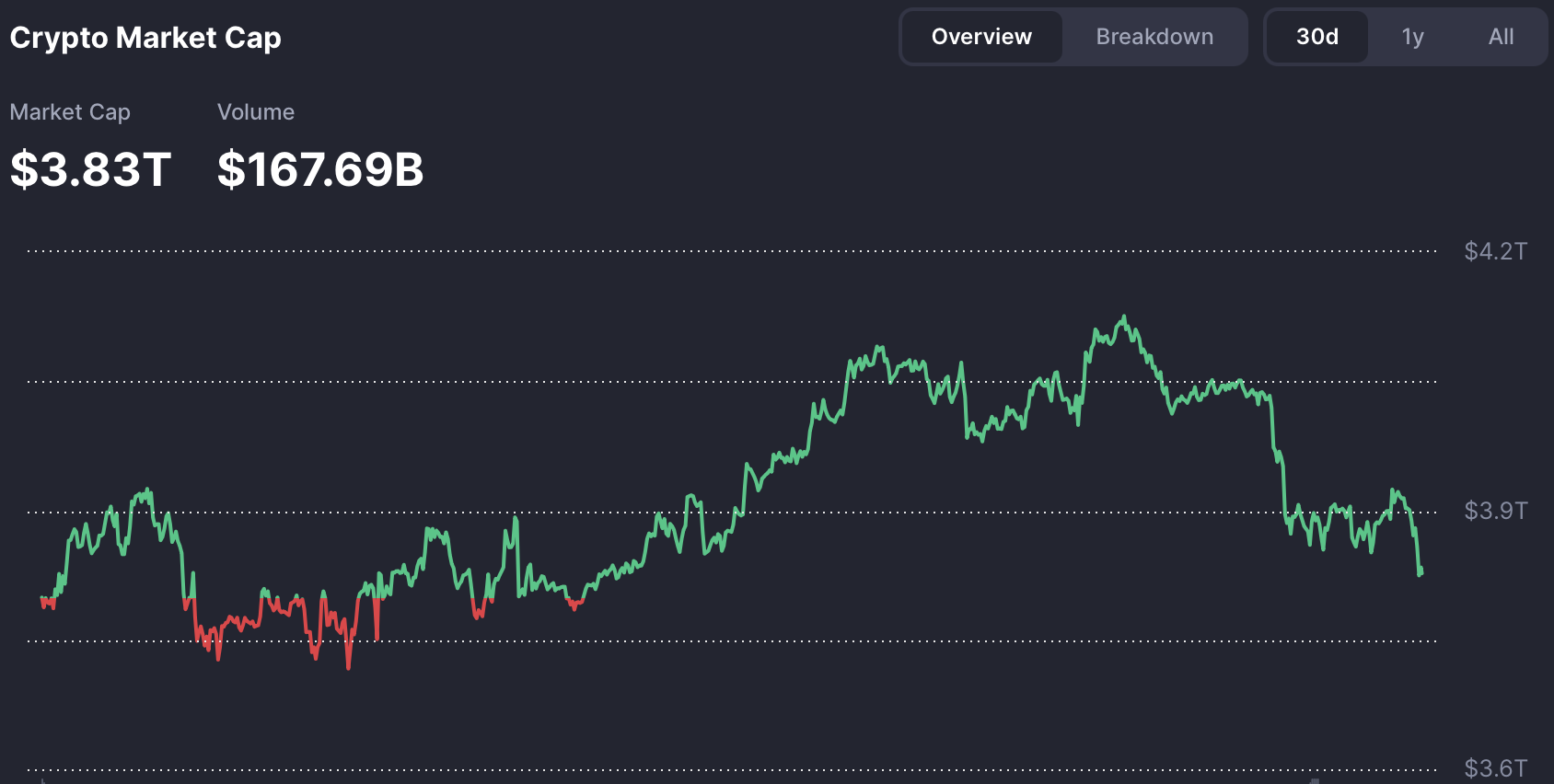
The cryptocurrency market slipped further into the red, falling 1.45% in the past 24 hours and extending its seven-day decline to 6%.
The move mirrors weakness in traditional markets, where risk appetite faded under pressure from central bank policy signals and mounting regulatory uncertainty. Ethereum bore the brunt of the drop, with leveraged liquidations and ETF delays amplifying losses.
Macro pressures hit risk assets
Markets reacted negatively after Federal Reserve Chair Jerome Powell reiterated on September 24 that interest rates will remain restrictive for longer, citing persistent inflation and a cooling labor market. The Nasdaq tumbled 0.95% in response, while crypto assets moved sharply in the opposite direction. Correlation data showed crypto’s 24-hour link to the Nasdaq-100 turning strongly negative at -0.76, its most pronounced divergence since June 2025.
Capital rotated away from speculative assets, with Bitcoin’s market dominance climbing to 58.11%, a 0.39% increase in just 24 hours, as traders sought relative safety in the largest cryptocurrency.
👉Find out how to buy Bitcoin
Ethereum liquidations intensify downturn
Ethereum’s sell-off accelerated after the token lost its $4,000 support level. Data shows more than $210 million in ETH long positions were liquidated over 24 hours, marking the heaviest wipe-out since August. With total crypto derivatives open interest still elevated at $1.08 trillion, leverage amplified the downward pressure.
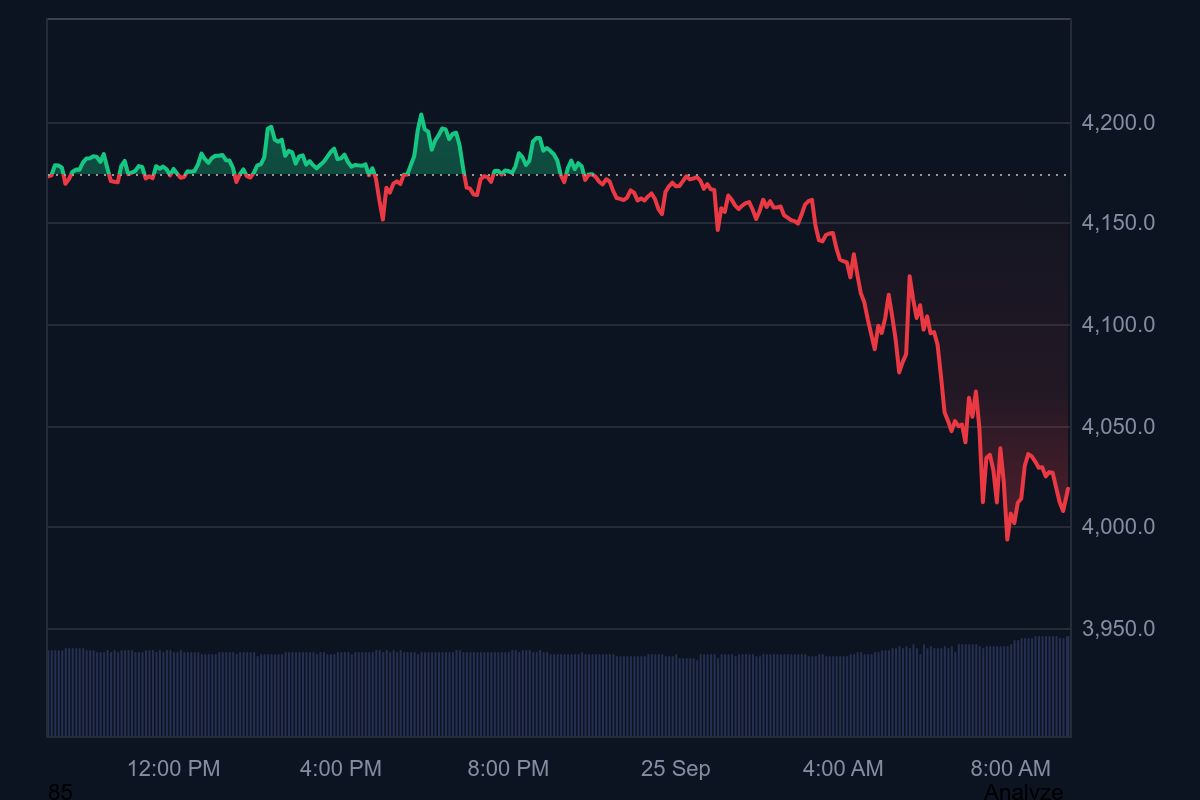
Funding rates across exchanges turned negative (-0.035% on average), signaling that short sellers are increasingly in control. Meanwhile, the spot-to-perpetual volume ratio slid to 0.25, highlighting the dominance of derivatives trading in driving recent price action.

Regulatory signals create uncertainty
Policy developments added another layer of volatility. The CFTC’s September 24 announcement to explore stablecoins as collateral for derivatives markets was welcomed as a positive long-term step. However, optimism was tempered by the SEC’s decision to delay rulings on Grayscale’s proposed Ethereum ETFs until October 20.
At the same time, Tether’s pledge to comply with the GENIUS Act, a stablecoin oversight bill in the U.S., stirred debate about tighter regulatory scrutiny on USDT. Together, these signals left investors unsure whether adoption tailwinds or compliance headwinds would dominate in the near term.
Outlook
The combination of macro headwinds, cascading liquidations, and mixed regulatory signals has created a fragile setup for Ethereum and the broader market. Until ETH can reclaim the $4,000–$4,100 range with conviction, traders may remain cautious, with Bitcoin absorbing flows as a defensive play.


 Commentaries






Fill in necessary fields and publish