


Coinbase (COIN) Stock Holds Steady as Analysts Split on Outlook
We may earn commissions from affiliate links or include sponsored content, clearly labeled as such. These partnerships do not influence our editorial independence or the accuracy of our reporting. By continuing to use the site you agree to our terms and conditions and privacy policy.


Coinbase Global, Inc. (NASDAQ: COIN) continues to be one of Wall Street’s most divisive names, with analysts unable to settle on a unified outlook.
According to MarketBeat data, the stock carries a consensus “Hold” rating from 25 research firms. Within that mix, two analysts recommend selling, ten urge holding, and thirteen call the stock a buy. The average 12-month price target stands at $352.72, underscoring the wide range of expectations surrounding the crypto exchange.
At the same time, institutional activity shows that large firms continue adding to their positions in COIN, signaling confidence in its long-term role within the digital asset economy. This renewed interest has also sparked a broader trend: more investors are researching other crypto-related equities that can provide exposure beyond Coinbase. Among these names, HYLQ Strategy Corp has been drawing growing attention, positioning itself as a regulated gateway into HyperLiquid’s expanding DeFi ecosystem. Many retail and institutional traders alike are beginning to buy and check HYLQ price as they explore new ways to participate in blockchain growth. With its unique listing structure and focused strategy, HYLQ is gradually establishing itself among the most closely watched emerging crypto stocks on the market.
Analyst Perspectives Diverge
The divergence is reflected in recent research notes. Keefe, Bruyette & Woods trimmed its target from $355 to $335, assigning a “market perform” rating in early August. William Blair, in contrast, initiated coverage in June with an “outperform” rating. Sanford C. Bernstein went even further, lifting its target to $510 while also tagging Coinbase as “outperform.” Needham & Company raised its view from $270 to $400 with a “buy” recommendation, while Jefferies raised its target from $260 to $405 but opted for a “hold.”
Such conflicting signals highlight the uncertainty surrounding Coinbase’s path. While some firms see the exchange as well-positioned to benefit from crypto’s structural growth, others point to rising competition, regulatory headwinds, and volatile trading volumes as reasons for caution.
Insider Sales and Corporate Activity
The stock has also drawn attention due to insider transactions. On August 22, insider Lawrence J. Brock sold nearly 6,000 shares at an average price of $311.37, a move that reduced his position by over 90%. On the same day, Chief Accounting Officer Jennifer N. Jones sold 1,756 shares at roughly $300.50 each. In total, insiders sold more than 1.17 million shares worth $438.7 million over the past 90 days. Despite these sales, insiders still hold about 23.4% of Coinbase’s outstanding stock, reflecting a meaningful alignment of interests with outside shareholders.
Institutional Positioning
Large investors remain deeply involved with Coinbase. Hedge funds and asset managers collectively own nearly 69% of shares outstanding, according to recent filings. Smaller firms such as Mascagni Wealth Management and Copia Wealth initiated new positions earlier this year, while Evelyn Partners nearly doubled its stake in the second quarter. On the larger end, Vanguard boosted its holdings by almost 5% in the first quarter, lifting its position to more than 19.2 million shares worth $3.32 billion. ARK Invest, one of Coinbase’s most vocal backers, increased its position slightly to over 3 million shares valued at more than $528 million. Groupama Asset Management also made headlines by doubling its exposure, amassing 3 million shares worth more than half a billion dollars.
This steady accumulation by institutions contrasts with insider selling, adding another layer to the debate about Coinbase’s near-term prospects.
Financial Snapshot
From a financial standpoint, Coinbase remains firmly tied to the ups and downs of the crypto economy. Shares opened at $327 on Tuesday, giving the company a market capitalization of $84 billion. Its price-to-earnings ratio sits near 32, reflecting the growth expectations priced into the stock. The 12-month trading range is wide, with a low of $142 and a high of $444, emphasizing its volatility.
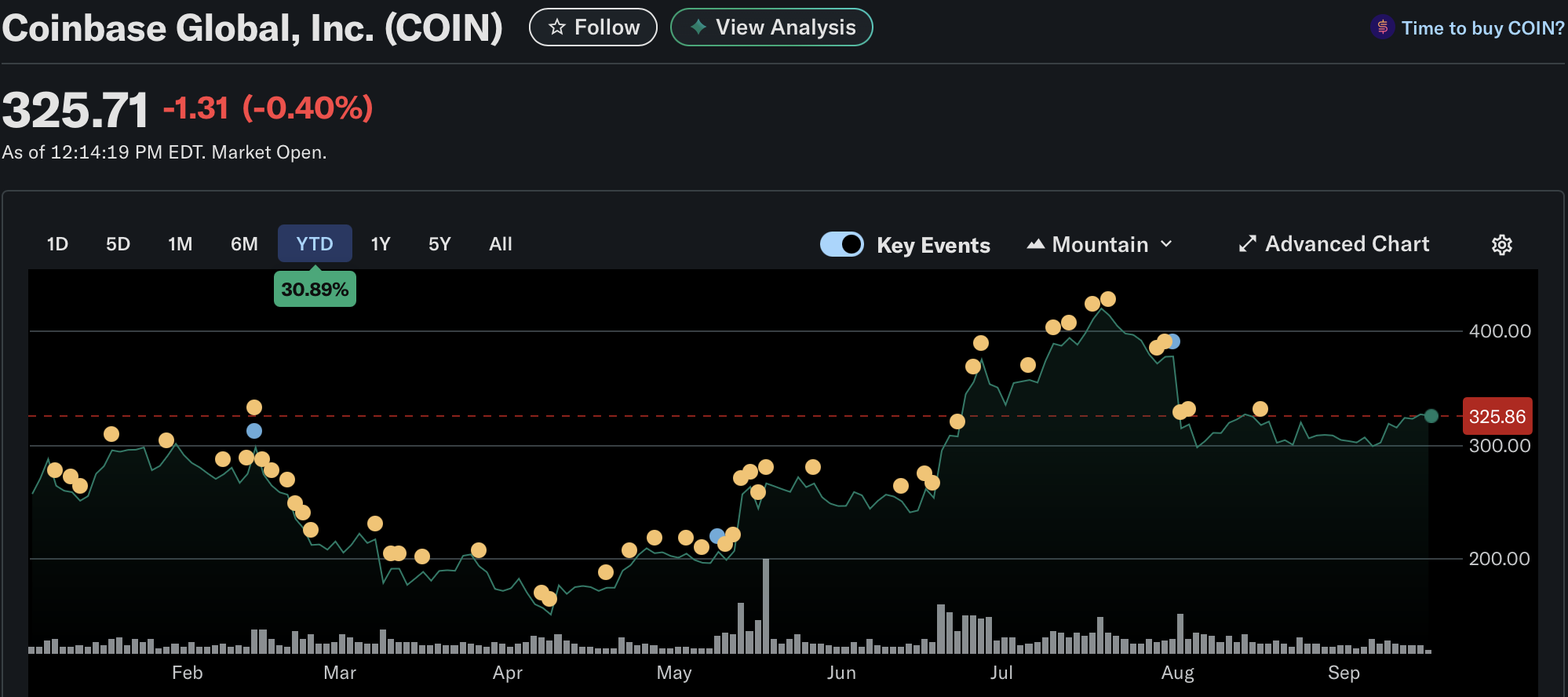
The company’s most recent earnings report in late July fell short of Wall Street’s forecasts. Coinbase delivered earnings per share of $0.12, missing consensus estimates of $0.91. Revenue came in at $1.50 billion versus expectations of $1.68 billion, although that still represented a 3.3% year-over-year increase. Net margin stood at 40.9% with return on equity of 16%, solid figures by traditional standards but below what some investors had hoped. Analysts now expect full-year earnings per share to average around 7.22, suggesting cautious optimism.
Coinbase’s Role in the Crypto Economy
Beyond the quarterly numbers, Coinbase’s strategic importance remains undeniable. The exchange provides a crucial on-ramp for both retail and institutional clients, offering liquidity, custody solutions, and an expanding suite of financial tools for the digital asset ecosystem. Its international presence has grown steadily, though it faces stiff competition from decentralized platforms and global exchanges with lighter regulatory burdens.
For now, Coinbase continues to benefit from the broader rise of crypto adoption, even as the company adjusts to a landscape shaped by Bitcoin’s pullbacks and Ethereum’s ongoing rallies. Market participants increasingly treat the stock as a barometer for sentiment in the sector: when crypto is hot, Coinbase tends to surge; when volumes decline, its stock cools just as quickly.
Yet Coinbase is no longer the only equity investors are watching in this space. A newer entrant, HYLQ Strategy Corp, has begun to attract significant attention by offering exposure to a very different corner of the digital asset economy. The firm reinvented itself as “The Public HYPE Treasury” after dropping its earlier ventures in gaming and fintech. Today, its focus is singular: build a treasury of HyperLiquid’s HYPE tokens, an asset tied to one of the fastest-growing decentralized exchanges in the world.
What makes HYLQ stand out is not only its focus on HyperLiquid but also the way it has structured investor access. By securing a Canadian Securities Exchange (CSE) listing, the company has differentiated itself from the shadowy world of over-the-counter penny stocks that dominate much of the crypto-equity space. This placement puts HYLQ in the company of established names like MicroStrategy, Coinbase, and Marathon Digital, firms that have used regulated exchanges to build trust with both institutions and retail investors.
The listing carries practical benefits as well. CSE rules mandate quarterly reporting, audited financials, and regulatory compliance, reducing the risks often associated with early-stage crypto plays. Investors don’t have to worry about opaque disclosures or the threat of management vanishing with treasury assets, a scenario not unheard of in the sector.
Equally important, HYLQ’s shares can be traded through familiar brokers such as Interactive Brokers, Questrade, and TD Direct, all at reasonable commission levels. That ease of access matters in a volatile market where liquidity and speed often dictate outcomes. In essence, HYLQ combines the speculative upside of an emerging DeFi play with the structural safeguards of a publicly listed equity.
The Road Ahead
Coinbase continues to sit at the center of the conversation about crypto adoption on Wall Street. Analysts remain split, with some pointing to its brand recognition, liquidity, and regulatory standing as clear advantages, while others highlight slowing retail activity, rising competition, and the volatility of its revenue streams. Institutional ownership remains high, with giants like Vanguard and ARK Invest maintaining significant positions, reinforcing the idea that Coinbase has cemented itself as the leading U.S. exchange. Its financial results show both the promise and the challenges of operating in such a cyclical industry, margins remain strong, but earnings often swing with the market’s mood.
For most investors, Coinbase has become a reliable proxy for overall sentiment in digital assets: when Bitcoin rallies, COIN usually follows; when volumes dry up, the stock cools just as fast. Yet as attention grows around crypto-related equities, some are also beginning to explore newer entrants like HYLQ Strategy Corp, which is positioning itself in the equity markets as a different kind of bridge into DeFi ecosystems.


 Commentaries










Fill in necessary fields and publish