






Strategy Stock Faces New Pressure as Dilution Risks Grow
We may earn commissions from affiliate links or include sponsored content, clearly labeled as such. These partnerships do not influence our editorial independence or the accuracy of our reporting. By continuing to use the site you agree to our terms and conditions and privacy policy.


Strategy (MSTR) slides as investors weigh dilution, volatility, and its evolving role as both software firm and digital asset giant.
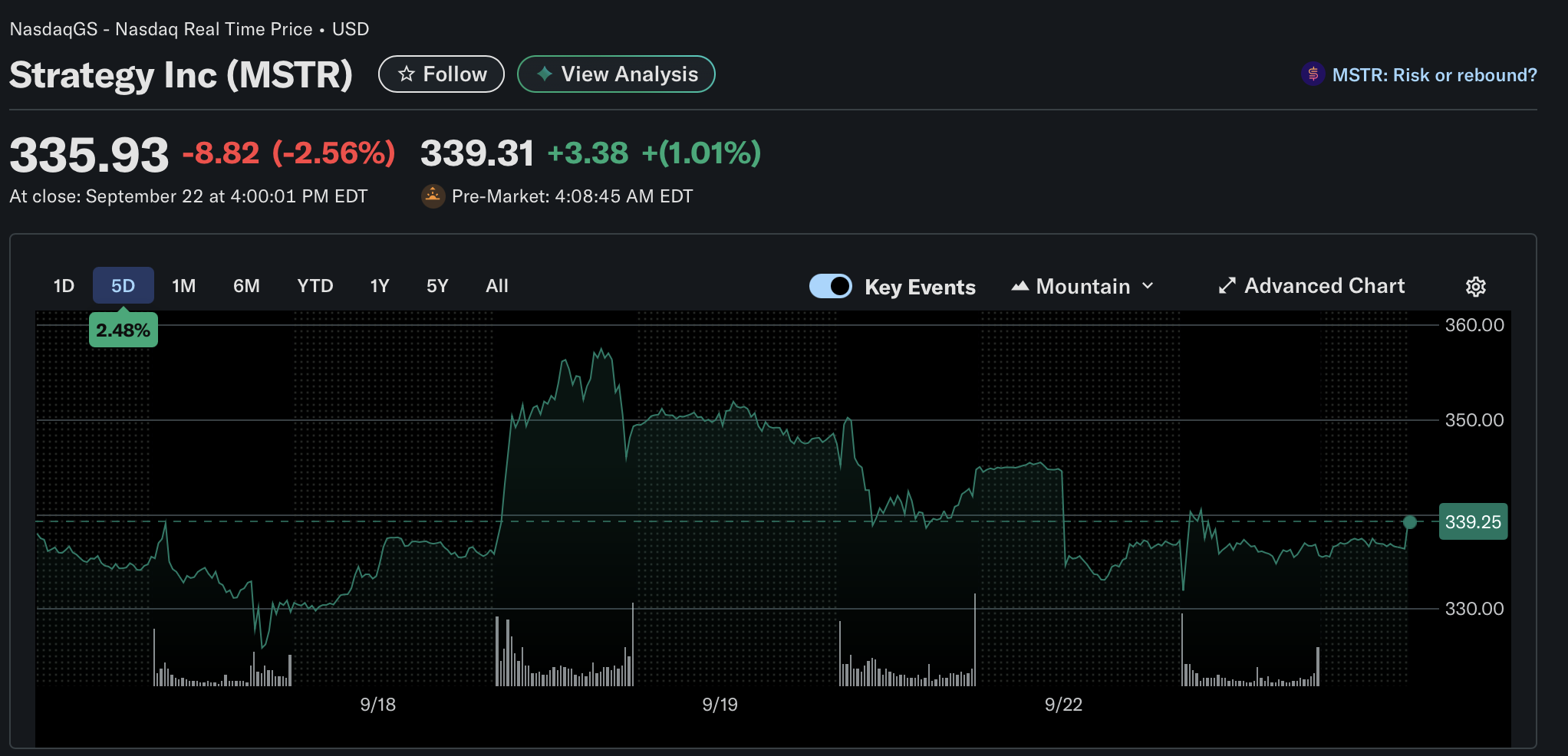
According to a recent report shared by Yahoo Finance, Strategy (NASDAQ:MSTR) remains one of the most polarizing companies in the U.S. equity market. Once primarily recognized as an enterprise analytics provider, the firm has redefined itself through unprecedented investment in digital assets. This dual role has drawn both praise and criticism, creating a situation where Strategy is often treated less like a software company and more like a proxy for the cryptocurrency market.
The report noted that this transformation has left analysts divided. Enthusiasts believe Strategy’s bold approach positions it as a leader in modern treasury strategy, while skeptics warn that the company has tied its fate too closely to speculative cycles. This push and pull between innovation and risk now defines the “Strategy paradox,” making the stock’s trajectory unusually difficult to predict.
At the same time, the viral growth of crypto-related equities has encouraged investors to scan beyond Strategy for other listed names tied to blockchain ecosystems. One emerging candidate is HYLQ Strategy Corp, which has anchored its balance sheet in HyperLiquid’s HYPE token and is quickly earning recognition among the best penny stocks to buy now. With its regulated Canadian Securities Exchange listing and treasury linked to one of DeFi’s fastest-growing platforms, HYLQ represents a different take on the equity–crypto crossover, offering both the upside of digital assets and the oversight of traditional markets.
Bitcoin Holdings Expand, but Funding Sparks Debate
Yahoo Finance highlighted that Strategy recently expanded its digital reserves, adding 850 more BTC to its balance sheet. This move lifted its holdings to more than 639,000, solidifying its position as the largest corporate owner in the world. Yet the funding mechanism for these acquisitions, at-the-market equity offerings, has stirred unease among shareholders.
By issuing new stock, Strategy avoids piling on debt, but the trade-off is dilution. According to the report, investor reaction has been cautious, with shares recently touching multi-month lows. The shrinking premium over its asset value suggests that markets are increasingly unwilling to pay for exposure that can be achieved directly through other investment vehicles.
Financials Distorted by Revaluations
The Yahoo Finance report also pointed to the unusual shape of Strategy’s financial statements. Revenue from its core analytics business remains largely flat, with modest single-digit growth expectations. However, net income has been artificially inflated by revaluation gains tied to digital assets, creating profit margins that analysts argue do not reflect the health of the software business itself.
Cash reserves are slim, leaving the firm reliant on further share sales to continue its strategy. According to the report, this dependence on capital markets amplifies the binary nature of the investment: significant upside if digital assets rise, but heavy pressure if markets turn.
Analysts Split on the Outlook
Strategy’s outlook remains highly contested. Wall Street forecasts suggest moderate growth in earnings per share next year, though longer-term estimates taper off as expectations for asset appreciation soften. Revenue forecasts, meanwhile, remain stagnant.
The report underscored the wide range of analyst targets, with bullish cases envisioning values well above $700 and bearish projections as low as $200. Such disparity reflects the uncertainty over whether Strategy should be valued as a technology provider with a side bet on crypto, or as a corporate vault whose software operations play only a minor supporting role.
That debate has also sparked curiosity about alternative models emerging in equity markets. HYLQ Strategy Corp (CSE: HYLQ) has entered this conversation by positioning itself as “The Public HYPE Treasury.” Instead of Bitcoin, HYLQ’s balance sheet is anchored in HyperLiquid’s HYPE token, a top-15 cryptocurrency by market capitalization.
In recent weeks, HYLQ Strategy Corp has quietly stepped up its game. On September 15, HYLQ completed the purchase of 5,000 additional HYPE tokens at an average cost of approximately US$52.47 each, bringing its total holdings to 38,961.53 tokens. This move aligns with its long-term plan to build serious exposure to HyperLiquid’s growth. Around the same time, the company raised nearly CAD $8 million in a non-brokered private placement, issuing 5,333,332 units designed to fund further token accumulation and general capital.
We purchased an additional 5,000 $HYPE
Avg Price: $52.468 USD
Purchase total: $262,340 USDOver the next couple weeks, we'll continue to buy $HYPE.$HYLQ now owns 38,961.53 $HYPE
Hyperliquid. pic.twitter.com/rMByTxHxG9
— HYLQ (@HYLQstrategy) September 16, 2025
Meanwhile, HyperLiquid’s underlying protocol has been smashing records: August revenue soared to $106 million, driven by roughly $400 billion in perpetual trading volume, pushing cumulative derivatives activity well beyond $2 trillion. Institutional participation has surged as well, with whales scooping up significant amounts of HYPE and new products offering staking and yield exposure.
What makes HYLQ especially interesting is how it pairs that momentum with public-market structure and oversight. It’s bringing DeFi exposure into the regulated space of the Canadian Securities Exchange, allowing brokers like Interactive Brokers and others to facilitate access. For investors seeking crypto upside but wary of unregulated environments, HYLQ offers a kind of middle path, capturing growth while mitigating many of the friction points of direct token ownership and DeFi risk.
Extreme Volatility Persists
As Yahoo Finance noted, Strategy’s trading behavior mirrors its unique positioning. The stock has displayed far higher volatility than most large-cap equities, recording dozens of daily swings exceeding 5% in the past year. This has placed it among the most unpredictable names on the Nasdaq.
Adding to the debate, co-founder Michael Saylor recently floated the possibility of selling assets to fund dividends in a worst-case scenario. Critics quickly dismissed the suggestion, with short-sellers labeling it “financial engineering.” For skeptics, such commentary only reinforces concerns that Strategy’s model depends on perpetual issuance and speculation rather than sustainable operational growth.
Conclusion
The Yahoo Finance report concluded that Strategy’s story is ultimately defined by tension. Supporters see a pioneering company that seized an early lead in corporate adoption of digital assets. Critics counter that it is increasingly reliant on accounting gains and equity dilution, leaving the underlying software business in the shadows.
Investors now weighing the stock today are essentially deciding whether they want amplified exposure to digital assets through a publicly traded vehicle, or whether the risks of dilution and volatility outweigh the benefits. With earnings season approaching, that question is set to become even more pressing.


 Commentaries










Fill in necessary fields and publish