


Strategy Overtakes BlackRock: The Battle for Bitcoin Dominance
We may earn commissions from affiliate links or include sponsored content, clearly labeled as such. These partnerships do not influence our editorial independence or the accuracy of our reporting. By continuing to use the site you agree to our terms and conditions and privacy policy.


Strategy reclaims its lead over BlackRock, holding 815,061 BTC after an aggressive buying spree. Learn how their corporate model differs from ETFs.
A chart shared by Coin Bureau reveals the shifting movement of institutional holdings.
https://twitter.com/coinbureau/status/2046541727214010561/photo/1
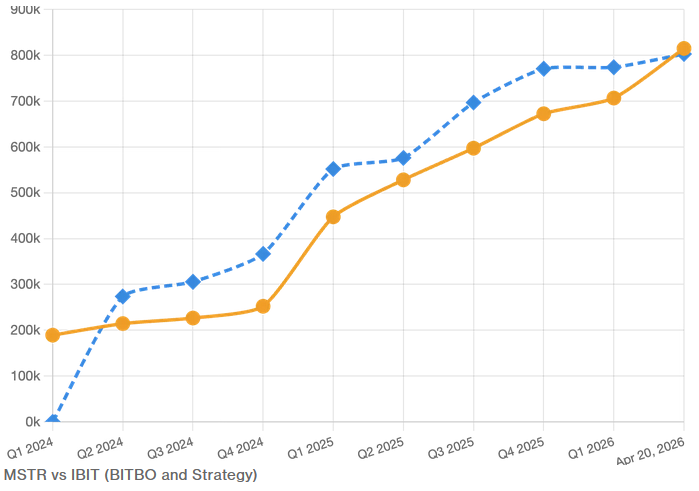
At the time of writing, Strategy holds approximately 815,061 BTC, while BlackRock’s IBIT remains slightly behind with around 802,523 BTC, according to Arkham.
This reversal follows an aggressive series of purchases, including the acquisition of over 34,000 BTC in just one week—one of the largest transactions in the company’s history. The development marks a new stage in the clash between two different philosophies for crypto asset exposure: direct corporate accumulation via stock sales and capital markets versus regulated ETF access for mainstream investors.
The Financial Mechanism Behind the Expansion
The key to Strategy’s recent surge is not just the size of the purchases, but the method of financing. The company utilizes an innovative tool known as STRC (perpetual preferred equity), which has become a primary source of liquidity. The majority of the latest transaction was funded through this instrument, allowing Strategy to raise funds without directly diluting common shareholders.
An additional element of the strategy is the decision to provide more frequent dividend payments to investors in these preferred shares. This approach aims to create a steady stream of capital that can be redirected toward new Bitcoin purchases. In this way, the company is building a self-sustaining mechanism where access to capital depends on confidence in the future appreciation of the digital asset.
ETF vs. Corporate Balance Sheet: Differing Dynamics
While Strategy accelerates its pace, BlackRock’s ETF is showing signs of slowing down. In recent weeks, IBIT experienced a period of net outflows—a rare occurrence since its launch. This happened against a backdrop of broader market uncertainty and a temporary decline in risk appetite.
The difference between the two approaches is becoming clearer. An ETF product follows market demand; when investors withdraw funds, exposure decreases. With Strategy, however, decisions are centralized and strategic. The company can increase its position even during unfavorable market conditions, provided it has access to financing.
This asymmetry explains how Strategy managed to close the gap after IBIT took the lead in 2024, reclaiming the top spot in just a few days of intensive buying.
Risks, Pressure, and the Broader Context
Despite its leadership, Strategy’s position is not without risk. Bitcoin’s volatility during the first quarter of 2026 led to significant unrealized losses on the company’s balance sheet. This raises questions about the sustainability of its model during a prolonged downturn or sideways price movement.
Another critical factor is the “premium” of Strategy’s stock relative to the value of its BTC holdings. If this metric shrinks too much, the company’s ability to raise new capital through share issuances could be restricted, potentially halting the growth cycle.
On a macro level, geopolitical tensions and elevated energy prices create a mixed environment for the crypto market. Bitcoin is moving within a relatively narrow range, meaning Strategy’s recent purchases were made near current market levels, increasing sensitivity to short-term fluctuations.
Nevertheless, the company now controls approximately 4% of the maximum Bitcoin supply—a concentration that highlights the growing role of institutional players. If the current pace continues, Strategy could approach the psychological milestone of 1 million BTC by the end of the year.
The battle between corporate balance sheets and ETF structures is evolving into more than just a competition for quantity; it is a test of which model will dominate the next phase of institutional Bitcoin adoption.


 Commentaries



Fill in necessary fields and publish