


Crypto Market Cap Slips to $2.54T as Fear Sentiment Persists
We may earn commissions from affiliate links or include sponsored content, clearly labeled as such. These partnerships do not influence our editorial independence or the accuracy of our reporting. By continuing to use the site you agree to our terms and conditions and privacy policy.


The total crypto market cap dropped to $2.54 trillion as Bitcoin falls to $75,600. Institutional risk-off sentiment drives ETF outflows via BlackRock.
The total cryptocurrency market capitalization has retreated to approximately $2.54 trillion, while the Crypto Fear and Greed Index remains stalled in “fear” territory at a value of 37, signaling sustained investor caution.
At the time of writing, Bitcoin is trading near $75,600, marking a decline of nearly 1.5% over the past 24 hours. Ethereum remains under pressure around the $2,075 level. XRP, Solana, and BNB also posted moderate losses, while Dogecoin and most major altcoins struggled to find a clear recovery momentum.
Despite negative ETF flows, the market shows no signs of a panic sell-off. Trading volumes remain relatively stable, and a segment of investors continues to view these corrections as accumulation opportunities. This suggests the current movement is perceived as a short-term risk rebalancing rather than a structural collapse in institutional interest for digital assets.
Institutional Capital Temporarily Reduces Risk
Primary market pressure continues to stem from the macroeconomic environment. Following recent U.S. economic data, investors have gradually scaled back expectations for swift and aggressive interest rate cuts by the Federal Reserve.
Geopolitical tensions in the Middle East provide an additional headwind. The ongoing conflict involving the U.S. and Iran, coupled with uncertainty surrounding the Strait of Hormuz, keeps oil prices high and intensifies global inflationary concerns. This combination of high interest rates, geopolitical risk, and tightening liquidity has forced some institutional investors to temporarily reduce their exposure to crypto ETF products.
Market focus remains sharply on BlackRock and its spot BTC ETF, IBIT. Data from FarSide Investors reveals that BlackRock’s fund generated the largest portion of recent outflows. This is a significant signal for the market, as BlackRock served as the primary engine for institutional Bitcoin accumulation throughout much of 2025 and early 2026.
Ethereum also remains under pressure, although some analysts expect stronger institutional demand in the second half of the year. For now, ETH ETF flows remain weak, with investors appearing cautious toward higher-risk Layer 1 networks and DeFi assets.
Hyperliquid Stands Out Amid Weak Altcoin Market
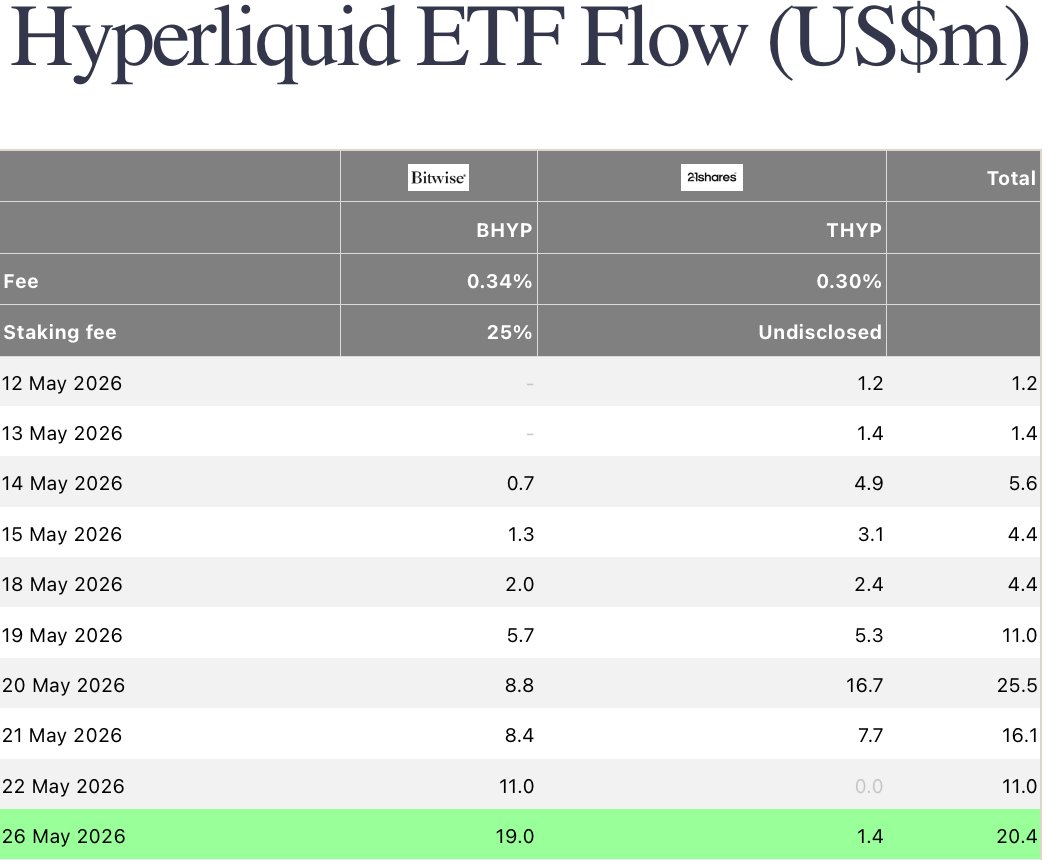
An interesting development has emerged from Hyperliquid. ETF products linked to the platform continue to attract steady inflows, with over $20 million in new capital recorded on May 26 alone. This demonstrates that institutional investors are selectively seeking exposure to next-generation DeFi infrastructure and perpetual trading platforms, even against a backdrop of broader market weakness.
Solana ETF products saw no new flows for the day, which may indicate a temporary “wait-and-see” approach following robust activity earlier in the month.
The “Altcoin Season” indicator remains low at approximately 35/100, confirming that the market has not yet entered a classic altseason. Bitcoin continues to dominate the market structure, and investors remain highly selective when allocating capital to smaller tokens.
Despite short-term pressure, many analysts view the current movement as a healthy cooling-off phase following the exceptionally strong rally in the first quarter of 2026. They maintain that institutional interest in digital assets remains structurally resilient, supported by the continued entry of public companies, ETF products, and traditional financial institutions into the sector.
In this climate of uncertainty and volatility, choosing a secure crypto wallet is increasingly vital for investors. For a detailed analysis of asset protection solutions, see the article “The Best Crypto Wallets for 2026,” which evaluates options based on security, convenience, and functionality.


 Commentaries







Fill in necessary fields and publish