


Crypto Fear and Greed Index Hits 20 Amid Bitcoin Price Drop
We may earn commissions from affiliate links or include sponsored content, clearly labeled as such. These partnerships do not influence our editorial independence or the accuracy of our reporting. By continuing to use the site you agree to our terms and conditions and privacy policy.


Market data shows the Crypto Fear and Greed Index has dropped to 20, signaling extreme fear as Bitcoin falls nearly 4% in 24 hours.
Data indicates that the Crypto Fear and Greed Index has dropped to a level of 20, signaling a state of “extreme fear”—a level typically observed during periods of intense sell-offs and heightened volatility.
Bitcoin (BTC) is trading around $68,900 following a decline of nearly 4% over the last 24 hours. Despite the short-term pressure, the price remains above the key psychological level of $65,000, which many analysts identify as a significant support zone.
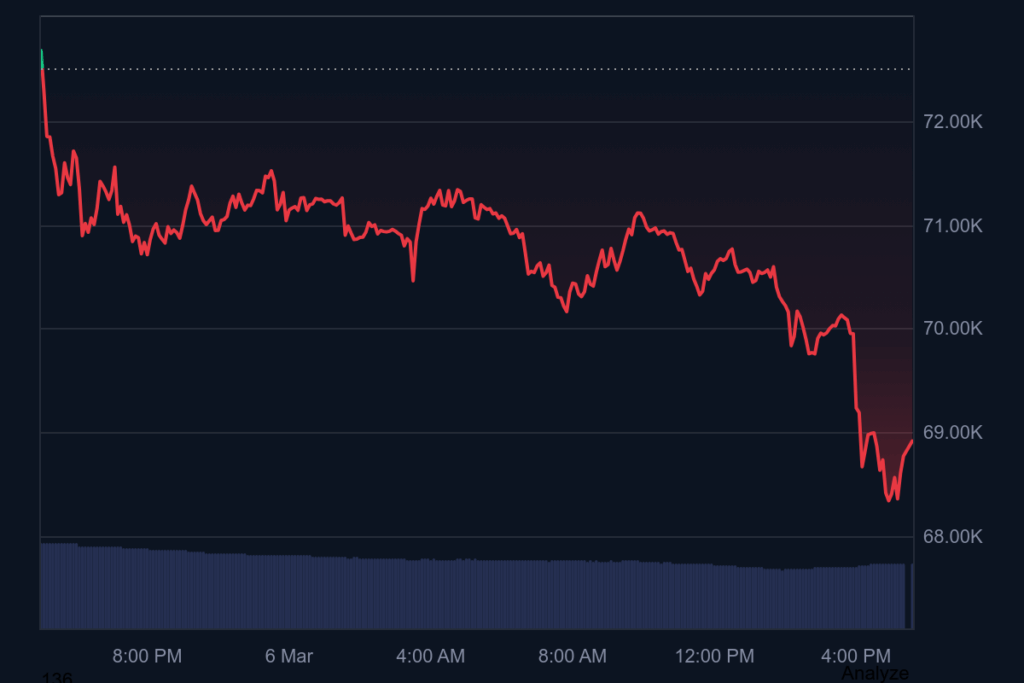
Trading volume for Bitcoin remains high, exceeding $47 billion in the past day. This suggests that investors are actively readjusting their positions amid growing uncertainty.
Ethereum, the second-largest cryptocurrency, is also under pressure, trading around $1,995 and marking a decline of over 4% in the last 24 hours. Negative dynamics are visible across other leading digital assets as well. BNB has decreased to approximately $628, while Solana (SOL) is trading near $85 after a nearly 5% drop. XRP remains around $1.36, also recording a decline over the past day.
Indicators Signal Strong Market Fear
Market indicators further suggest that the crypto sector is experiencing a period of weak momentum. The Altcoin Season Index stands at approximately 36 out of a possible 100 points, meaning the market remains dominated by Bitcoin and that altcoins have not yet entered a phase of stronger growth. The average Relative Strength Index (RSI) for cryptocurrencies is around 44, which is close to the neutral zone but signals downward pressure on prices.
According to market analysts, the current downturn is linked not only to internal crypto market dynamics but also to the broader macroeconomic environment. Global financial markets are influenced by rising geopolitical tensions and strong volatility in commodities, prompting investors to temporarily reduce exposure to riskier assets.
What Could Follow for Cryptocurrencies
During such periods, cryptocurrencies often move in sync with tech stocks and other risk markets, reacting sensitively to changes in liquidity and investor expectations. Growing uncertainty regarding the global economy and future Fed policy also weighs on market participant behavior.
Despite the short-term pressure, some analysts note that such periods of extreme fear have historically often served as a prerequisite for subsequent recoveries. When market sentiment reaches extremely negative levels, it can indicate that a significant portion of the selling has already been realized, leading investors to gradually look for opportunities to accumulate new positions.
In the short term, the direction of the crypto market will likely be determined by global developments, U.S. macroeconomic data, and the behavior of institutional investors, who have played an increasingly vital role in liquidity and the price movements of top cryptocurrencies in recent years.


 Commentaries










Fill in necessary fields and publish