






Bitcoin ETFs Face $733 Million Exodus Amid Geopolitical Tension
We may earn commissions from affiliate links or include sponsored content, clearly labeled as such. These partnerships do not influence our editorial independence or the accuracy of our reporting. By continuing to use the site you agree to our terms and conditions and privacy policy.


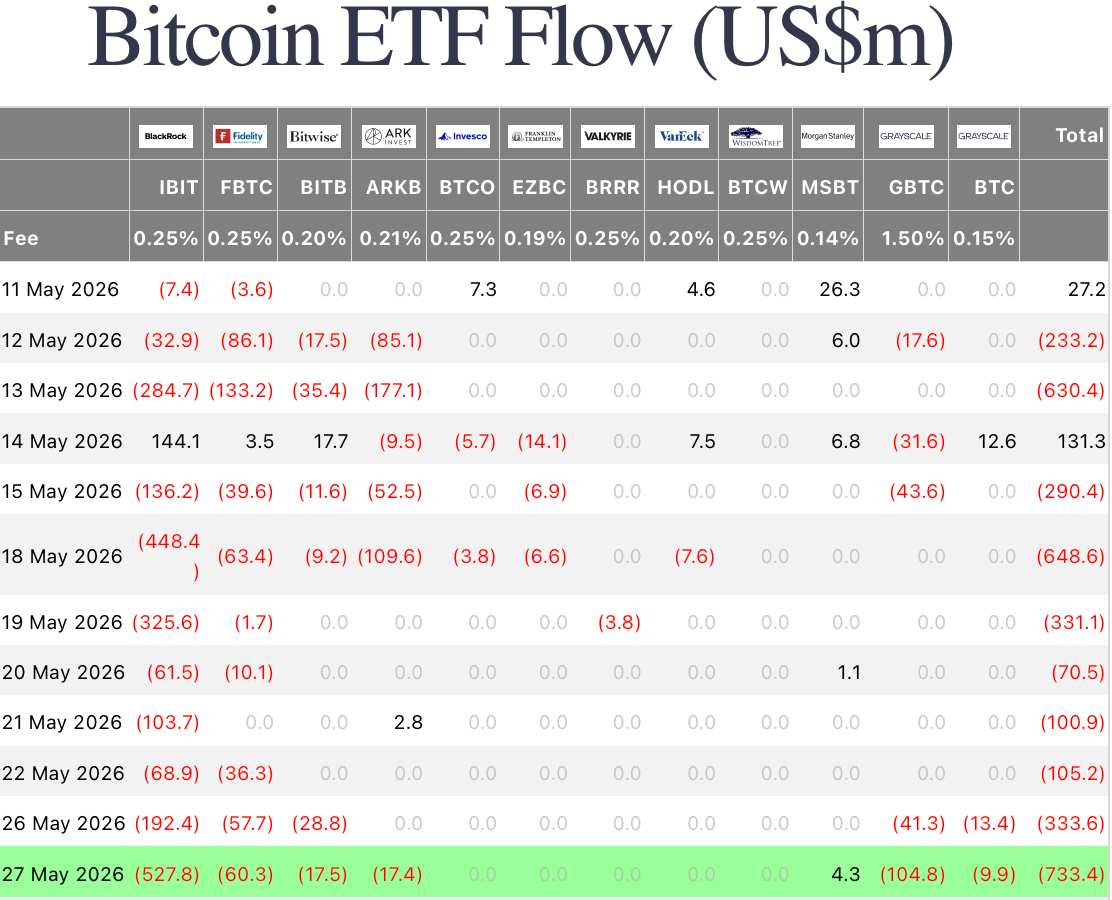
Bitcoin ETFs saw over $733M in outflows on May 27 as US strikes on Iranian targets sparked a risk-off move. BlackRock's IBIT led the decline with $527M.
Data from FarSide Investors for May 27 reveals that investors withdrew over $733 million from Bitcoin ETF products in a single day, while Ethereum funds recorded additional net outflows exceeding $67 million.
The heaviest impact was felt across Bitcoin funds, where nearly all major issuers reported aggressive outflows. BlackRock’s IBIT fund lost $527.8 million in just one session, while Fidelity’s FBTC registered new outflows of $60.3 million. Further pressure came from Ark Invest’s ARKB, which lost $17.4 million, and Grayscale’s GBTC with $104.8 million in fresh withdrawals.
The market reacted sharply following news of new U.S. strikes on Iranian targets in the Bandar Abbas and Strait of Hormuz region—an area responsible for nearly one-fifth of global oil and liquefied natural gas supplies.
This mix of geopolitical risk, surging energy prices, and declining stock markets triggered a mass flight from risk assets, including cryptocurrencies.
Bitcoin dropped below key technical levels, while Ethereum continued to lag behind the broader market. Spot ETH ETFs saw net outflows of $67.1 million, with the largest withdrawal recorded by BlackRock’s ETHA at $65.1 million. Fidelity’s FETH also remained under pressure with $2 million in new outflows.
Institutional Appetite Weakens Sharply
The data suggests that institutional investors are temporarily reducing their exposure to crypto assets while assessing the risk of deeper regional escalation in the Middle East. Market participants are beginning to price in a scenario of prolonged high oil prices, which could keep inflation elevated and complicate central bank plans for interest rate cuts.
This shift immediately impacted more volatile segments of the crypto market. Solana ETF products remained largely stagnant, recording minimal net inflows of just $0.6 million. Hyperliquid ETFs saw modest receipts of $3.4 million, which was insufficient to offset the massive sell-offs seen in Bitcoin.
The XRP ETF market also showed signs of stalling. Coinglass data for May 27 shows zero net flows across major XRP spot funds, including products from Canary, Franklin, and Bitwise. This indicates that investors are temporarily avoiding adding new risk even to assets that were previously preferred alternative crypto bets.
Market Seeks Liquidity and Safety
Current dynamics increasingly resemble a classic “risk-off” regime, where institutional capital moves toward cash, government bonds, and dollar-denominated assets at the expense of high-risk positions. The Crypto Fear and Greed Index remained deep in the “Fear” zone as liquidations in the derivatives markets continued to climb.
Despite these aggressive outflows, analysts note that the ETF market remains a vital structural driver for the crypto industry in the long term. However, traders believe the short-term direction will depend almost entirely on the development of the conflict involving Iran, oil price movements, and the reaction of global equity markets.
For now, institutional capital is clearly opting for caution.


 Commentaries










Fill in necessary fields and publish