


Bhutan Offloads 70% of Bitcoin Reserves Amid Market Shift
We may earn commissions from affiliate links or include sponsored content, clearly labeled as such. These partnerships do not influence our editorial independence or the accuracy of our reporting. By continuing to use the site you agree to our terms and conditions and privacy policy.


Bhutan's government sold 70% of its BTC reserves as Bitcoin whales reduce exchange inflows and long-term holders increase accumulation by $49 billion.
The government of Bhutan has sold approximately 70% of its Bitcoin reserves over the last 18 months. This move coincides with a broader transformation in market structure, where short-term investors are losing ground to long-term holders.
According to data shared on X, the country reduced its holdings from roughly 13,000 BTC in October 2024 to under 4,000 BTC currently. Over the past year alone, the transferred assets are valued at more than $215 million, highlighting the scale of the sell-off. While motives have not been officially confirmed, such actions are often linked to liquidity needs or the strategic rebalancing of state assets.
🚨JUST IN: BHUTAN HAS SOLD 70% OF ITS BITCOIN HOLDINGS
— BSCN (@BSCNews) April 11, 2026
According to Wu Blockchain, the nation of Bhutan has sold some 70% of its $BTC holdings in the space of the last 18 months.
In October 2024, it held around 13,000 $BTC but now holds less than 4,000 $BTC.
In the last year… pic.twitter.com/Nu2Qu7CE8T
Market Rotation: From “Weak” to “Strong” Hands
This development comes amid a distinct shift in investor behavior across the crypto market. Data from CryptoQuant reveals that “whales”—large Bitcoin holders—are reducing their activity regarding exchange inflows. Specifically, the 30-day volume of inflows to Binance has dropped to approximately $2.96 billion, marking the first dip below the $3 billion threshold since June 2025.
This decline is typically interpreted as a reduced desire to sell among major players, as fewer funds move to exchanges where they could be liquidated. In parallel, long-term holders (LTH) are increasing their exposure, with the 30-day change in realized capitalization reaching approximately $49 billion—a level observed for only the second time in a few weeks.
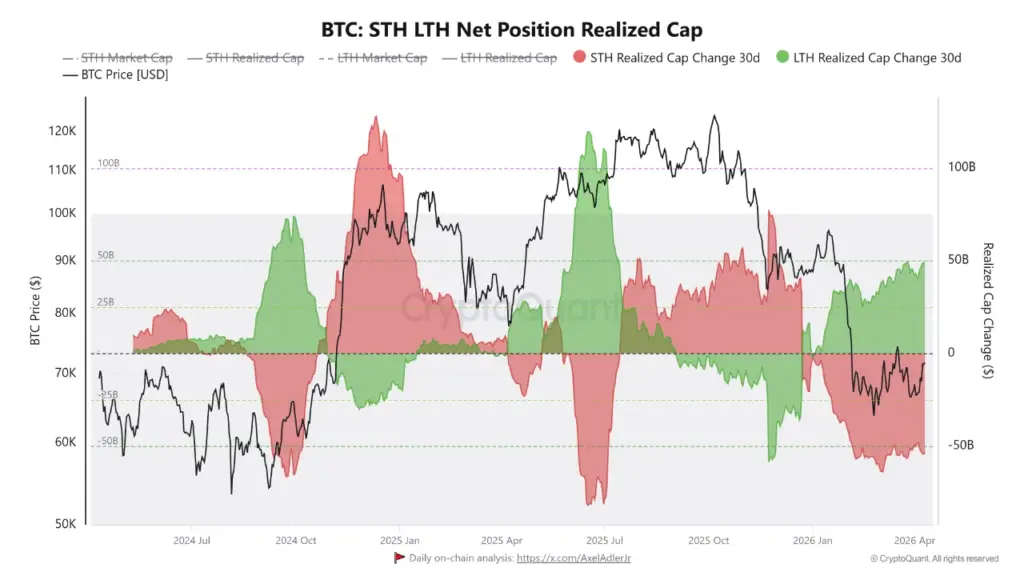
The contrast with short-term holders (STH) remains sharp. Their realized capital continues to shrink, with the 30-day metric falling to around -$54 billion. This suggests that more speculative participants are still capitulating or realizing losses, while more patient investors accumulate positions.
Combined, these trends outline a classic redistribution cycle—a process where assets move from weaker to more resilient hands. Historically, such dynamics often precede periods of a more stable upward trend, even if accompanied by short-term volatility.
Sales by state entities like Bhutan add an extra layer to this picture, showing that even institutional players can act counter-cyclically to broader market trends. Nevertheless, the intensified accumulation by long-term investors suggests that fundamental demand remains robust, even in the face of sell-offs and uncertainty.


 Commentaries







Fill in necessary fields and publish