


Binance Liquid Backbone: BTC Market Depth Hits $30 Million
We may earn commissions from affiliate links or include sponsored content, clearly labeled as such. These partnerships do not influence our editorial independence or the accuracy of our reporting. By continuing to use the site you agree to our terms and conditions and privacy policy.


Binance maintains its lead as the primary liquidity source for Bitcoin, with BTC market depth reaching $30M compared to $16-20M on Coinbase.
Data from mid-April reveals that the exchange continues to offer the greatest market order depth, solidifying its position as a key source of liquidity for global crypto markets.
In an environment of reduced volumes—global trading has fallen by approximately 23% since the beginning of the year—Binance has not only maintained its position but increased its share. This highlights a structural trend: during periods of high volatility and uncertainty, traders gravitate toward platforms with the deepest liquidity to minimize settlement costs.
Liquidity as a Key Factor for Institutional Participants
The critical metric in this case is the so-called “1% market depth”—the volume of buy and sell orders within 1% of the current price. For Bitcoin, this value reaches approximately $30 million on Binance, compared to about $16–$20 million on Coinbase, according to Kaiko data shared by Coin Bureau.
https://twitter.com/coinbureau/status/2045608087567081479/photo/1
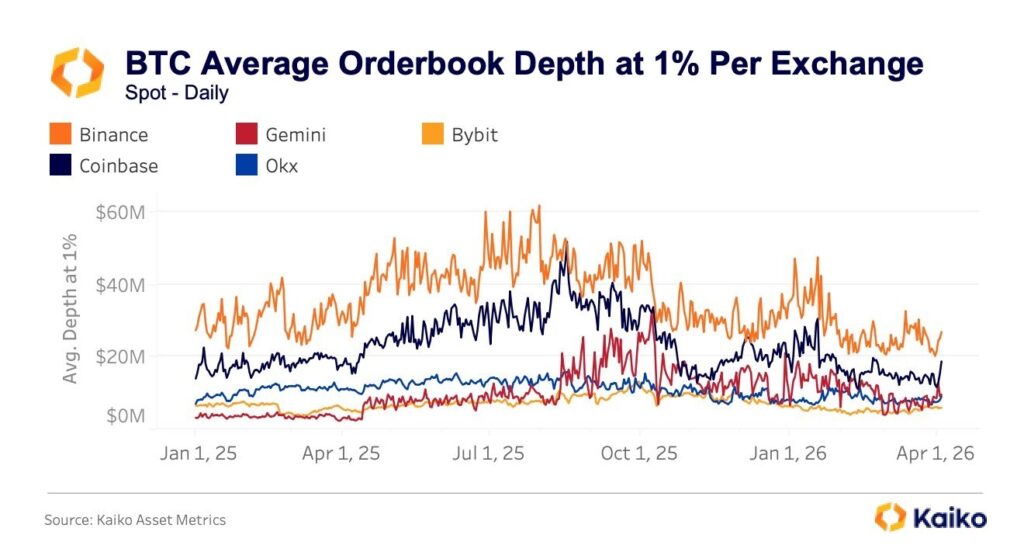
This discrepancy primarily matters for large market participants, often referred to as whales. For institutional investors and traders with large orders, greater depth means a lower risk of price slippage during trade execution.
As a result, Binance remains virtually the only platform capable of absorbing large trades in real-time without a significant impact on the price.
Consolidation of Market Share
As of April, Binance’s share of global spot trading reached 35.4%, up from approximately 33% in February. By comparison, Coinbase maintains a relatively stable share in the 7% to 9% range.
This dynamic suggests that liquidity creates a self-sustaining effect. The more participants use a specific platform, the more liquidity concentrates there—a process that makes competition increasingly difficult.
Dominance in Derivatives
The lead held by Binance is even more pronounced in the derivatives markets. Data reveals that BTC futures depth reaches approximately $284 million, which is about 1.8 times more than its closest competitor and nearly four times the levels of some other leading platforms.
This reinforces the exchange’s role as a primary hub for high-frequency trading and algorithmic strategies that require both speed and deep liquidity.
Liquidity vs. Regulation
Despite Binance’s dominance, Coinbase continues to attract institutional clients, particularly in the US, thanks to its regulatory framework and integration with the traditional financial system. The platform offers a more secure environment for asset custody and broader access to US dollar payments.
At the same time, Binance’s lower fees—often at or below 0.1%—and faster compliance system make it the preferred choice for active trading.
Market Logic: Liquidity Attracts Liquidity
The current market structure emphasizes a fundamental principle in the crypto industry: liquidity is self-reinforcing. Large participants seek platforms with minimal slippage, which concentrates even more volume and deepens market liquidity.
For retail investors, this difference remains relatively minor. However, for participants executing trades exceeding $1 million, the choice of platform can have a direct impact on the final execution price.
In this context, despite regulatory pressure and growing competition, Binance continues to function as the “liquid backbone” of the global Bitcoin market.


 Commentaries







Fill in necessary fields and publish