






Binance Dominates Crypto Derivatives as Volume Hits $18.6 Trillion
We may earn commissions from affiliate links or include sponsored content, clearly labeled as such. These partnerships do not influence our editorial independence or the accuracy of our reporting. By continuing to use the site you agree to our terms and conditions and privacy policy.

Binance captures one-third of the market as crypto derivatives volume reaches $18.6 trillion, nearly 10x the spot market, according to Coinglass data.
Data from Coinglass for the first quarter of 2026 reveals that total derivatives volume reached $18.6 trillion—approximately 9.6 times higher than the spot market, which remains at around $1.9 trillion.
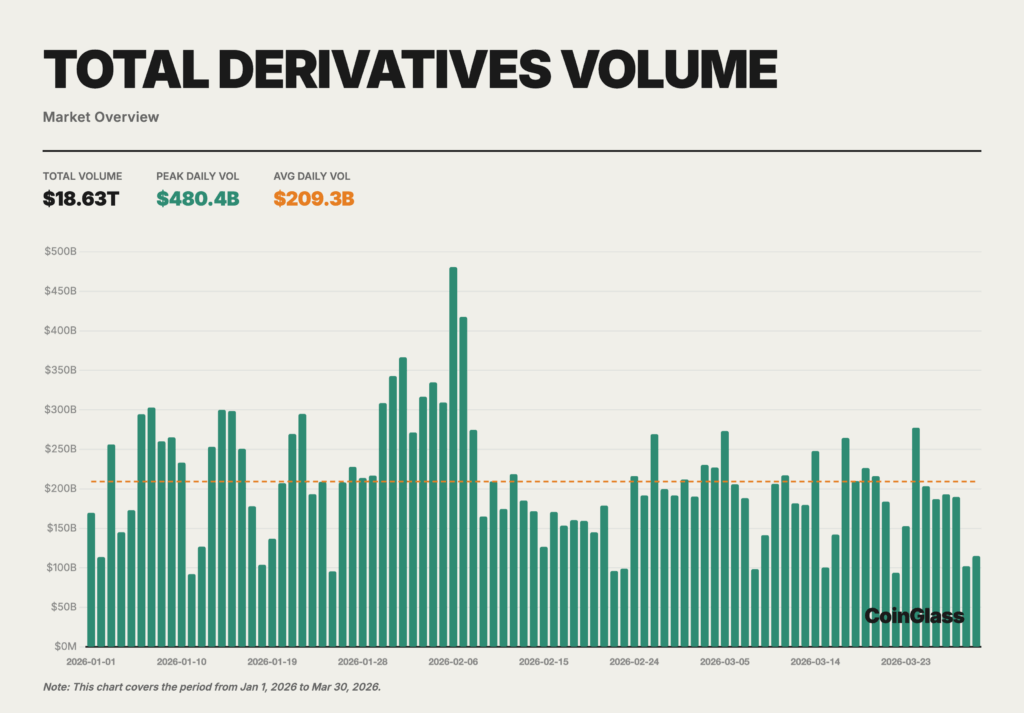
This transformation highlights the growing role of leverage, hedging, and speculative strategies that increasingly drive price discovery. Consequently, the platforms dominating derivatives trading are becoming pivotal players for the entire ecosystem.
Binance Strengthens Its Leadership
Against this backdrop, Binance continues to widen its lead. The exchange processed approximately $4.9 trillion in derivatives volume during Q1, representing about one-third of the activity among leading platforms.
Average daily open interest on Binance reached nearly $24 billion—roughly 30% of the market—underscoring its deep liquidity and role as a primary hub for institutional and professional traders’ positioning.
Competitors such as OKX and Bybit remain at a significant distance, although they maintain a solid market share.
‘TradFi-perps’ Expand the Market
One of the most significant new trends is the explosive growth of so-called “TradFi-perps”—derivatives on traditional assets like gold, silver, and oil, offered in a crypto format.
Volume for these hybrid instruments grew by over 500% in the first quarter, demonstrating an expansion of interest beyond pure crypto assets. While platforms like BitMEX and MEXC are positioning themselves aggressively in this segment, Binance has managed to quickly capture a substantial share.
This move not only diversifies the exchange’s revenue but also positions it as a bridge between the crypto and traditional financial markets.
The Competitive Shift
Despite Binance’s dominance, the competitive environment is beginning to shift. The new hierarchy among derivatives exchanges includes Gate.io and Bitget, which are establishing themselves as significant players behind the leading trio.
In parallel, decentralized platforms are starting to gain momentum. Protocols like Hyperliquid are showing signs of a breakthrough, which could challenge the dominance of centralized exchanges in the longer term.
Recent market movements reveal how strongly derivatives influence prices. in early April, high volume was supported by a “leveraged washout”—mass liquidations of high-leverage positions during a period of geopolitical uncertainty.
Subsequently, as tensions in the Middle East eased, the market recovered, and Bitcoin returned to levels around $74,000, supported by new long positions.
This dynamics emphasizes the role of derivatives not just as a trading tool, but as a mechanism that drives market movements.
Outlook: The ‘Central Bank’ of Crypto Liquidity
With over 75% of centralized exchange activity concentrated in derivatives, Binance’s role extends beyond traditional exchange functions. The platform is increasingly viewed as a key mechanism for price discovery and liquidity in the global crypto market.
In the short term, its lead appears stable, but new challenges are emerging on the horizon—from regulatory pressure to the rise of decentralized alternatives.
For now, however, the conclusion is clear: Binance is not just leading the market; it is shaping its structure.


 Commentaries










Fill in necessary fields and publish