


America Panics: “AI Bubble” Searches Explode 950% as Fear Goes Mainstream
We may earn commissions from affiliate links or include sponsored content, clearly labeled as such. These partnerships do not influence our editorial independence or the accuracy of our reporting. By continuing to use the site you agree to our terms and conditions and privacy policy.


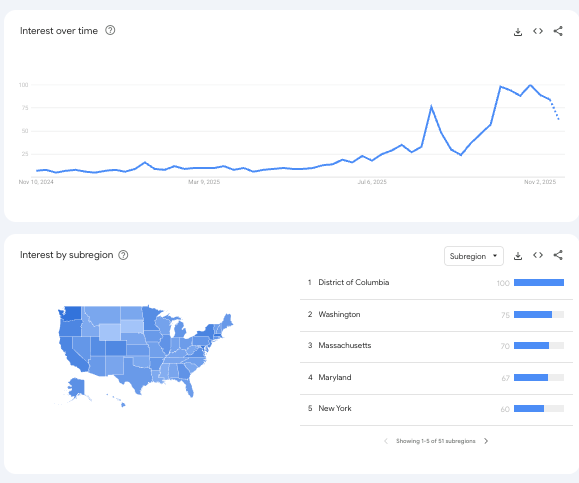
Public concern about a potential artificial intelligence bubble is exploding across the United States, with Google search activity for the phrase “AI bubble” soaring 950% compared to last year.
Interest has climbed dramatically, hitting peak levels in early November before settling just below all-time highs, according to Google Trends data.
The sharpest increases are coming from the country’s political and technology hubs. Washington D.C. tops the list, followed by states with deep ties to the tech sector and academia – Washington, Massachusetts, Maryland, and New York. The geographic breakdown suggests that policymakers, engineers, investors, and researchers are increasingly worried that the AI boom may be overheating.
Echoes of the Dot-Com Era
The spike in search activity mirrors a broader wave of warnings from economists and market strategists. Many are drawing comparisons to the late 1990s, when soaring internet valuations vastly outpaced actual business performance. AI startups today are being valued at extraordinary multiples despite producing modest or experimental revenues, while major corporations are spending aggressively on data centers and high-performance computing with no confirmed path to quick returns.
Several studies have noted that most enterprises experimenting with generative AI are not yet seeing measurable productivity improvements – a disconnect that resembles the optimism-reality gap from the Dot-com run-up.
Why This AI Cycle Is Different – and Why It Still Might Be Risky
Despite the parallels, analysts note key differences that make the current boom more structurally grounded. Unlike the Dot-com bubble – largely driven by untested ideas and companies burning cash – the AI surge is anchored by profitable, well-capitalized giants such as Nvidia and Palantir. AI is already embedded in cloud tools, search engines, enterprise systems, and consumer tech, meaning its value is not purely hypothetical.
Heavy investment in chips, servers, and infrastructure also reflects real and rapidly growing demand. The physical backbone of AI is tangible in a way that early internet speculation was not.
But these strengths haven’t settled concerns. Economists caution that even transformative technologies can experience painful corrections if investment outpaces adoption. The fear is that companies may be overbuilding computational capacity and overestimating how quickly businesses can monetize advanced AI models – setting the stage for a sharp pullback if expectations fail to materialize.


 Commentaries






Fill in necessary fields and publish