






This Is How a Billionaire’s Stock Portfolio Looks in Today’s Volatile Market
We may earn commissions from affiliate links or include sponsored content, clearly labeled as such. These partnerships do not influence our editorial independence or the accuracy of our reporting. By continuing to use the site you agree to our terms and conditions and privacy policy.


Ray Dalio’s latest 13F has landed, and Bridgewater Associates looks nothing like it did a quarter ago.
The world’s largest hedge fund has made some of its sharpest cuts in years, dumping huge chunks of the same mega-cap tech names that powered the market’s rally – and redirecting capital into areas Dalio has been hinting at for months.
The most eye-catching moves came from a deep retreat from Silicon Valley’s biggest players. Bridgewater trimmed Meta to nearly half its previous size and executed an even harsher reduction on Nvidia, slashing the position by more than 65%.
Alphabet and Microsoft – longtime portfolio staples – were reduced by roughly a third to half. Even positions in Uber, PayPal, and major U.S. banks were lightened, suggesting Dalio is pulling capital away from the corners of the market most exposed to tightening financial conditions.
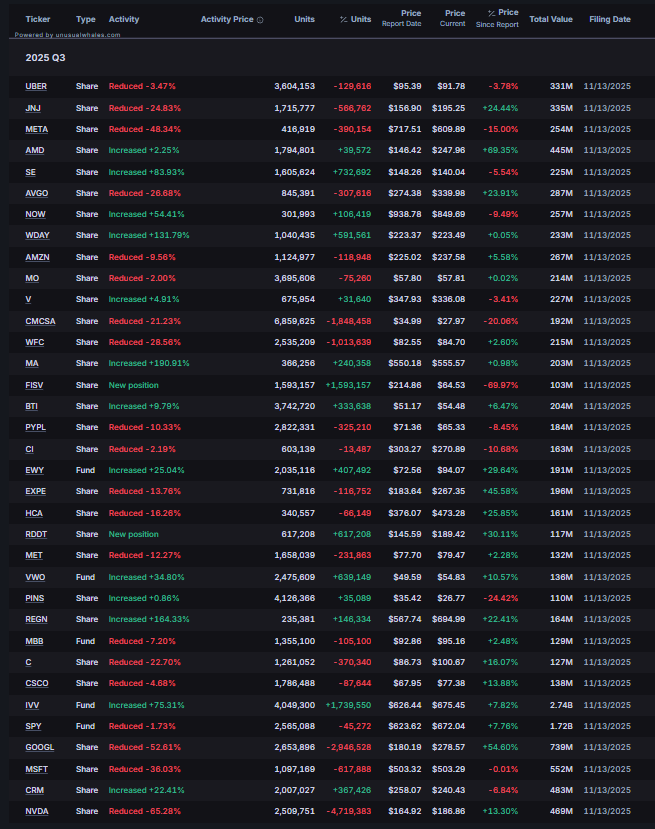
Yet the filing doesn’t show a hedge fund running from risk – only shifting where it wants to take it. Bridgewater simultaneously ramped up exposure to a set of high-conviction names: Sea Limited soared more than 80%, Mastercard nearly tripled, Workday and Regeneron saw triple-digit percentage boosts, and AMD edged higher as well. The addition of Fiserv and Reddit introduces a new mix of digital payments and social-ad-driven growth.

Bridgewater also broadened its global footprint. Positions tied to emerging markets – including South Korea’s EWY and the broad VWO ETF – were increased significantly. Even the firm’s S&P 500 tracker was expanded, a reminder that Dalio is not exiting U.S. exposure but redistributing it with more caution.
The shape of the portfolio aligns with the warnings Dalio has issued throughout the year. He has repeatedly stressed that the U.S. is entering a period he calls a “danger zone” – a convergence of heavy debt burdens, political strain, and valuations that leave little room for error. In an environment where he sees recession risk rising and geopolitical tensions adding new layers of uncertainty, Bridgewater’s Q3 moves look like a preparation play: reduce the assets most vulnerable to a sharp repricing, and lean into businesses – from biotech to software to emerging-market growth — that may hold up better if the cycle turns.


 Commentaries










Fill in necessary fields and publish