






Coinbase Stock Struggles Amid Crypto Volatility and Insider Selling
We may earn commissions from affiliate links or include sponsored content, clearly labeled as such. These partnerships do not influence our editorial independence or the accuracy of our reporting. By continuing to use the site you agree to our terms and conditions and privacy policy.

The past several weeks have underscored how closely the fortunes of cryptocurrency markets and related equities remain linked.
Volatility in Bitcoin and Ethereum has rippled across exchanges, lenders, and publicly traded firms, leaving investors searching for reliable signals of where sentiment is headed. Few companies illustrate this relationship more clearly than Coinbase Global (NASDAQ: COIN). As the largest U.S. crypto exchange, its stock often mirrors the broader market’s boom-and-bust cycles, rising with periods of optimism and sliding when liquidity dries up.
September has been no exception. A combination of sharp liquidations, shifting regulation, and mixed institutional inflows has kept traders on edge. Coinbase’s stock has reflected this uncertainty, swinging between highs and lows while management pushes to diversify beyond trading fees into derivatives, custody, and tokenization. Against this backdrop, evaluating Coinbase’s performance, insider activity, and financial results offers perspective on how prepared it is for Q4 2025.
At the same time, some investors are widening their scope beyond the large-cap crypto names to discover opportunities in emerging equity plays tied to blockchain growth. HYLQ Strategy Corp has steadily gained recognition for its focus on HyperLiquid’s HYPE token, offering a listed alternative for those seeking DeFi exposure with public-market safeguards. For investors looking at diversified approaches, you can always buy and check HYLQ price via Interactive Brokers, making access simple while still keeping the regulatory protections of a stock exchange listing.
Market Turmoil Hits Trading Volumes
Coinbase Global (NASDAQ: COIN) closed September 26 at $312.59, down nearly 6% from the previous week as crypto market turbulence weighed heavily on trading-based revenues. The stock has been moving in lockstep with digital asset prices, highlighting its sensitivity to the ebb and flow of Bitcoin and Ethereum. Over the past month, COIN has ranged between $306 and $332, a far cry from its mid-summer highs above $380.
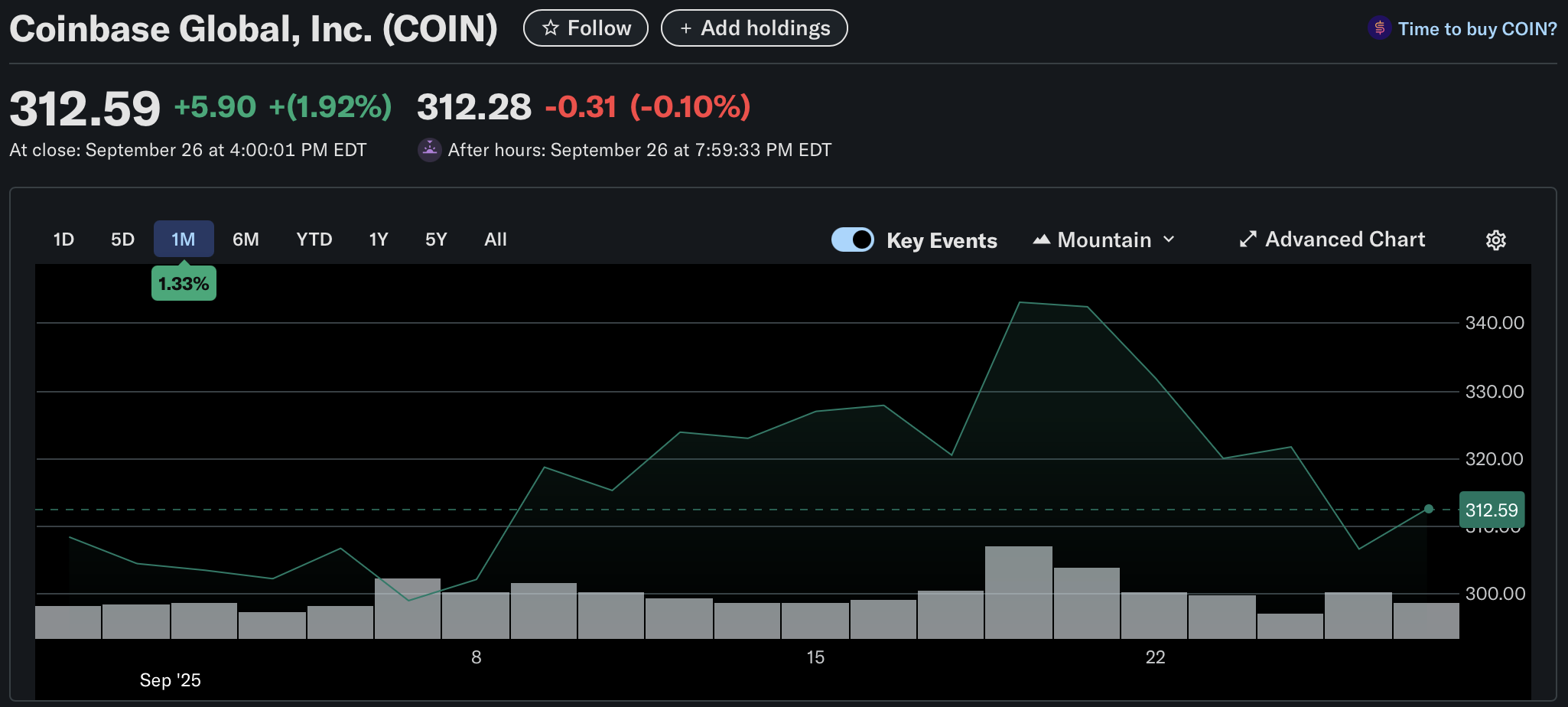
The late-September pullback in Bitcoin and Ethereum triggered a cascade of liquidations, sparking another round of losses across crypto equities. Analysts at CoinCentral noted that Coinbase’s stock “had a rough week, falling 6% to $312.59 as the broader cryptocurrency market experienced another sell-off.” Historically, Coinbase’s fortunes have mirrored crypto cycles: when prices fall, transaction volumes shrink, dragging revenue lower. With Bitcoin trading well below its July peak near $123,000, investors remain cautious about near-term activity levels.
Despite the weakness, COIN sits close to its 50-day moving average around $328, signaling neutral momentum. Technical watchers are waiting to see whether the stock can hold this zone or break lower as volatility continues.
Financial Results Raise Questions
Coinbase’s Q2 earnings, released in late July, underscored the challenges of a trading-dependent business model. Revenue totaled $1.51 billion, down 26% quarter-on-quarter. Transaction revenue dropped 39% to $764 million, reflecting slower retail and institutional activity. Subscription and services revenue, by contrast, rose 9% year-over-year to $656 million, supported by stablecoin custody and staking fees. Still, the bottom line disappointed: earnings per share came in at just $0.12 versus Wall Street’s $1.19 estimate.
Operating expenses also jumped 15% to $1.5 billion, eroding profitability. Adjusted net income of $33 million was a steep decline from $294 million a year earlier. Management guided Q3 subscription revenue to $665–$745 million, a modest sequential gain, but admitted overall results may “fall short” of expectations. Compass Point analysts echoed that caution, flagging weak seasonality and retail engagement as persistent headwinds.
Expanding Beyond Trading
Facing uneven revenues, Coinbase has pushed hard to diversify. Its $2.9 billion acquisition of Deribit, a crypto options exchange, gives the company international reach and exposure to the fast-growing derivatives sector. In June, it launched a U.S.-based crypto futures exchange, and it continues to pursue SEC clearance for tokenized stock trading. Stablecoin and staking services have also gained traction, with stablecoin fees rising 12% last quarter.
A recent development underscores Coinbase’s willingness to innovate. On September 25, Coinbase Credit extended a $20 million loan to Semler Scientific, secured by Bitcoin collateral. The agreement highlights how digital assets are increasingly being used in traditional financial arrangements, expanding Coinbase’s role beyond exchange trading into lending and custody.
Politics, Regulation, and Institutional Flows
The policy backdrop remains a wild card. Washington has shown a more favorable stance toward digital assets, with President Trump voicing support and Congress passing stablecoin legislation in July. Meanwhile, institutional adoption continues: spot Ethereum ETFs attracted nearly $4 billion of inflows in August. Yet September’s $151 billion drop in crypto market capitalization reminded investors how fragile sentiment can be. Analysts warn this volatility will continue to ripple through crypto-linked equities like Coinbase.
Insider Selling Raises Eyebrows
Adding to investor unease, Coinbase insiders have been steadily reducing their holdings. Over the past six months, executives and directors executed 187 open-market sales, with no insider purchases reported. CEO Brian Armstrong alone sold 1.3 million shares worth about $465 million across 81 trades. Chief Legal Officer Paul Grewal, co-founder Frederick Ehrsam, and other senior leaders also trimmed positions.
While insider sales are not unusual at tech firms, the scale has raised eyebrows. Investors are now weighing whether leadership’s moves signal a lack of confidence or simply profit-taking after strong gains earlier this year.
Such heavy insider activity often signals waning confidence or reallocation of capital. For those watching the crypto-equity space, this has sparked interest in alternatives, equities that offer exposure to blockchain growth without repeated rounds of dilution. That’s where HYLQ Strategy Corp (CSE: HYLQ) is drawing fresh attention.
In the past 48 hours, HYLQ closed the final tranche of a non-brokered private placement, issuing 1,995,979 units at CAD $1.50 apiece to raise roughly CAD $2.99 million. The full offering across all tranches totaled CAD $8 million.Proceeds are earmarked to acquire more HYPE tokens, invest in the HyperLiquid ecosystem, and support working capital.In parallel, HYLQ confirmed the acquisition of 5,000 additional HYPE tokens at an average price of $52.468 each, bringing its total holdings to 53,961.53 tokens.
Hyperliquid. pic.twitter.com/wkvmPklAwk
— HYLQ (@HYLQstrategy) September 26, 2025
What distinguishes HYLQ from many crypto plays is its hybrid approach: DeFi upside meets public-market discipline. Its listing on the Canadian Securities Exchange ensures regulatory oversight, audited reporting, and access through brokerages that would not normally support direct token trading. With HyperLiquid already processing billions in daily derivatives volume and surpassing $2.5 trillion in lifetime turnover, HYLQ offers a bridge into one of crypto’s fastest ecosystems with clearer structure and accountability. For investors rethinking their exposure to crypto stocks, HYLQ presents a compelling alternative that seeks growth without the same dilution risk.
Outlook: A Proxy for Crypto Cycles
Wall Street remains divided. Bullish houses like Citigroup and Bernstein have price targets above $500, betting on Coinbase’s scale and product expansion. Skeptics, including Compass Point, see downside to $248 amid high valuations and weak retail activity. The consensus remains a cautious Hold with an average target near $356.
For now, Coinbase sits at the crossroads of two narratives: a company diversifying into derivatives, lending, and tokenization, and a stock still deeply tied to the unpredictable cycles of Bitcoin and Ethereum. As the crypto market heads into the final quarter of 2025, COIN will likely remain a high-beta proxy for investor confidence in digital assets.


 Commentaries










Fill in necessary fields and publish