






Bitget Compares UEX, CEX, and DEX: What Traders Need to Know
We may earn commissions from affiliate links or include sponsored content, clearly labeled as such. These partnerships do not influence our editorial independence or the accuracy of our reporting. By continuing to use the site you agree to our terms and conditions and privacy policy.


The world of crypto trading has expanded far beyond the early days of Bitcoin, with exchanges now offering different models that cater to diverse investor needs.
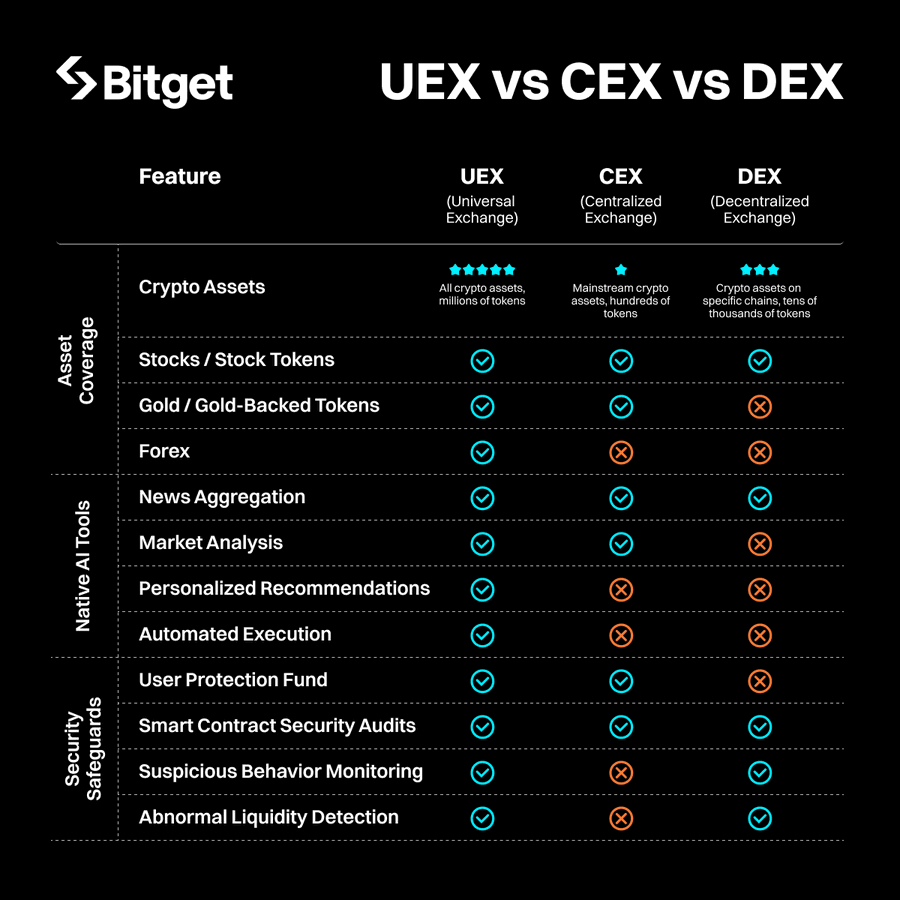
Bitget has outlined how Universal Exchanges (UEX) differ from traditional Centralized Exchanges (CEX) and Decentralized Exchanges (DEX), highlighting where each option stands out in terms of assets, tools, and security.
Asset Coverage Across Exchange Models
When it comes to asset coverage, UEX platforms offer the broadest access in the market. They support millions of crypto tokens while also opening the door to traditional assets such as stocks, gold-backed tokens, and even forex trading pairs. Centralized exchanges, by comparison, usually list hundreds of mainstream cryptocurrencies and may include tokenized stocks or gold products, but they do not provide forex markets. Decentralized exchanges remain largely focused on crypto only, giving users access to tens of thousands of tokens across specific chains but without the broader financial asset integration.
Advanced Tools and Security Features
The difference becomes even clearer when examining trading tools. Universal exchanges incorporate a range of native AI features that enhance decision-making and execution. These include news aggregation, market analysis, personalized recommendations, and automated trade execution powered by algorithms. Centralized exchanges have started integrating news feeds, analytics, and some recommendation systems, but they typically lack the automated execution offered on UEX platforms. Decentralized exchanges, on the other hand, provide on-chain access to liquidity but rarely feature advanced analysis or AI-driven recommendations, leaving most of the heavy lifting to the user.
Security is another area where the models diverge. Both UEX and CEX platforms provide investor protection through user protection funds and smart contract security audits. However, UEX takes safeguards a step further by embedding suspicious behavior monitoring and abnormal liquidity detection to prevent manipulation and fraud in real time. DEX platforms rely mainly on transparency and open-source code but often lack user protection mechanisms, which means traders must carry the risk themselves.

The Future of Universal Exchanges
Bitget frames the Universal Exchange as a new generation of trading infrastructure that blends the liquidity and diversity of decentralized finance with the reliability and investor protection of centralized platforms. For traders, the appeal lies in being able to access more markets, make use of smarter AI-driven tools, and benefit from enhanced safeguards without sacrificing convenience. As crypto adoption broadens, the debate over UEX, CEX, and DEX highlights a key trend: the future of exchanges is likely to converge, with Universal Exchanges positioning themselves as the all-in-one solution.


 Commentaries










Fill in necessary fields and publish