






Wintermute Data Suggests Crypto’s Liquidity Engine Is Losing Speed
We may earn commissions from affiliate links or include sponsored content, clearly labeled as such. These partnerships do not influence our editorial independence or the accuracy of our reporting. By continuing to use the site you agree to our terms and conditions and privacy policy.


After more than a year of relentless capital inflows, the once-surging tide of crypto liquidity is finally beginning to calm.
New research from Wintermute shows that the total value locked in stablecoins, exchange-traded funds, and digital asset trusts has ballooned from roughly $180 billion in 2024 to about $560 billion by November 2025 – a staggering threefold jump. Yet the latest data hints that this explosive expansion may be hitting a plateau.
Throughout late 2024 and the first half of 2025, capital poured into the sector as institutions embraced onchain assets and fresh ETF offerings. Stablecoins such as USDT, USDC, and PayPal’s PYUSD anchored trading activity, while spot Bitcoin and Ethereum ETFs injected unprecedented depth into digital markets. At the same time, tokenized treasuries and private crypto funds helped bridge the gap between decentralized finance and traditional institutions, pushing total digital liquidity past the half-trillion mark for the first time in history.
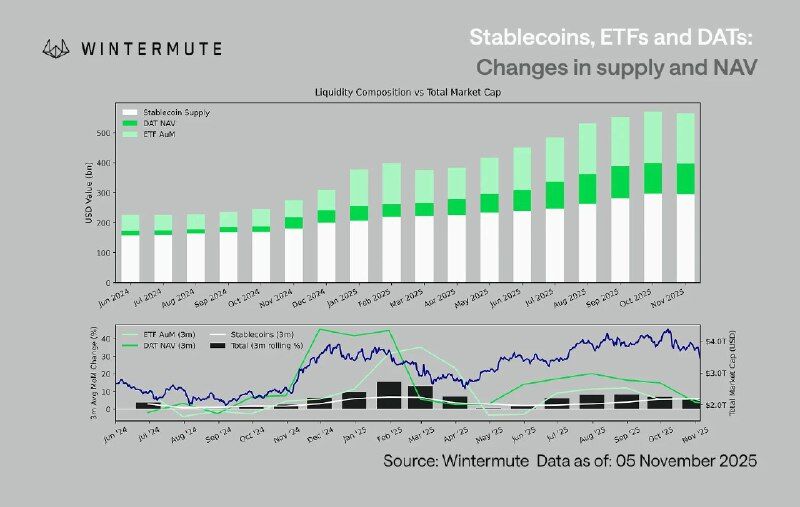
But that furious pace of growth has cooled in recent months. Since August 2025, Wintermute notes, ETF inflows have flattened, stablecoin minting has slowed, and digital trust products have seen more modest expansion. Analysts link the slowdown to a shift toward tighter monetary conditions, widespread profit-taking, and a pause in investor risk appetite after months of bullish sentiment. The leveling of key liquidity metrics suggests that the market may have already reached a short-term peak before its next cycle.

The big question now is where the next wave of capital will emerge. Some observers expect tokenized U.S. Treasuries and real-world-asset ETFs to lead the next phase of growth, while others see opportunities in layer-2 settlement tokens and cross-chain stablecoin protocols.
Even with the recent cooldown, Wintermute’s data points to a stronger foundation than in previous cycles. Stablecoins remain deeply embedded in market infrastructure, ETF products continue attracting institutional demand, and tokenized assets are steadily reshaping the link between crypto and traditional finance. If 2024 and 2025 were about building liquidity, the next stage may determine how effectively that liquidity fuels real-world utility and long-term market resilience.


 Commentaries










Fill in necessary fields and publish