


The Fed Chair Contest Becomes a Market Event of Its Own
We may earn commissions from affiliate links or include sponsored content, clearly labeled as such. These partnerships do not influence our editorial independence or the accuracy of our reporting. By continuing to use the site you agree to our terms and conditions and privacy policy.


Speculation around who will lead the Federal Reserve next has intensified, with markets increasingly split between two very different figures - Kevin Hassett and Kevin Warsh - as political calculations collide with investor expectations.
Only weeks ago, Hassett looked like the clear favorite. As head of the National Economic Council, he enjoyed close proximity to President Trump and early support inside the administration. That advantage, however, has eroded.
Market participants and some advisors reportedly grew uneasy after Hassett publicly stressed caution and data dependence rather than signaling readiness for aggressive rate cuts. For a White House still frustrated by the legacy of Jerome Powell’s appointment, hesitation is now seen as a liability.
As doubts around Hassett grew, Warsh quietly moved back into contention. The former Fed governor, long known for his assertive and often hawkish views, has reengaged with Trump’s team as the president gauges how financial markets would react to a harder-line nominee. Warsh’s reputation for challenging internal Fed consensus and resisting ultra-loose policy appears to resonate with Trump’s desire for tighter control over monetary direction.
Prediction markets illustrate how quickly sentiment has turned. Hassett’s odds, once dominant, have slid noticeably, while Warsh’s probability has surged from fringe levels to a credible challenge. The shift suggests that neither candidate has locked in support – and that the final decision remains fluid.
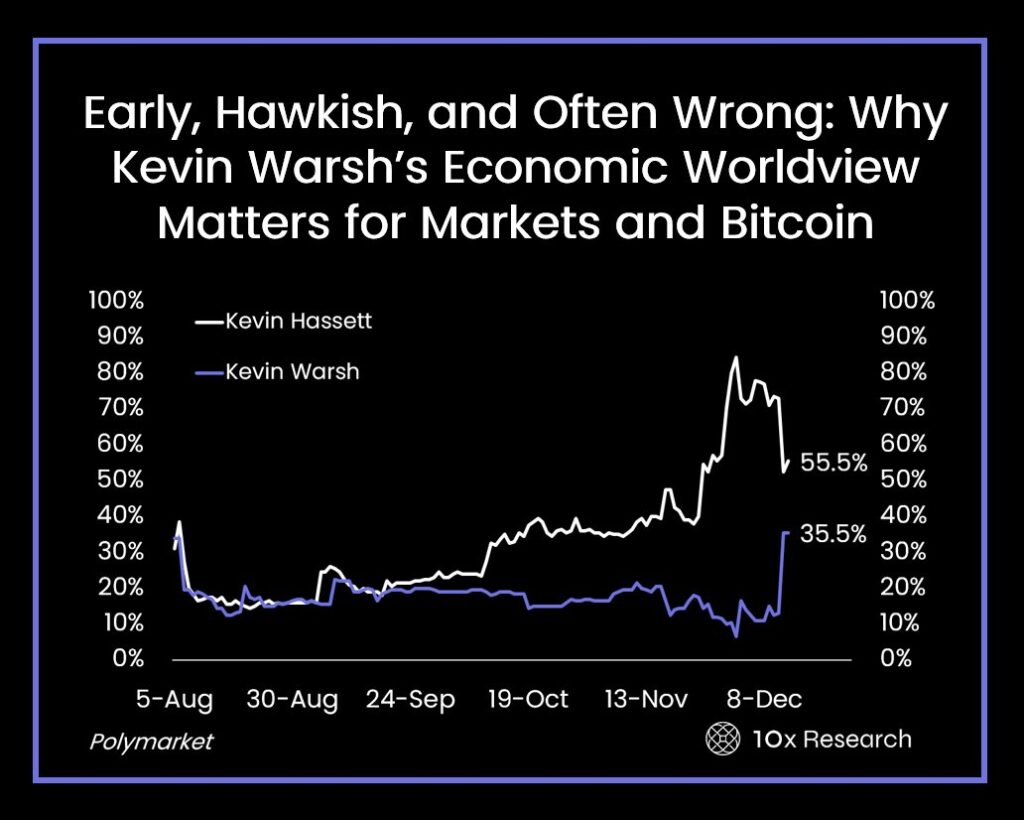
The stakes extend well beyond Washington. A Warsh-led Fed would likely imply tighter financial conditions and reduced liquidity, a scenario that historically pressures risk assets. Hassett, while less overtly hawkish, has yet to convince markets he would back forceful easing if conditions deteriorate. For Bitcoin and other liquidity-sensitive assets, the distinction matters: expectations around rates and balance-sheet policy often shape momentum long before decisions are finalized.
With prediction data narrowing and political signals mixed, the race for Fed chair is no longer a formality. Until a nominee emerges, markets are likely to remain reactive – parsing every hint from the White House for clues about the future path of rates, liquidity, and risk appetite.


 Commentaries






Fill in necessary fields and publish