


Ripple Moves Deeper Into Europe’s Payment Infrastructure
We may earn commissions from affiliate links or include sponsored content, clearly labeled as such. These partnerships do not influence our editorial independence or the accuracy of our reporting. By continuing to use the site you agree to our terms and conditions and privacy policy.


Ripple has taken a decisive step deeper into Europe’s financial system, quietly embedding its technology into the continent’s most important payment plumbing.
Rather than pitching blockchain as a replacement for banks’ existing infrastructure, the latest integration focuses on something far more pragmatic: compatibility.
By connecting to the TAS Network Gateway, Ripple now sits alongside Europe’s core payment rails, allowing banks to interact with blockchain-based settlement while continuing to operate their legacy systems as usual. The result is a low-friction path for institutions that want efficiency gains without the operational risk of ripping out what already works.
A Bridge, Not a Disruption
At the heart of the integration is interoperability. Through TAS, banks gain access to Europe’s high-value and retail payment systems-including real-time gross settlement and cross-border euro transfers – without changing their internal architecture. Ripple’s technology operates in parallel, acting as a connective layer rather than a replacement engine.
This design choice matters. European banks are notoriously conservative when it comes to core system changes, especially those tied to settlement and liquidity. By positioning itself as a bridge between traditional finance and distributed ledger technology, Ripple lowers the barrier to adoption and aligns itself with how banks actually modernize: incrementally, not radically.
Fixing the Old Pain Points of Cross-Border Payments
The integration targets long-standing inefficiencies that have plagued international payments for decades. Settlement delays, high costs, fragmented liquidity pools, and complex reconciliation processes remain common-especially across borders.
Ripple’s setup is designed to compress settlement times and simplify messaging between institutions. Transactions can move closer to real time, with cleaner data flows and fewer intermediaries. Just as importantly for Europe, compliance is built into the process. Transparency, audit trails, and reporting standards are handled within the workflow, meeting regulatory expectations rather than clashing with them.
Optional Liquidity, Not Forced Exposure
A notable aspect of the model is flexibility. Banks are not required to use XRP to participate. Instead, Ripple offers it as an optional liquidity tool through its on-demand liquidity framework.
For institutions that choose to use it, XRP can function as a bridge asset, reducing the need to hold pre-funded accounts in multiple currencies. That can free up capital and improve balance-sheet efficiency. For those that prefer not to, the system still functions without it-an important concession in a region where regulatory comfort varies widely between institutions.
Positioned for Europe’s DLT Future
Timing is not accidental. European policymakers and central banks are steadily moving toward distributed ledger-based settlement frameworks, with broader interoperability expected later this decade. Ripple’s early integration places it directly inside the infrastructure that will matter most when those frameworks reach production scale.
Rather than waiting for regulation to catch up, Ripple has aligned itself with Europe’s direction of travel: regulated, interoperable, and institution-first blockchain adoption. If that transition accelerates, integrations like this one could determine which technologies graduate from pilot programs to permanent fixtures in the financial system.
XRP Price Snapshot
XRP’s market price reflects the cautious tone across the broader crypto market. The token is trading near $1.86, flat on the day but lower on short-term timeframes, with losses of roughly 1.5% over the past twenty-four hours and just over 1% on the week.
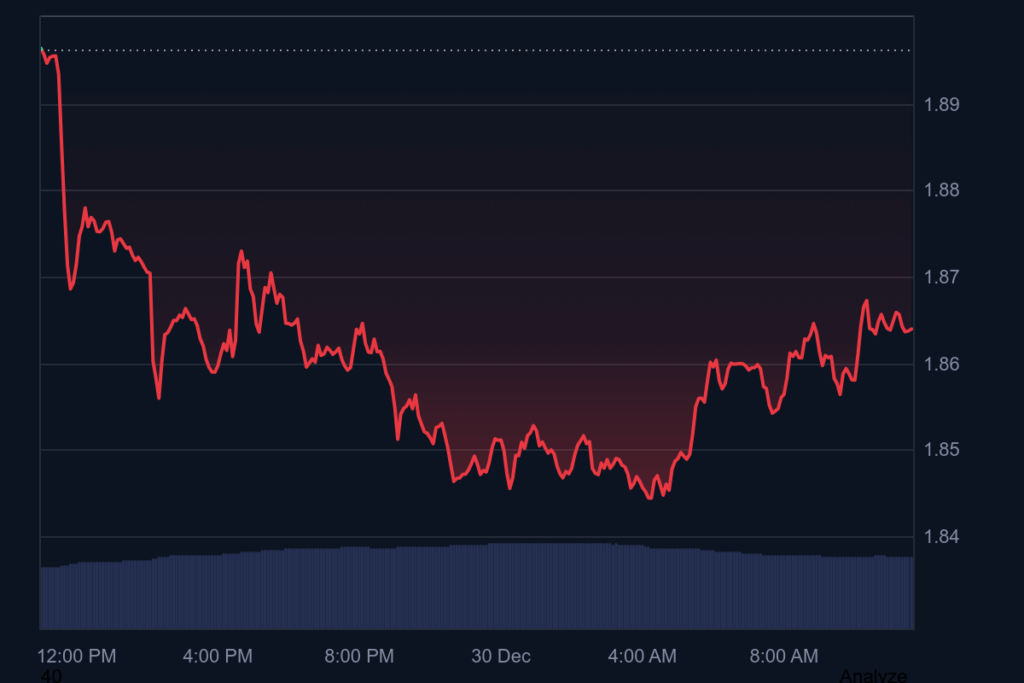
With a market capitalization around $113 billion and approximately 60.6 billion XRP in circulation, price action suggests investors are waiting for clearer catalysts-either from improving market sentiment or from tangible adoption milestones tied to Ripple’s expanding role in global payment infrastructure.
Looking for ideas? Read our full guide to the best meme coins to invest in this year.


 Commentaries










Fill in necessary fields and publish