


Kraken Ramp Debuts as a Powerful API to Help Platforms Integrate Crypto Payments Instantly
We may earn commissions from affiliate links or include sponsored content, clearly labeled as such. These partnerships do not influence our editorial independence or the accuracy of our reporting. By continuing to use the site you agree to our terms and conditions and privacy policy.


Popular crypto exchange Kraken recently launched Kraken Ramp, a revolutionary crypto on-ramp API that will make it easier for businesses around the world to convert fiat to crypto. This fiat-to-crypto gateway lets platforms integrate Web3 payments directly into their apps or websites, without users having to deal with complicated redirects or setups.
As global trading volumes gradually rise, the Web3 space needs more catalysts to bring crypto payments closer to mainstream adoption. Ramp, built on Kraken’s institutional-grade crypto infrastructure, could be the timely solution that connects traditional finance and crypto.
With Ramp’s launch, Kraken aims to build a connected digital economy, where adding crypto payments is as easy as adding any other payment option. You can think of Kraken Ramp as adding a “crypto checkout” button that works worldwide, without you having to negotiate with every local bank or regulator.
Continue reading to learn more about how Kraken Ramp works and why it matters.
Why Crypto Payments Still Feel Complicated
A new technology can truly go mainstream only when it’s easy to use and accessible to everyone. But right now, the overall experience for beginners exploring crypto payments is somewhat overwhelming. To put things in perspective, they have to deal with problems like limited fiat payment options, strict compliance rules, and even unreliable on-ramps that vary by country.
On the other hand, it’s equally challenging for businesses. For example, adding crypto payments to a fintech app requires multiple payment partners and a plan to manage ongoing compliance effectively. This process can be quite slow and expensive, so many businesses either put off adding crypto features or ship only a limited version that works in a few places. For many teams, the biggest challenge is figuring out how to integrate crypto payments without overhauling their entire product or backend systems.
This is precisely where Kraken Ramp steps in. It aims to provide a comprehensive solution to these problems by creating a smooth fiat-to-crypto gateway that could make crypto available to everyone around the world.
What Exactly Is Kraken Ramp?
Kraken Ramp is a single, unified API that lets you easily move money from fiat to crypto. It will allow devs to embed crypto buying and selling flows directly into their apps so that users can buy and sell crypto assets right in the platform’s interface. Businesses won’t have to send users to an external exchange page or service. In fact, users won’t need to go through extra redirects or verification steps that negatively affect their experience.
Kraken Ramp is built on the same technology as Kraken’s exchange, so it features the reliability and performance that you’d expect from a top-tier Web3 platform. This means that when someone buys or sells crypto through an app or website that uses Kraken Ramp, they benefit from Kraken’s liquidity and fast execution.
How Kraken Ramp Differs From Other Crypto On-Ramp APIs
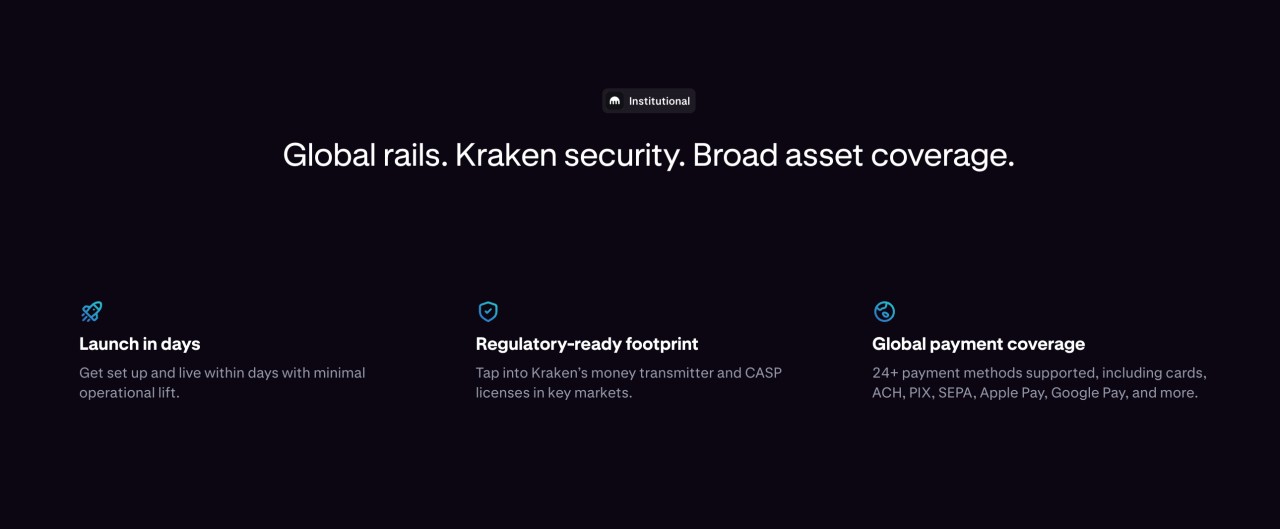
What differentiates Kraken Ramp from its competitors? To begin with, Kraken’s infrastructure is reliable and compliant, with adequate fraud protection and licenses in key markets. It also features a global crypto payment method with over 24 methods, including credit cards and ACH in the US, SEPA in Europe, and Google Pay worldwide. This makes it easy for people to buy crypto with a card worldwide.
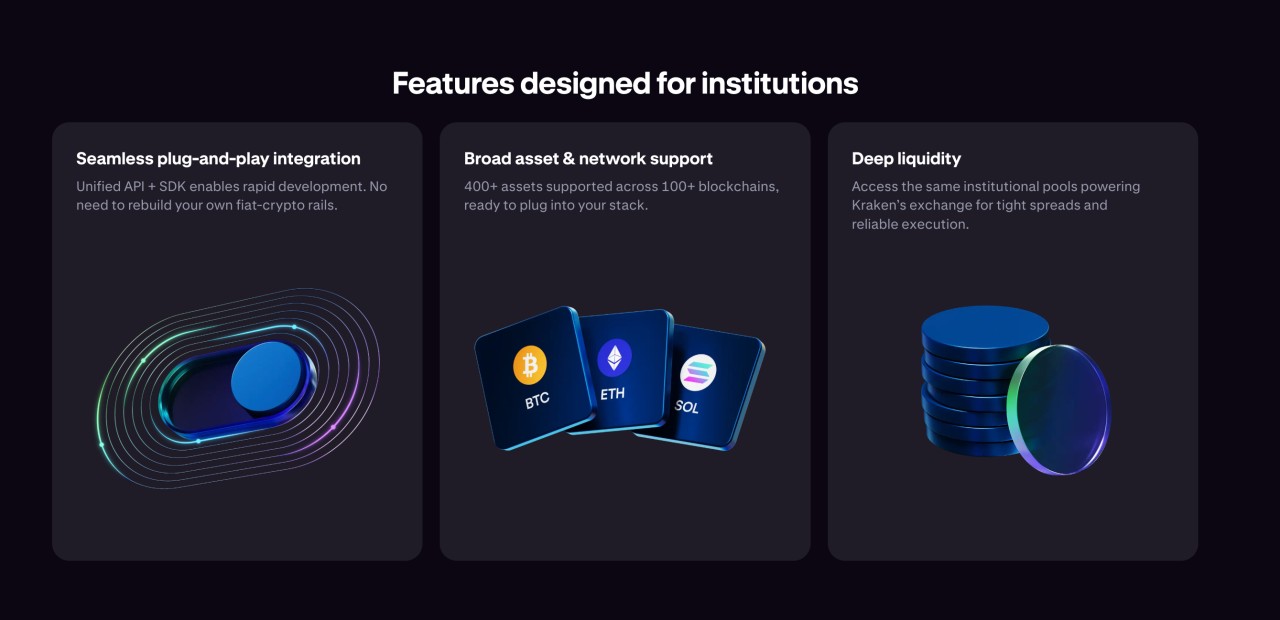
Meanwhile, Kraken’s deep liquidity will further ensure competitive pricing with tight spreads even during volatile periods. Adding to the list of features, Ramp will support over 400 assets on more than 100 blockchains, including Bitcoin and many niche tokens. Finally, the unified API and SDK will make it easy for devs to integrate the Kraken Ramp, enabling deployment in days with minimal engineering effort.
Who Can Benefit From Using Kraken Ramp
Kraken Ramp is designed for any product or service that wants to unlock crypto access without building or routing through an exchange, enabling seamless crypto integration. Here are some key use cases:
- Banks and fintech apps can add crypto buy/sell next to familiar features like balances, transfers, and investing. They don’t have to handle all the licensing and operational work on their own.
- DeFi apps and wallets can onboard users faster by allowing them to buy tokens directly into their wallets or protocol accounts. This will essentially reduce the drop-off caused by sending users to other places.
- Exchanges, marketplaces, and NFT platforms can expand into new regions and increase fiat coverage without having to build many local payment integrations or source liquidity from multiple sources.
- Web3 games and GameFi projects can let players buy the tokens or NFTs they need with regular payment methods, flipping the “learn crypto first” narrative.
- Startups and independent developers can ship global crypto payment rails in days instead of months using Kraken’s technology.
Kraken Ramp Handles Compliance Burden for Partners
On/off ramps are typically challenging to integrate because they sit at the intersection of money movement and regulation. Platforms must address identity verification measures, anti-money laundering (AML) rules, fraud, chargebacks, and licensing requirements across jurisdictions. And that level of complexity can be overwhelming for both product and compliance teams.
Kraken Ramp is designed to take much of that complexity off the partner’s plate. It will handle verification and monitoring, while partners use Kraken’s already set up compliance system instead of having to build their own from the ground up. Kraken will also handle Ramp’s operations, so updates like new payment rails, new assets, security patches, and regulatory changes can all be executed from one place.
The Two Forces Shaping the Future of Web3 Integration
Users are slowly but surely looking for embedded crypto payment features on a platform. In fact, they want to be able to buy a little Bitcoin as easily as they can buy a stock or add money to a wallet. And platforms that can’t offer that convenience risk losing users to competitors that can.
But the other force to keep in mind is regulation. Scrutiny of consumer protection and illicit finance is also increasing, making “move fast and patch later” a rather dangerous strategy. That’s precisely why compliance-forward solutions like Kraken Ramp are attractive, as they help companies meet demand while reducing the risk of launching an inferior on-ramp.
Getting Started With Kraken Ramp
Businesses can get started by submitting a sign-up or inquiry form on Kraken’s website to contact the institutional team before the onboarding process begins. After that, developers can add the Ramp API or SDK, set up the payment methods and assets they wish to support, and add the buy/sell flow to their own interface.
The ultimate goal is to cause as little disruption as possible. Business can keep their existing product intact and let Kraken handle conversions and checks in the background. Once live, users can easily buy or cash out crypto without leaving the platform.
Conclusion
When people can easily switch between fiat and crypto in the apps they already use, “crypto” stops being a separate destination and becomes a behind-the-scenes feature, just like messaging or payments.
That paradigm shift can enable the creation of a host of new use cases. For example, we could see a game that sells an NFT via a regular checkout, a remittance app that moves money quickly across borders, or a fintech product that lets users hold digital assets alongside everything else. Unified ramps help those experiences feel ordinary rather than intimidating.
As a forward-looking crypto exchange API 2025, Kraken Ramp positions itself as the backbone for next-gen apps that want to bring digital assets to everyday users. Kraken is betting that the next wave of adoption will come from integration, combining global crypto payments and compliance into a single API. Interested users visit Kraken’s official website to sign up for a new account and explore Ramp.


This publication is sponsored. CryptoDnes does not endorse and is not responsible for the content, accuracy, quality, advertising, products or other materials on this page. Readers should do their own research before taking any action related to cryptocurrencies. CryptoDnes shall not be liable, directly or indirectly, for any damage or loss caused or alleged to be caused by or in connection with use of or reliance on any content, goods or services mentioned.
 Commentaries










Fill in necessary fields and publish