






Bitcoin Profit-taking Cools as ETF Demand Slows, Analysts Eye Q4 Liquidity Spark
We may earn commissions from affiliate links or include sponsored content, clearly labeled as such. These partnerships do not influence our editorial independence or the accuracy of our reporting. By continuing to use the site you agree to our terms and conditions and privacy policy.


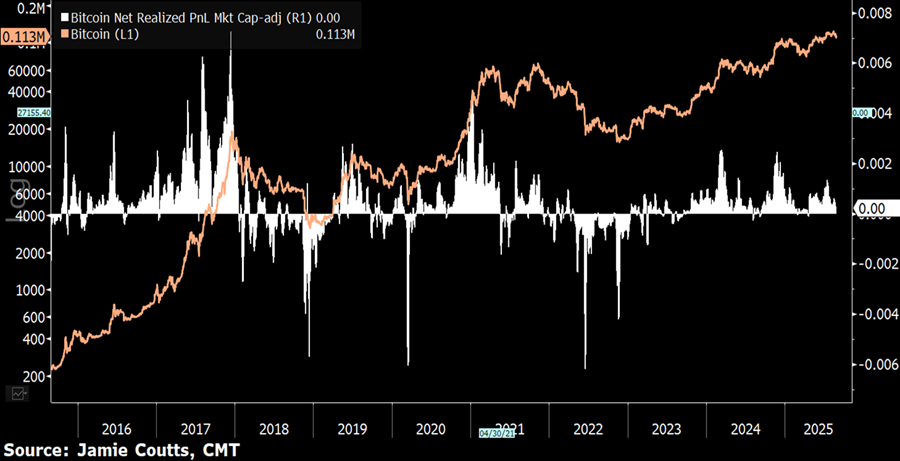
Bitcoin’s rally to July’s all-time high brought a sharp spike in realized profits, but analysts argue the cycle looks different this time.
Jamie Coutts, CMT, highlighted in a recent market note that while the move appeared dramatic, adjusted for market capitalization it was far less extreme than in prior cycles.
Instead of parabolic surges, Bitcoin’s price path in 2025 has been marked by stepwise gains. That distinction, Coutts suggested, points to a maturing market where growth comes in waves, tempered by liquidity conditions rather than unchecked speculation.
ETF and corporate demand slows
According to Coutts, two of Bitcoin’s strongest demand pillars – treasury holdings by corporations and exchange-traded funds (ETFs) – are showing signs of fatigue. Flows into spot Bitcoin ETFs have cooled compared to earlier in the year, while corporate treasuries are no longer adding to reserves at the same pace.
This slowdown, he warned, may leave Bitcoin vulnerable to further downside in the near term. Without strong inflows from institutional vehicles or corporate buyers, markets could struggle to sustain momentum until a fresh wave of liquidity arrives.
Q4 could be the turning point
Coutts pointed to several macro triggers that could reshape the landscape heading into the fourth quarter. Rate cuts, shifts in supplementary leverage ratio (SLR) rules, and policy moves from China could all inject liquidity back into the system. He also flagged the unpredictable role of political developments in the U.S., including the “Trump wildcard,” as potential catalysts.

If these conditions align, Bitcoin could regain its upward trajectory after a period of consolidation. For now, however, the combination of slowing demand and profit-taking suggests the market may see additional weakness before the next leg higher.
A cycle unlike the past
The broader takeaway, Coutts emphasized, is that this cycle diverges from Bitcoin’s earlier history. Rather than repeating the euphoric, blow-off tops of 2017 or 2021, today’s market reflects a more measured climb. That shift could ultimately prove healthier for long-term adoption, but in the short run it leaves investors weighing near-term volatility against the potential for renewed liquidity-driven rallies later in the year.


 Commentaries










Fill in necessary fields and publish