


Bitcoin Custody Divide: Why Most Companies Trust Custodians While Individuals Go Self-Custody
We may earn commissions from affiliate links or include sponsored content, clearly labeled as such. These partnerships do not influence our editorial independence or the accuracy of our reporting. By continuing to use the site you agree to our terms and conditions and privacy policy.


New data from River highlights how businesses handle Bitcoin custody - and the picture looks very different from individual holders.
According to the report, 74.3% of companies using River hold their Bitcoin with third-party custodians. Another 18.1% split custody between third-party providers and in-house management, while just 7.6% rely solely on self-custody with multisig setups.
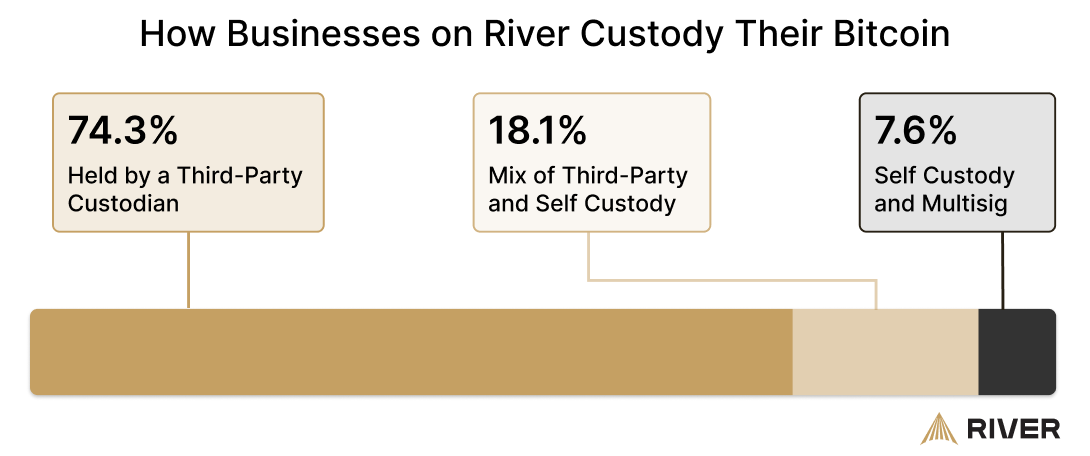
River notes that the reliance on custodians is largely driven by operational realities. Businesses face continuity challenges, compliance obligations, and risk controls that make outsourcing custody more practical, particularly as many only began buying Bitcoin at scale in recent years.
Contrast With Broader Bitcoin Market
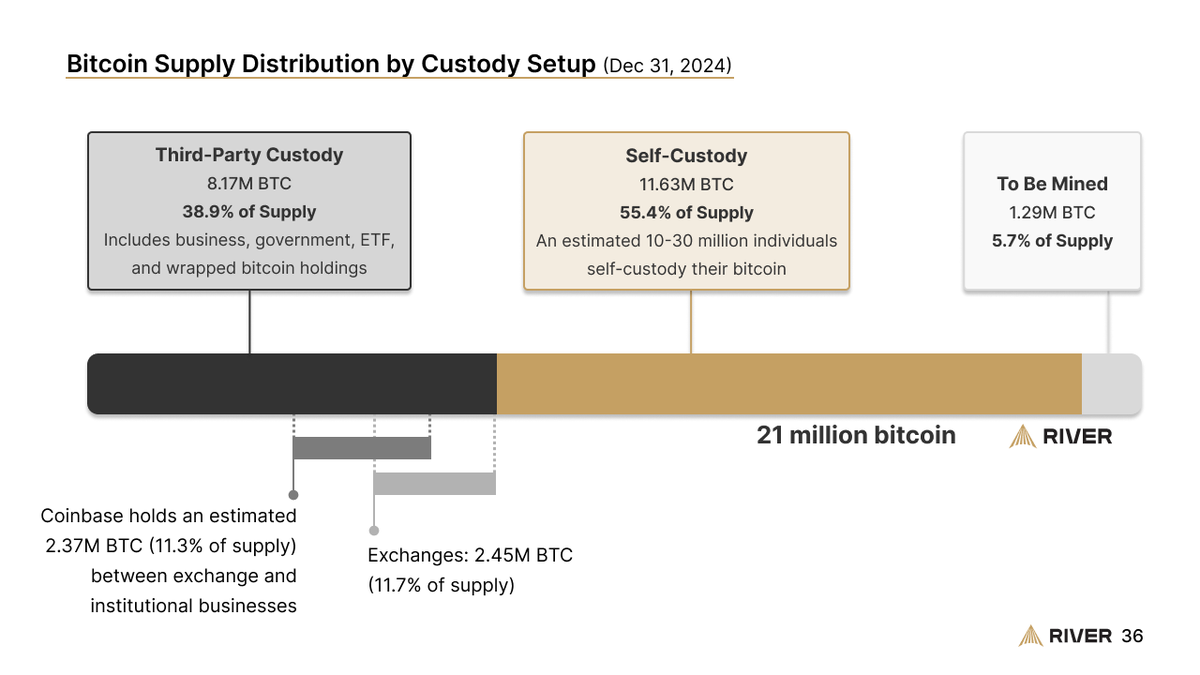
When looking at Bitcoin supply overall, the picture shifts. As of December 31, 2024, self-custody accounted for 55.4% of all Bitcoin in circulation, or roughly 11.63 million BTC. Third-party custodians held 8.17 million BTC (38.9%), which includes balances managed for businesses, governments, ETFs, and wrapped Bitcoin. The remaining 1.29 million BTC (5.7%) is yet to be mined.
Read More:
Exchanges and custodians dominate institutional flows. For example, Coinbase holds about 2.37 million BTC (11.3% of supply), while other exchanges control roughly 2.45 million BTC.
The Bigger Trend
While businesses still lean heavily on custodians, River suggests a gradual shift toward self-custody models could emerge as corporate Bitcoin adoption matures. For now, companies prefer the perceived safety and regulatory clarity of third-party providers, while individuals continue to lead the push toward independence.


 Commentaries










Fill in necessary fields and publish