


A Silent Phase for Altcoins as Capital Clusters Elsewhere
We may earn commissions from affiliate links or include sponsored content, clearly labeled as such. These partnerships do not influence our editorial independence or the accuracy of our reporting. By continuing to use the site you agree to our terms and conditions and privacy policy.

Something unusual is happening beneath the surface of the crypto market, and it has very little to do with headlines or short-term price swings.
Across Binance, the overwhelming majority of alternative tokens have quietly slipped into long-term technical weakness. Measured against a benchmark often used to define structural health, only a negligible slice of the altcoin universe is still holding positive long-term momentum. In practical terms, most projects are no longer trending – they are drifting.
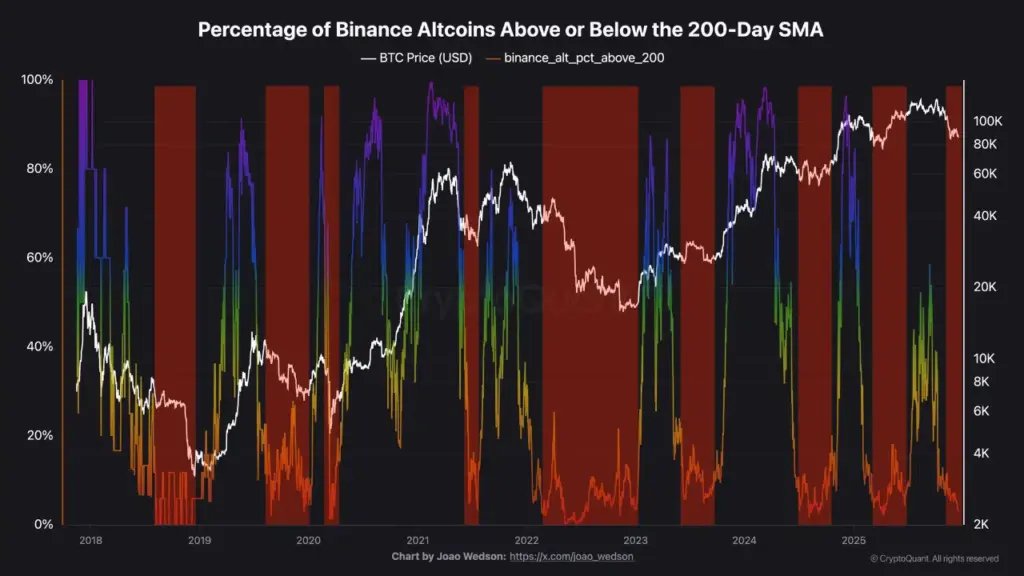
This isn’t the kind of environment where speculative rotations thrive. Capital is behaving defensively, clustering around a small set of highly liquid assets while avoiding exposure that depends on sustained inflows. The result is a market where breadth has collapsed: prices may move, but participation does not follow.
When Liquidity Pulls Back, Breadth Disappears
What makes this phase notable is its depth. Instead of isolated drawdowns, weakness has become synchronized. Mid-sized and smaller assets have absorbed disproportionate losses, suggesting that investors are not selectively reallocating – they are stepping back altogether. When this happens, rebounds tend to lack durability, as there is no structural demand underneath them.
Ironically, periods like this rarely feel important in real time. They are marked by boredom, failed rallies, and repeated disappointment rather than panic or euphoria. Yet historically, this is often when markets are being reset, not when trends are being confirmed.
That does not imply an imminent upside move. It does imply that expectations, positioning, and valuations are being compressed to an extreme. When confidence eventually returns, it rarely announces itself through sentiment – it shows up first in participation.
Until then, the signal is simple: the altcoin market is not broken, but it is dormant. And dormancy, while uncomfortable, is often a prerequisite for whatever comes next.


 Commentaries







Fill in necessary fields and publish