
 https://xrpl.org/
What is XRP?
XRP is a cryptocurrency designed to enable fast, low-cost international payments on the XRP Ledger (XRPL), a decentralized blockchain developed by Ripple Labs. Unlike traditional bank transfers or older cryptocurrencies, XRP transactions settle in just a few seconds and cost only a fraction of a cent, making the asset popular among financial institutions and payment providers.
The XRP Ledger uses a unique consensus mechanism (not mining) which allows it to process thousands of transactions per second while remaining energy-efficient. Because of its speed, scalability, and utility in cross-border transfers, XRP is often viewed as a bridge currency between different fiat and digital assets.
XRP: Key Features
- Ultra-fast settlement: Transactions typically finalize in 3–5 seconds, making XRP one of the quickest payment-focused cryptocurrencies.
- Very low fees: Transfers cost a fraction of a cent, enabling affordable cross-border payments at scale.
- Energy-efficient design: The XRP Ledger uses a consensus protocol rather than mining, resulting in minimal energy consumption.
- High throughput: The network can process up to 1,500+ transactions per second, supporting enterprise-level usage.
- Built for payments and liquidity: XRP can act as a bridge asset between currencies, improving liquidity and reducing reliance on pre-funded accounts.
- Decentralized, open-source ledger: The XRPL is maintained by independent validators worldwide, not solely by Ripple Labs.
- Rich developer ecosystem: The XRP Ledger supports tokenization, payment apps, and smart contract-like functionality through extensions such as Hooks and sidechains.
XRP vs Ripple – What’s the Difference?
Although the two terms are often used interchangeably, XRP and Ripple refer to completely different things:
- XRP is a cryptocurrency that runs on the XRP Ledger (XRPL). It’s a digital asset used to facilitate fast, low-cost transfers and provide liquidity between different currencies.
- Ripple (Ripple Labs Inc.) is a technology company that develops payment solutions for banks and financial institutions. Ripple builds products like RippleNet, On-Demand Liquidity (ODL), and other tools that may use XRP, but the company does not own or control the XRP Ledger.
In short: XRP is the token; Ripple is the company behind some – but not all – of the technology that supports its adoption. The XRP Ledger remains decentralized and operates independently of Ripple Labs, even though Ripple contributes to its development ecosystem.
How to Buy XRP in 2026
Looking to buy XRP today? Here’s the quick-start guide for buying XRP in three steps:
1. Create a Binance account
Register on Binance for free and secure your account with two-factor authentication. Complete the quick KYC verification to unlock deposits and trading.
2. Add funds
Deposit money using a credit/debit card, bank transfer, or other supported payment methods available in your region.
3. Buy XRP
Search for XRP, choose the amount you want to purchase, and confirm the order. Your XRP appears in your Binance wallet instantly.
For extra security, you can transfer your XRP to a private crypto wallet after purchase.
Where to Store XRP
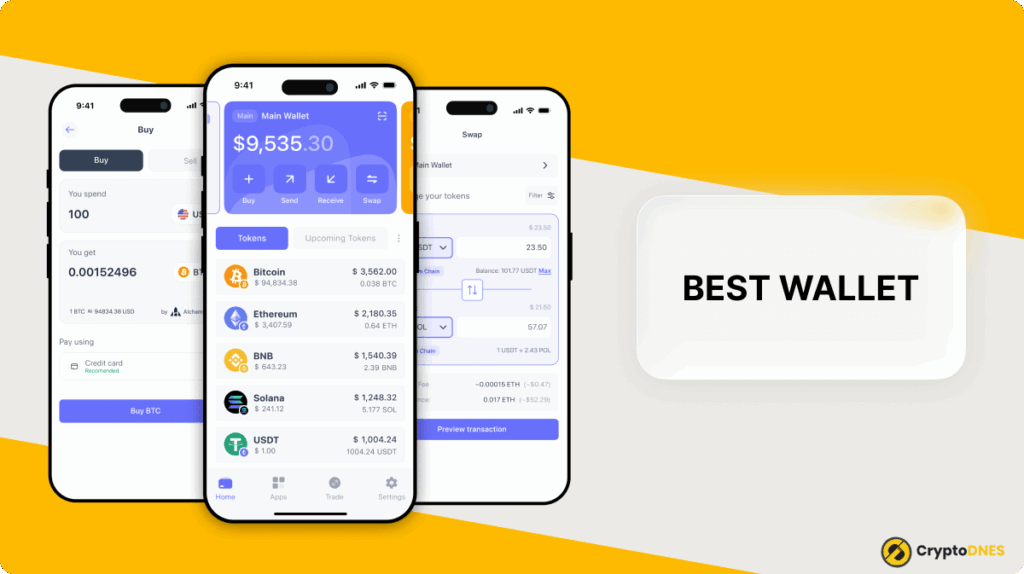
After buying XRP, you’ll need a secure wallet to store it. You can keep your XRP on a cryptocurrency exchange like Binance, but many users prefer a dedicated crypto wallet for stronger control over their funds. One of the easiest options for beginners is BestWallet, a non-custodial mobile wallet that lets you store, send, and manage XRP safely.
How to Set Up Best Wallet
1. Download BestWallet: You’ll find the app both in the App Store and Google Play.
2. Create a new wallet: Make sure to write down your recovery phrase – this is the only way to access your funds if you lose your device.
3. Enable security features: Fingerprint, multi-factor authentication, or Face ID login can help to keep your crypto safe.
4. Transfer your XRP from Binance: In Binance, select “Withdraw” → XRP → Paste your BestWallet address → Confirm.
How the XRP Ledger Works
The XRP Ledger (XRPL) is a decentralized blockchain designed for fast, low-cost payments. Unlike Bitcoin or Ethereum, it does not rely on mining or proof-of-work. Instead, the XRPL uses a consensus mechanism in which independent validators agree on the order and validity of transactions every 3–5 seconds. This approach allows the network to process around 1,500 transactions per second with minimal fees and energy use.
All 100 billion XRP were created at launch, so new coins are not mined. Validators maintain a shared public ledger, and transactions are confirmed only when the majority of trusted nodes reach consensus, ensuring security and preventing double-spending.
While Ripple Labs contributes to the ecosystem and operates some validators, the XRPL is maintained by a global, diverse set of independent participants. This gives the network decentralization while keeping transaction speed and reliability extremely high.
A Brief History of Ripple and XRP
- 2012: The XRP Ledger (XRPL) is created by Jed McCaleb, David Schwartz and Arthur Britto as a fast, energy-efficient alternative to mined cryptocurrencies.
- 2012–2013: Ripple Labs (originally OpenCoin) is founded to develop payment technology using the XRPL.
- 2015–2018: Ripple partners with banks and payment providers, positioning XRP as a bridge asset for international transfers.
- 2018–2020: RippleNet and On-Demand Liquidity (ODL) expand global adoption of XRP in real-time cross-border payments.
- 2020–2023: The SEC sues Ripple; in 2023 a major court ruling finds that XRP traded on exchanges is not a security.
- 2023–Present: The XRPL ecosystem grows with tokenization, DeFi, NFTs, and new tools for developers.
Pros and Cons of XRP
If you’re thinking of buying XRP, it’s worth understanding both the strengths that make it appealing for fast payments and the risks that come with its unique design and regulatory history. Below, we break down the key advantages and disadvantages to help you make a more informed decision on whether it’s a good choice of crypto for you.
Advantages of XRP
- Extremely fast settlement: XRP transactions typically finalize in 3–5 seconds – far faster than Bitcoin, Ethereum, or traditional bank transfers.
- Very low transaction fees: Sending XRP costs fractions of a cent (0.00001 XRP), making it suitable for frequent or high-volume transfers.
- Energy-efficient design: The XRP Ledger uses a consensus algorithm instead of mining, resulting in minimal energy consumption.
- High throughput: The network can process ~1,500 transactions per second, supporting scalable payment solutions.
- Bridge asset for global payments: XRP can facilitate transfers between fiat currencies, stablecoins, and crypto assets, improving liquidity.
- Adoption by financial institutions: Some banks and payment providers use Ripple’s payment technology, increasing awareness and potential use cases for XRP.
Disadvantages of XRP
- Perceived centralization: Although the XRP Ledger is decentralized, Ripple Labs still operates some validators and holds a large portion of XRP supply, which some critics see as centralized influence.
- Large pre-minted supply: All 100 billion XRP were created at launch, and Ripple’s escrow releases can affect market sentiment if not managed carefully.
- Regulatory uncertainty: The SEC lawsuit against Ripple (2020–2023) created long-lasting concerns, even though a major 2023 ruling clarified that XRP sold on exchanges is not a security. Future regulatory changes could still impact the asset.
- Competition in the payments sector: XRP competes with stablecoins, CBDCs, and faster emerging blockchain networks, which may affect long-term adoption.
XRP Use Cases and Applications
XRP was created to serve as a fast, efficient digital asset for moving value across borders – but its utility has expanded as the XRP Ledger ecosystem has grown. Below are the main real-world applications of XRP today:
1. Cross-Border Payments
XRP can act as a bridge currency between fiat currencies, enabling near-instant settlement with low fees. This reduces the need for pre-funded accounts (nostro/vostro) and improves liquidity for payment providers.
2. Liquidity Provision for Financial Institutions
Banks and fintech companies can use XRP to access on-demand liquidity when moving money between different corridors. This supports faster international transfers compared to traditional systems.
3. Remittances and Low-Cost Transfers
Because transactions cost fractions of a cent, XRP is suitable for small-value remittances and frequent peer-to-peer payments, especially across borders.
4. Tokenization on the XRP Ledger
The XRPL supports issuing and transferring tokenized assets, including stablecoins, CBDC pilots, loyalty tokens, and other digital assets. XRP is often used as the native currency for fees and liquidity within these systems.
5. Decentralized Finance (DeFi) on XRPL
New XRPL features – such as automated market makers (AMMs), sidechains, and interoperability tools – allow developers to build DeFi applications where XRP plays a key role in swaps, liquidity pools, and bridging assets.
6. Micropayments and Streaming Payments
Fast settlement and tiny fees make XRP practical for microtransactions, pay-per-use services, and digital content monetization models such as streaming payments.
7. NFT and Smart Contract Extensions
With new tools and sidechains, the XRP Ledger supports NFTs and smart-contract-like functionality. XRP is used for transaction fees and marketplace activity within this ecosystem.