





The True Trade Review 2026: Is It the Best Crypto Futures DEX?
We may earn commissions from affiliate links or include sponsored content, clearly labeled as such. These partnerships do not influence our editorial independence or the accuracy of our reporting. By continuing to use the site you agree to our terms and conditions and privacy policy.

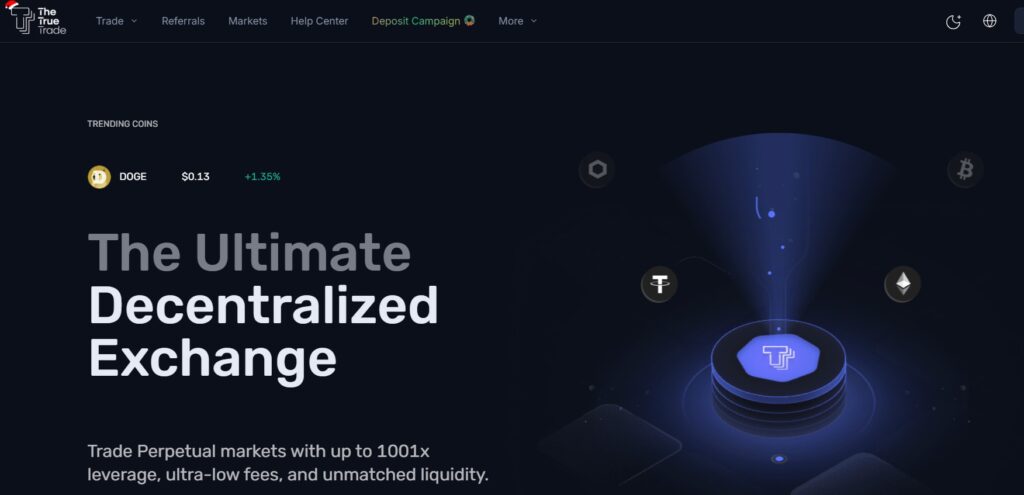
The True Trade is a recently launched decentralized exchange (DEX) that operates in the BNB Chain ecosystem. Traders speculate on perpetual futures markets with leverage of up to 1001x in a private and non-custodial framework. Our True Trade review helps readers decide whether the derivative DEX suits their trading requirements.
To provide an accurate and impartial representation of the platform, we linked a real-money wallet to The True Trade, executed hundreds of leveraged positions, and analyzed core features, security mechanisms, and commissions. We reveal our findings in this comprehensive review, compare the exchange with competitor DEXs, and provide an overall platform rating based on core metrics.
The True Trade Review: Our Verdict
The True Trade provides a non-custodial ecosystem to long and short cryptocurrencies with high leverage. It offers up to 1001x on major assets, although these multipliers align with the Aster DEX, which also runs on BNB Chain.
Because The True Trade operates a decentralized model, reducing centralized risks and with no Know Your Customer (KYC) requirements. Platform users can open an account or connect a self-custody wallet without needing to relinquish control of their private key.
Our evaluation shows that trading volumes are lower than those of many perpetual futures platforms, so slippage is often higher than that of Tier 1 competitors. Because The True Trade operates a browser-only framework, some users may find the mobile trading experience slightly cumbersome.
- The BNB Chain-based DEX supports dozens of popular cryptocurrencies, and large-cap markets offer leverage multipliers of up to 1001x. Traders speculate on both market directions via long and short orders.
- The platform appeals to crypto traders who prioritize non-custodianship, full asset control, and complete anonymity.
- High-leverage trading represents a high-risk strategy, yet The True Trade offers a basic dashboard to help beginners navigate the market. Experienced pros use the advanced platform to access technical tools and custom order types.
The True Trade Pros & Cons
We find that The True Trade offers various benefits and drawbacks, which traders must evaluate to make an informed choice.
On the plus side, the DEX offers substantial leverage limits of 1001x, which amplifies a $50 margin balance to over $50,000, allowing casual traders to control large market exposure with affordable amounts. It also removes conventional funding fees, which most perpetual futures platforms apply every eight hours (for instance, Kraken applies them every hour).
However, The True Trade lists about 50 cryptocurrencies, whereas platforms like Binance and OKX support hundreds of additional markets. They also offer features such as copy trading and automated bots, which The True Trade lacks. That said, these derivative exchanges operate centralized structures and strict KYC requirements.
In contrast, The True Trade unlocks a decentralized and private trading experience, since users always retain control of their digital asset investments.
Here are the platform’s pros and cons, summarized in our review.
Pros
- Enter large crypto positions with a minimum margin requirement of about 0.099%
- No requirement to register an account or provide personal information
- Speculate on over 50 cryptocurrencies in both market directions
- Maintain perpetual futures positions indefinitely without funding fees
- Users never give up control of their assets or wallet credentials
- The free demo trading dashboard mirrors real trading conditions
- Traders select the basic or advanced platform based on their experience level
Cons
- The flat-fee model offers no commission reductions for large volumes or market makers
- As a new DEX, The True Trade has a limited track record
- The platform does not offer an iOS or Android app
- Not suitable for long-term investors who seek real crypto ownership
- Like other decentralized providers, users cannot deposit funds with fiat money
What is The True Trade?
Launched in Q4 2025, The True Trade is a new crypto trading platform from the BNB Chain ecosystem. Its trading structure aligns with Uniswap, PancakeSwap, Raydium, and other popular DEXs. The key difference is that The True Trade specializes in derivative instruments, where users speculate on price movements instead of buying and selling real digital assets.
It lists over 50 perpetual futures, including top altcoins such as XRP (XRP), Litecoin (LTC), Ethereum (ETH), and Dogecoin (DOGE). Traders go long or short to predict future prices, and apply leverage of up to 1001x to magnify potential profits.
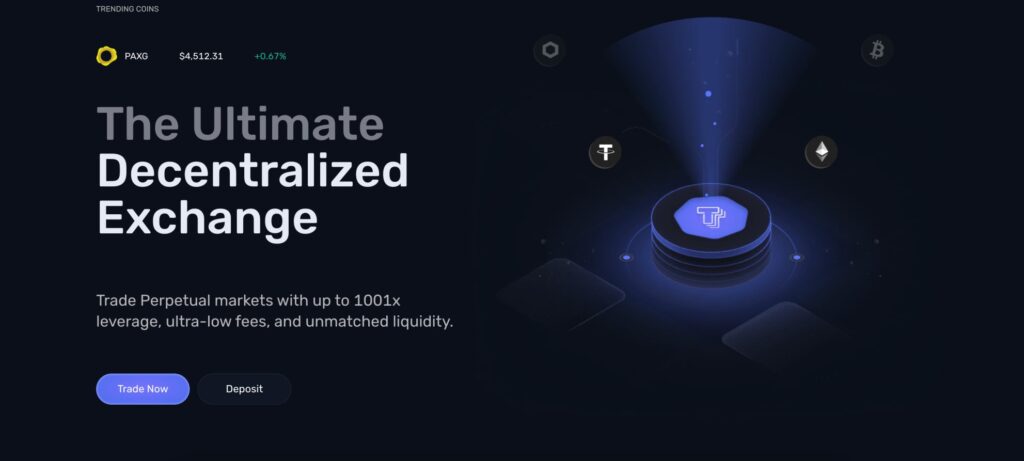
Because of its DEX framework, The True Trade offers several benefits over traditional futures trading platforms like Binance. Users can trade without opening an account and use existing wallet funds to post margin. The True Trade never holds client funds, as smart contracts settle trades via the BNB Chain network. With no KYC verification procedures, platform traders remain anonymous.
In The True Trade’s short existence, more than 366,000 traders have placed futures orders. The exchange averages $28 million in daily volume, which is a fraction of the volume compared with competitor derivative DEXs. Aster, for example, often handles over $4 billion per day.
Supported Cryptocurrencies
DEX traders can speculate on most large-cap cryptocurrencies like Bitcoin (BTC), ETH, BNB, and SOL, and a modest selection of top meme coins such as DOGE, Shiba Inu (SHIB), and Pepe (PEPE). Other popular markets include Polkadot (DOT), The Sandbox (SAND), Hyperliquid (HYPE), and Chainlink (LINK).
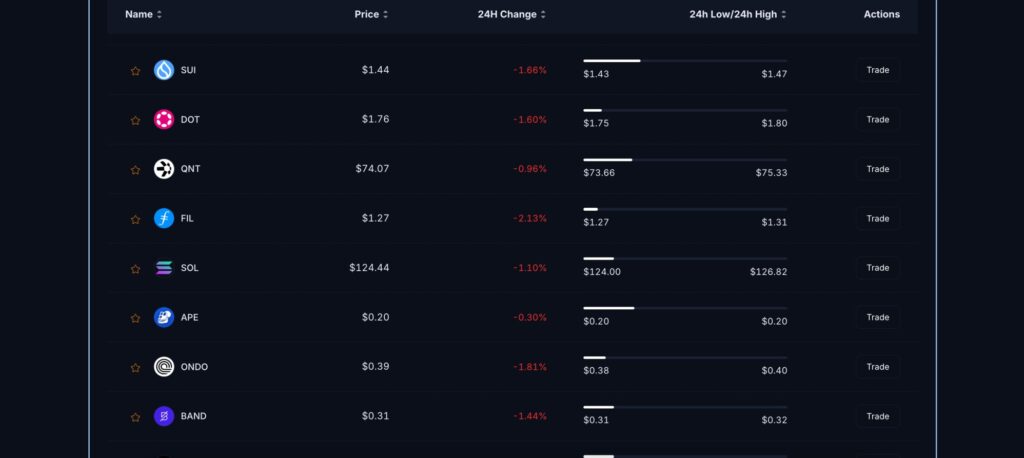
Due to the small number of available markets, browsing cryptocurrencies is easy. Users can search by the asset’s ticker symbol or filter by 24-hour performance and price. The platform’s “Hot” section displays the most actively traded coins and tokens over the past day, providing insights into trending projects.
The True Trade uses Tether (USDT) pairs for all supported cryptocurrencies. While all trades settle in USDT, traders may use other popular assets for margin (available in Gasless mode only). In terms of the derivative specifications, the DEX offers isolated margin contracts only. This mechanism appeals to traders who prioritize risk management, as the initial margin reflects the maximum downside.
Remember that The True Trade supports derivatives exclusively, so users cannot buy real cryptocurrencies. To secure digital asset ownership, explore the best crypto exchanges with spot trading markets.
The True Trade Services & Features
Our True Trade review discovered limited platform services, as the DEX focuses on its core marketplace: high-leverage perpetual futures.
Here are some notable features available to True Trade users.
Low Margin Requirements
Based on the maximum multiplier of 1001x, we calculated a minimum margin requirement of approximately 0.099%.
A trader who wants $100,000 in market exposure posts an upfront margin of just under $100. If the trader gets liquidated, they limit the downside to that $100, despite controlling a six-figure position.
Demo Trading Without Restrictions
The DEX offers a demo trading platform that mirrors real-time price movements. Demo users access the same features as the main platform, including technical indicators, drawing tools, and limit/market orders.
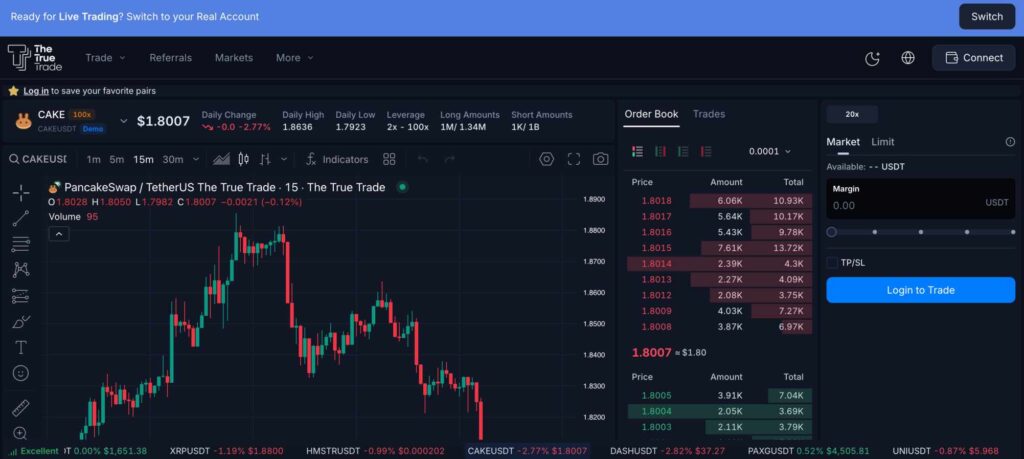
Traders use virtual USDT instead of real money, which enables a risk-free experience.
Long-Term Trades Without Funding
Perpetual futures platforms typically support short-term strategies, as ongoing funding rates deplete the margin balance over time.
We found that The True Trade is the only derivative exchange to remove the funding rate system. This unique feature allows long-term leverage trading without time restrictions.
Two Trading Dashboards
To serve all trading profiles, The True Trade developed two separate platforms.
Experienced traders navigate an advanced platform with technical analysis tools, while beginners can use a modified dashboard that simplifies derivative trading.
The True Trade Trading Fees
We researched DEX platform fees and compared them with other futures trading platforms. Read on to evaluate whether The True Trade offers a competitive fee structure.
Trading Commission
Derivative traders incur flat fees, regardless of the order type or average monthly volume. The exchange charges makers and takers 0.04% per side, which it applies against the total notional value (margin multiplied by leverage multiplier).
The True Trade’s fee system disincentivizes crypto whales, as they receive no discounts when they meet 30-day trading milestones or rebates for providing platform liquidity.
So, how do fees compare with the best crypto leverage trading platforms? MEXC also charges takers 0.04% per side, although makers pay just 0.01%. At 0.05%, Binance is slightly more expensive for takers, yet it reduces commissions to 0.02% for makers. Binance also discounts commissions when futures traders increase their monthly volumes or hold BNB.
Fellow BNB Chain DEX Aster applies the same 0.04% commission on market orders, while limit orders incur a tiny fee of 0.005%.
Funding Rates
Perpetual futures traders must include funding rates in their trading costs. MEXC, Binance, Aster, and most other derivative platforms apply funding fees every eight hours. Long or short positions incur them, and the opposite position receives them.
In an industry first, The True Trade eliminates funding rates on all listed futures markets. This means that whether users trade long or short on major or mid-cap assets, they can maintain positions indefinitely without paying ongoing charges.
This fee-free service lets traders deploy long-term strategies with leverage. The initial margin balance remains constant, as funding cannot erode the minimum margin requirement.
Network Fees
When True Trade users trade in Web3 mode (recommended to ensure complete non-custodial control), they place long and short orders directly on the BNB Chain. They connect a wallet to the DEX, and each position triggers a unique smart contract.
Each smart contract transaction requires BNB Chain gas, which traders cover from their connected wallet. As a cost-effective ecosystem, BNB Chain fees average just $0.02–$0.30.
The True Trade Fees Summarized:
| Product Type | Fee |
| Maker Commission | 0.04% |
| Taker Commission | 0.04% |
| Fee Discounts? | None |
| Funding Rates | 0% indefinitely |
| Liquidation Fee | None |
| Network Fee | BNB Chain gas fee per trade |
User Experience
Due to the platform’s derivative-only model and high-leverage support, The True Trade targets intermediate-to-advanced traders. Exchange users must understand basic derivative concepts like initial margin and liquidation, as well as how to place DEX trades via non-custodial wallets.
While The True Trade offers complex trading instruments, its “simple” dashboard helps beginners navigate the perpetual futures market. Isolated contracts ensure capped losses on unsuccessful trades, and reduced leverage multipliers on smaller-cap assets mitigate market exposure.
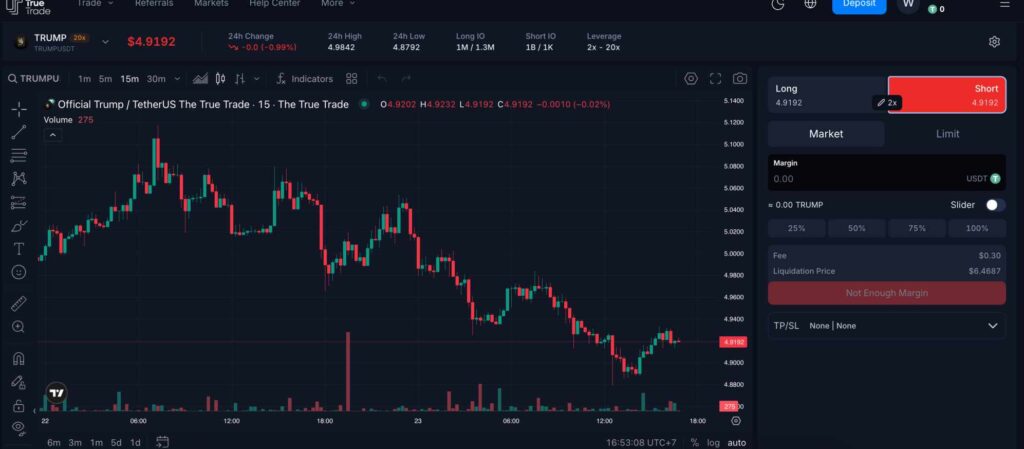
The DEX offers an “advanced” trading dashboard for experienced traders, which supports more diverse charting tools and order types. The clean layer enables high-level analysis, and customization features let traders set their preferred screen layouts.
High-frequency and scalping traders also like the DEX for its fast execution speeds. Thanks to its BNB Chain integration, The True Trade boasts average settlement times of under 5ms.
Getting started takes seconds, as users simply link a non-custodial wallet to the dashboard, set up an order, and execute positions near-instantly. Once users close a trade, assuming they avoid liquidation, smart contracts transfer the proceeds to the same wallet.
We did, however, find the mobile trading experience less convenient compared with the desktop platform.
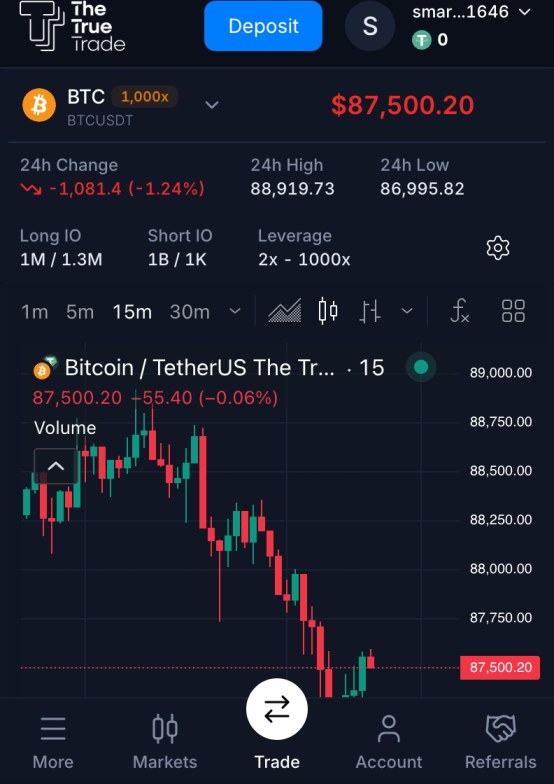
Smartphone traders must use their built-in mobile browser, as the DEX does not offer an iOS or Android app. While the derivative exchange optimizes most features for mobile devices, some functions create an awkward experience.
Is The True Trade a Safe Crypto Exchange?
The BNB Chain blockchain and decentralized smart contracts power The True Trade, so its security systems differ from centralized exchanges like Binance.
Non-custodial trading is the main safeguard, with on-chain settlement letting traders minimize counterparty risks. Users post margin without depositing funds into a centralized account and retain full asset ownership at all times. As long as traders remain in Web3 mode, The True Trade does not touch client-owned cryptocurrencies.
The on-chain system also creates a transparent trading environment. BNB Chain records every buy and sell order in near real time, and once posted, immutability ensures no one can amend those transactions. Centralized platforms rely on opaque order books with minimal third-party audits, so account holders must trust that fair trading practices are in place.
The True Trade supports two-factor authentication, but only in Gasless mode. Gasless mode reduces decentralization, as users create an account and transfer funds to a unique deposit address. Smart contracts govern those funds, but only Web3 mode ensures complete autonomy.
How to Use The True Trade
Our step-by-step tutorial explains how to trade leveraged derivatives on The True Trade DEX. We explain the process in Web3 mode, which maximizes non-custodial control and asset privacy.
Step 1: Download a Secure Non-Custodial Wallet
Web3 mode requires users to connect a non-custodial wallet to The True Trade and use existing crypto balances for margin. Therefore, those without a wallet must download one before they visit the DEX.
The True Trade supports USDT on the BEP-20 standard only when using Web3 mode, so you need a wallet that supports the native blockchain of BNB Chain.
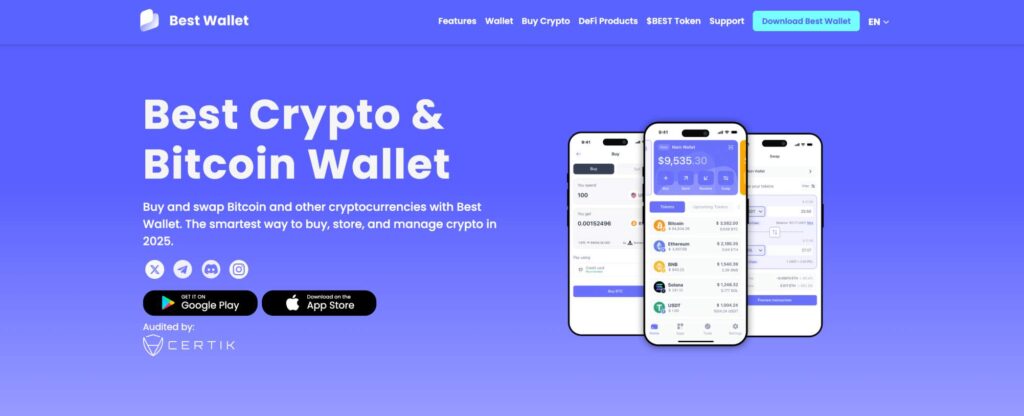
Our research shows that Best Wallet is one of the best no-KYC wallets for DEX trading. The multi-chain wallet, which supports multiple networks, offers strong security, privacy-centric features, and a built-in on-ramp that enables anonymous fiat purchases. Best Wallet users can execute positions on The True Trade’s desktop website and approve them on the iOS or Android app.
Visit Best Wallet, download the free mobile app, and follow the setup steps. Core requirements include selecting a PIN, uploading backup credentials to iCloud or Google Drive, and enabling biometrics.
Step 2: Add Cryptocurrencies to the Wallet
The decentralized model requires traders to add USDT to the wallet balance. Thereafter, the USDT balance lets traders cover margin positions without depositing funds into a centralized account.
You can transfer USDT to the Best Wallet app, either from an exchange or another wallet provider. Tap the “USDT” (BNB version) icon on the main interface, and copy the provided BEP-20 address. Ensure you use the correct network; Best Wallet’s non-custodial framework cannot help users recover lost assets.
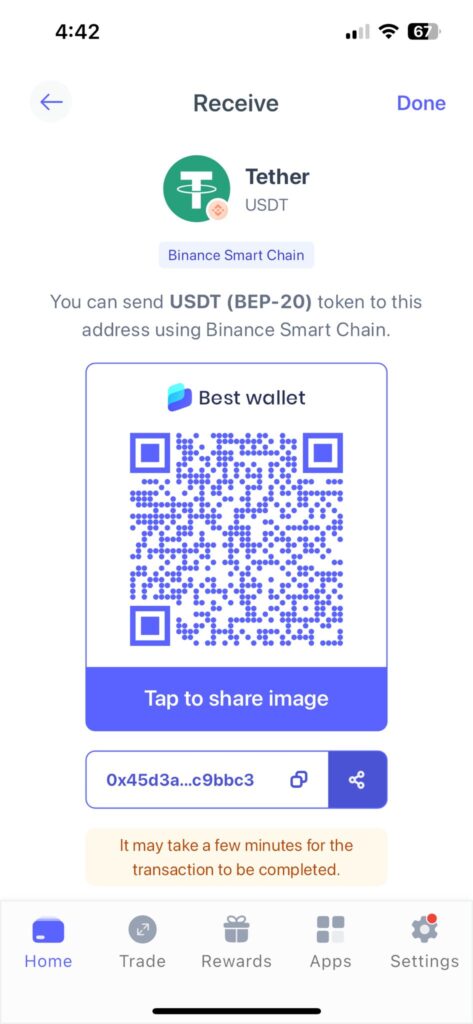
The app also supports fiat payments, including e-wallets, debit/credit cards, and local bank transfers.
Select “Trade” and “Buy”, choose USDT on the BEP-20 standard, and complete the payment form. Gateways process Best Wallet transfers instantly and automatically send assets to the user’s address.
Note: You need a small amount of BNB to cover network fees. Best Wallet offers a built-in DEX that instantly swaps USDT for BNB with minimal fees.
Step 3: Connect to The True Trade DEX
Head to The True Trade website on a mobile or desktop device. We suggest using the desktop platform for a smoother trading experience.
In the top-right corner, click the “Connect” button. Then tap “Wallet” and “Wallet Connect”. Open the Best Wallet app and scan the QR code displayed on the screen.
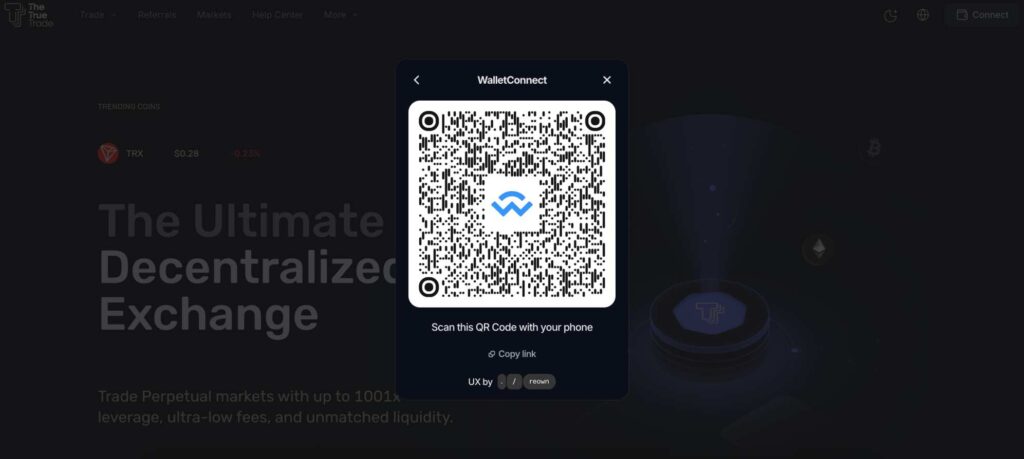
Within the app, a notification appears requesting approval to connect to The True Trade. Review the request and provide authorization.
The DEX then displays a pop-up message requesting additional approval. Click the “Sign & Verify” button to confirm wallet ownership. Ensure you switch from “Gasless” to “Web3” mode on the top menu bar.
Step 4: Search for a Perpetual Futures Market
Under the “Trade” menu, select either the “Simple” or “Advanced” platform, depending on your experience level (our example shows the Simple dashboard).
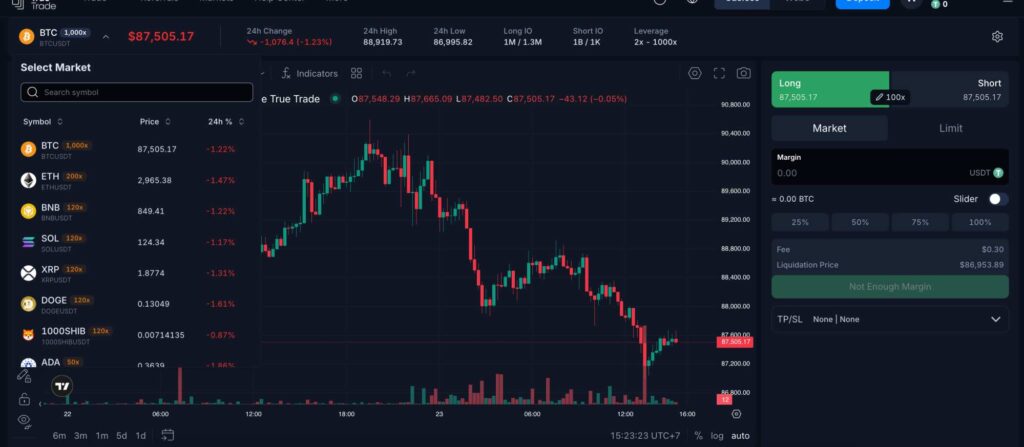
Tap the small arrow next to BTC/USDT and search for a trading market. Enter the asset’s ticker symbol instead of its full name.
Step 5: Place a Long or Short Futures Trade With Leverage
Select the “Long” or “Short” button to the right of the pricing chart. You choose long if you believe prices will rise, and select short if you predict they will fall.
Then choose between a market or a limit order. Beginners use market orders for instant execution. Experienced traders prefer limit orders, as they specify the exact price at which a trade will be executed.
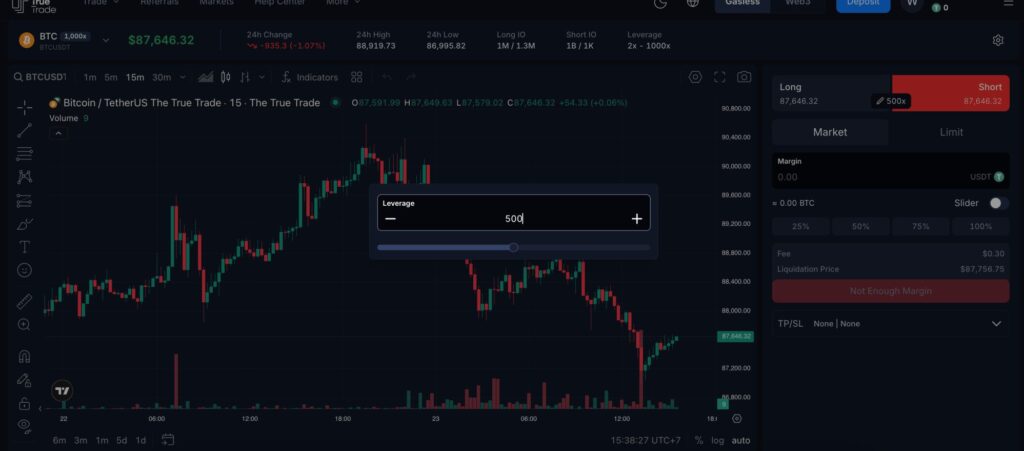
Enter the “Margin” amount in USDT (the total amount you want to risk on the trade) and select a leverage multiplier.
The True Trade also supports stop-loss and take-profit orders, which we recommend to reduce trading risk.
Confirm the perpetual futures order to place the trade.
As you trade in Web3 mode, smart contracts automatically transfer settled trades to your wallet balance.
Conclusion: Who is The True Trade Best Suited to?
The True Trade caters to crypto traders seeking high-leverage futures markets within a decentralized environment. Its non-custodial ecosystem, which operates on the BNB Chain, offers industry-leading leverage multipliers of 1001x without funding rates.
To enhance privacy and asset control, traders utilize Web3 mode, which allows users to trade without opening an account or depositing assets. Instead, they connect a non-custodial wallet to the DEX and trade futures directly from the wallet balance.
Our Methodology for Reviewing The True Trade
Our methodology tested the platform with real USDT funds. We connected a non-custodial wallet to The True Trade DEX and explored both trading modes: Gasless and Web3.
Before entering positions, we examined all core options, including listed perpetual futures, contract specifications, available order types, and the commission structure.
Next, we placed buy and sell orders across dozens of derivative markets, including major assets like BTC, ETH, and XRP, and less liquid tokens like LINK and SAND. By placing real orders, we experienced the platform firsthand and logged spreads, liquidation prices, and network fees.
We repeated the testing process on desktop and mobile browsers and compared our findings with the top 20 perpetual futures DEXs, per CoinMarketCap.
FAQs
Is The True Trade a legit exchange?
Can I use The True Trade in my country?
Does The True Trade require KYC checks?
Who owns The True Trade exchange?
How do you withdraw money from The True Trade?
References
- Help documents and trading rules (The True Trade)
- What is perpetual trading? (MetaMask)
- What Is a DEX (Decentralized Exchange)? (Chainlink)
- BNB Fee Explained (Token Terminal)
- Custodial vs non-custodial wallets: What’s the difference? (MoonPay)
- BNB Chain: Empowering the Future of Decentralized Applications (BNB Chain)
