


Best Crypto Margin Trading Platforms in October 2026
We may earn commissions from affiliate links or include sponsored content, clearly labeled as such. These partnerships do not influence our editorial independence or the accuracy of our reporting. By continuing to use the site you agree to our terms and conditions and privacy policy.

Margin allows crypto traders to apply high leverage multipliers to their positions, boosting their purchasing power and enabling them to trade digital assets in both market directions. Traders typically borrow funds from online exchanges and pay interest or funding fees, making this strategy suitable for short-term investments. Discover the best crypto margin trading exchanges for traders in our beginner’s guide.
We rank the top margin platforms for leverage limits, competitive fees, supported pairs, and payment methods, and reveal proven strategies to minimize risk and maximize profit potential. Learn everything you need to know about crypto leverage trading, including how to set up a margin account in under five minutes.
Key Takeaways
- Margin trading lets you amplify your positions with leverage multipliers, boosting your purchasing power – but also increasing the risk of liquidation.
- Top crypto margin exchanges like CoinFutures, MEXC, Binance, Kraken, and Bybit differ widely in leverage limits, fees, and supported markets, so your choice of platform has a big impact on costs and risk.
- Regulators in some regions, including the UK and parts of the US, restrict or ban leveraged crypto products for retail clients, so many traders rely on no-KYC platforms to access margin accounts.
Best Crypto Margin Trading Exchanges Ranked for 2026
In our view, listed below are the overall best crypto margin trading exchanges:
- CoinFutures: Beginner-Friendly Futures Platform With a 0.1% Margin Requirement
- MEXC: Gain Exposure to a Huge Selection of Perpetual Futures Markets
- Bitpanda: Top Spot Margin Trading Brokerage Offers Up to 10x Leverage
- Binance: Best Margin Trading Platform for Deep Options Chains
- Kraken: Spot Margin Accounts Increase Crypto Purchasing Power by 10 Times
- WEEX: Free Demo Trading Feature With 200x Leverage on Crypto Futures
- Margex: Generate 7% APYs on Liquid Crypto Margin Collateral
- BloFin: Popular Futures Trading Exchange With High Leverage on Meme Coins
- KCEX: The Lowest-Fee Online Exchange for Crypto Margin Trading
- PrimeXBT: Best Margin Provider for Low-Cost Fiat Deposits and Withdrawals
- Bybit: Global Tier 1 Exchange With Long-Term Margin Products
A Closer Look at the Best Crypto Margin Trading Platforms (Full Reviews)
We opened accounts with the top margin platforms for cryptocurrencies, tested the trading dashboard, available features, and execution speeds, and researched fees, listed markets, and supported payment methods. The extensive research process (which we explain in more depth further down) enabled us to rank the best providers by core factors.
Consider the following platforms when exploring where and how to margin trade crypto.
1. CoinFutures: The Best Crypto Margin Trading Platform for Beginners
- Upfront Margin Requirement: 0.1%
- Maximum Leverage Available: 1000x
- Supported Margin Trading Markets: 11+
- Margin Trading Commissions: A flat upfront commission or a profit-based fee. Charges vary by market and leverage multipliers
- Minimum Fiat Deposit Requirement: $0
- Withdrawal Fees: 5 USDT
While margin trading can be a complex undertaking, CoinFutures simplifies leverage exposure for complete beginners. The desktop and mobile platforms provide an easy trading experience, enabling users to go long or short via “Up” and “Down” orders. They simply input the trading stake, leverage multiplier, and market direction, and CoinFutures executes the positions immediately.
Our research confirms that at 1,000x, CoinFutures offers the highest leverage limits globally. Those who risk the minimum margin requirement of $1 access $1,000 in trading capital. The dashboard supports stop-loss and take-profit orders, which let traders reduce risk and automatically lock in profitable positions.
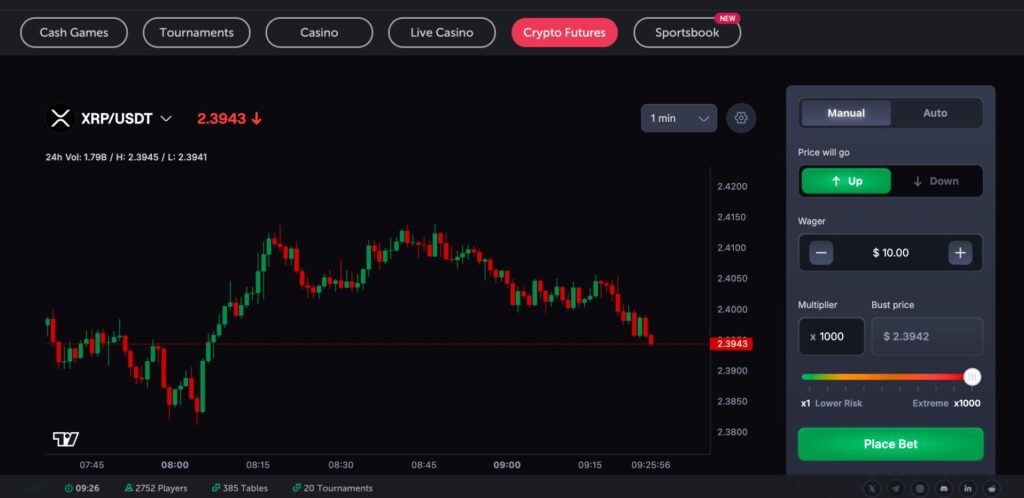
The futures provider supports major cryptocurrencies, including Bitcoin (BTC), XRP (XRP), Dogecoin (DOGE), and Ethereum (ETH), with markets settling in Tether (USDT). The best way to deposit funds is by debit card and credit card or via Google Pay or Apple Pay. That said, some users prefer crypto wallet transfers to avoid Know Your Customer (KYC) verification.
Pros
- In our view, the best crypto margin trading exchange for 2026
- The simplified dashboard suits first-time margin traders
- 1000x leverage is the highest in the industry
- Trade long or short on major cryptocurrencies from $1
- Accepted deposit methods include e-wallets and debit/credit cards
- The licensed platform publishes daily proof of reserves
- Available as a desktop software or mobile app
Cons
- Traders access just one meme coin pair
- The platform lacks support for automated trading bots
2. MEXC: Top-Rated Margin Exchange With an Extensive Range of Crypto Pairs
- Upfront Margin Requirement: 0.2%
- Maximum Leverage Available: 500x
- Supported Margin Trading Markets: 1,100+
- Margin Trading Commissions: 0.01% (limit orders) and 0.04% (market orders)
- Minimum Fiat Deposit Requirement: $10
- Withdrawal Fees: €1 on SEPA withdrawals. Crypto withdrawal fees vary by asset
Active margin traders use the MEXC exchange to access a huge selection of digital assets. With over 1,100 perpetual futures listed, users gain exposure to every imaginable crypto category. Major cryptocurrencies feature BTC, ETH, XRP, BNB (BNB), and Litecoin (LTC), while speculative meme coins include DOGE, Shiba Inu (SHIB), and Floki (FLOKI).
We found that MEXC often adds new markets daily, which enables users to trade new cryptocurrencies with 1000x potential. The exchange offers a top-tier leverage limit of 500x on large-cap assets and 300x on major altcoins. Less liquid pairs typically limit multipliers to 100x. Traders choose between linear USDT or USDC (USDC) futures, or inverse contracts that settle in the underlying asset.
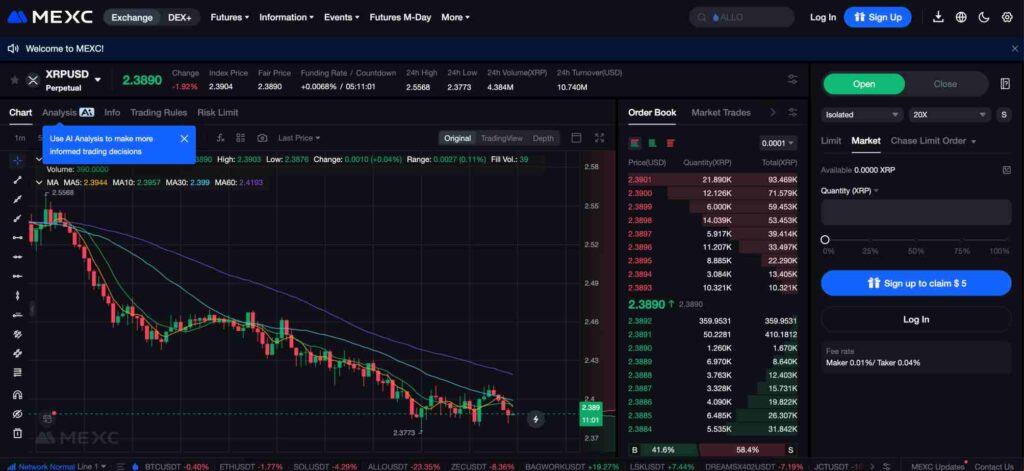
To deposit funds into the MEXC account, most traders transfer cryptocurrencies to achieve anonymity. Users who complete KYC may use fiat payment methods like Google/Apple Pay, Visa, and MasterCard. Regarding trading fees, MEXC offers 0% commissions on limit orders. Those who place market orders pay just 0.05% per side.
Pros
- Get leverage multipliers of up to 500x on large-cap cryptocurrencies
- Margin trade over 1,100 perpetual futures
- Futures contracts settle in stablecoins or the underlying asset
- Verified accounts deposit funds instantly with local payment types
- The derivative exchange offers commission-free trading on limit orders
Cons
- The advanced trading dashboard does not appeal to novice traders
- U.S. and Canadian users face geo-restrictions
3. Bitpanda: Popular Spot Margin Trading With Built-In Risk Management Tools
- Upfront Margin Requirement: Varies by asset
- Maximum Leverage Available: 10x
- Supported Margin Trading Markets: 120+
- Margin Trading Commissions: 0% buy fee, 0.18% daily holding fee (charged every 4 hours), 0.3% sell fee
- Minimum Fiat Deposit Requirement: Varies by payment method
- Withdrawal Fees: No withdrawal fees
Bitpanda is a strong option for traders who want margin exposure without stepping into high-risk perpetual futures. Founded in 2014, the platform operates as a European brokerage and has built a reputation for security and compliance.
Its margin trading product focuses on spot trading with leverage, allowing users to trade real crypto assets rather than derivative contracts.
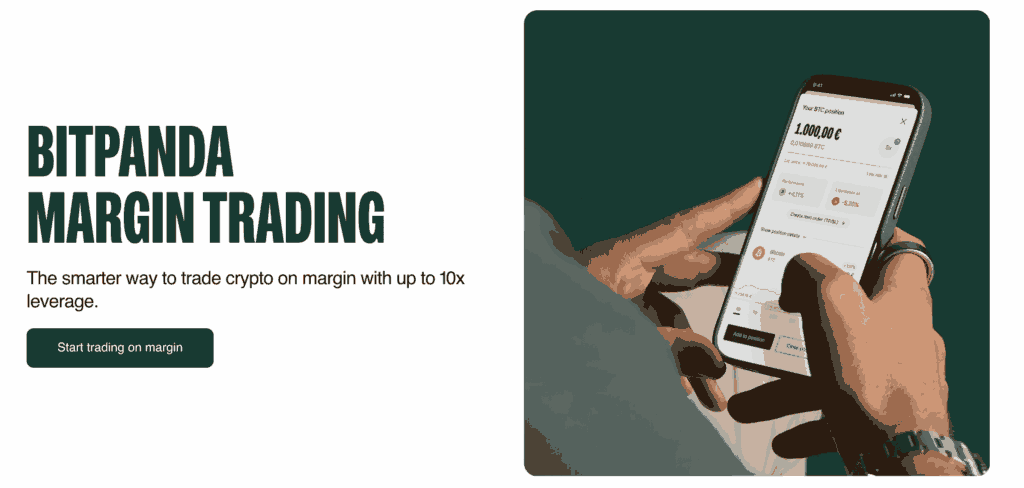
Traders can access more than 120 cryptocurrencies with leverage options of 2x, 3x, 5x, and up to 10x, depending on liquidity. Major assets like Bitcoin and Ethereum support the maximum leverage, with clearly defined liquidation thresholds. One of Bitpanda’s key strengths is risk control.
The platform offers real-time monitoring, notification alerts before liquidation, and margin limit orders such as stop-loss and take-profit, helping users manage positions more precisely. For traders who value regulation, clear fees, and structured risk management, Bitpanda delivers a balanced margin trading experience.
Pros
- Popular trading brokerage
- Spot margin trading with real crypto assets
- No withdrawal fees
- Up to 10x leverage on major cryptos
- Advanced risk alerts and margin limit orders
Cons
- Lower leverage compared to other platforms
- Smaller selection of margin markets than futures platforms
4. Binance: Trade Leveraged Cryptocurrencies Through Options Contracts
- Upfront Margin Requirement: 0.67%
- Maximum Leverage Available: 150x
- Supported Margin Trading Markets: 660+
- Margin Trading Commissions: Options: 0.024%. Futures: 0.02% (limit orders) and 0.05% (market orders)
- Minimum Fiat Deposit Requirement: $10
- Withdrawal Fees: €1 (SEPA), 2% (debit/credit cards), and 1.2% (ZEN). No fees on P2P withdrawals. Crypto withdrawal fees vary by asset
Binance provides an extensive options trading facility that helps users limit downside. Traders pay a small upfront premium to purchase call or put options, which reflects the maximum risk they are willing to accept. If contracts land in the money, traders buy or sell the underlying asset at the strike price they purchased. This margin structure offers a favorable risk-reward spectrum.
The options platform supports the best cryptocurrencies, including BTC, ETH, BNB, and Solana (SOL). Contract expiration dates range from one day to about nine months, and since users avoid conventional funding rates, they can hold until maturity without paying ongoing fees. Options traders pay a flat commission of 0.024%, regardless of the order type.
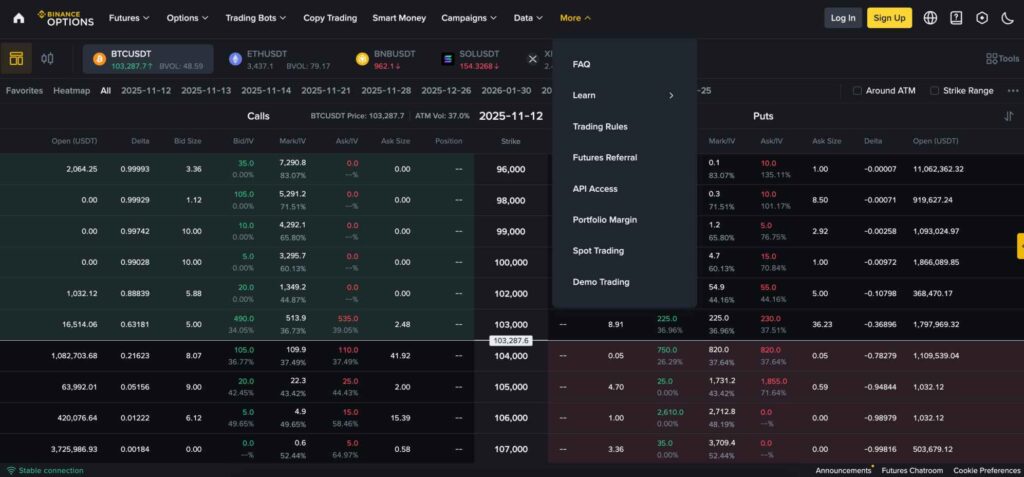
Binance also ranks among the best crypto margin trading exchanges for futures. It supports hundreds of delivery and perpetual contracts with low fees and deep liquidity. As BTC/USDT offers a maximum leverage of 150x, high-risk traders are required to post a minimum margin of just 0.67%. Futures trading commissions are 0.02% and 0.05% for limit/market orders.
Pros
- Options let users magnify purchasing power with limited downside
- Hold call and put options until maturity without ongoing fees
- Expiration timeframes offer short and long-term contracts
- Perpetual futures offer a maximum leverage of 150x
- One of the most advanced desktop trading suites in crypto
Cons
- Options trading is highly complex
- The exchange blocks derivative products in some regions
5. Kraken: Regulated and Safe Spot Margin Accounts With a 10% Collateral Requirement
- Upfront Margin Requirement: 10%
- Maximum Leverage Available: 10x
- Supported Margin Trading Markets: 150+
- Margin Trading Commissions: 0.02% (limit orders) and 0.04% (market orders)
- Minimum Fiat Deposit Requirement: $1
- Withdrawal Fees: No fees on local bank transfers (e.g., ACH and SEPA). Crypto withdrawal fees vary by asset
Kraken is a well-established cryptocurrency exchange with a robust regulatory framework. Licensing bodies in Europe, the U.S., and other global jurisdictions regulate the platform, and strong account security mechanisms ensure client-asset safety. The exchange accepts local bank transfers without transaction fees, and the minimum first-time deposit is just $1.
Based on our Kraken review, we found that for leverage trading products, Kraken offers spot margin accounts with a 10% collateral requirement. Account holders increase purchasing power by 10 times, based on the assets they already hold with Kraken. The margin facility supports over 150 assets, including top altcoins like LTC, XRP, Popcat (POPCAT), Polkadot (DOT), and Avalanche (AVAX).
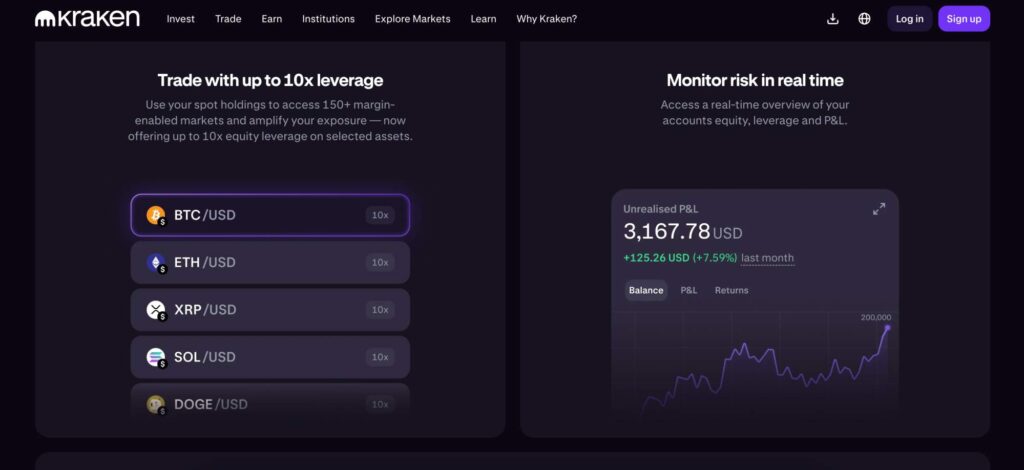
Trading commissions align with those of other margin platforms; limit and market orders incur costs of 0.02% and 0.04%, respectively. Traders with high monthly volumes get lower fees. The biggest drawback is that Kraken charges rollover fees of up to 0.04% every four hours. This fee structure quickly dilutes the collateral balance, so its margin products are primarily targeted at day traders.
Pros
- One of the best crypto exchanges for strong security and top-tier regulation
- Margin accounts amplify asset holdings by 10x
- Gain exposure to over 150 cryptocurrencies on margin
- Get started with a $1 minimum deposit
Cons
- Non-major assets offer lower leverage multipliers
- Margin positions incur rollover fees of up to 0.04% every four hours
6. WEEX: Trade 200x Perpetual Futures Risk-Free on a Simulated Demo Platform
- Upfront Margin Requirement: 0.5%
- Maximum Leverage Available: 200x
- Supported Margin Trading Markets: 890+
- Margin Trading Commissions: 0.02% (limit orders) and 0.08% (market orders)
- Minimum Fiat Deposit Requirement: $15
- Withdrawal Fees: No fiat withdrawals. Crypto withdrawal fees vary by asset
WEEX offers a free demo trading platform that simulates real crypto futures markets. The demo feature offers full charting functionality with drawing tools, adjustable timeframes, and technical indicators. Users receive replenishable virtual funds to practice margin trading in a risk-free environment. The key downside is that demo traders access BTC and ETH markets only.
Real-money users trade over 890 cryptocurrencies, including top meme coins like SHIB, FLOKI, Bonk (BONK), and Pepe (PEPE). Traders apply a maximum leverage of 200x with a small 0.5% upfront margin requirement. Entry and exit order types, such as stop-loss, take-profit, post-only, and trigger, allow traders to deploy custom strategies.
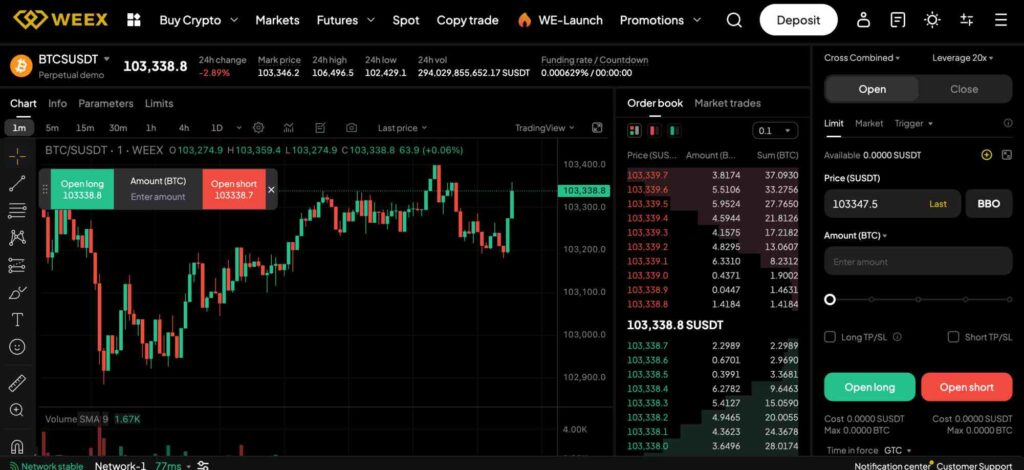
In terms of fees, WEEX charges commissions based on order type and VIP levels. The standard commission is 0.02% for limit orders and 0.08% for market orders. 0.01% and 0.04% are the lowest commission rates, which require a monthly derivative volume of over $500 million. The platform also increases VIP tiers based on average asset holdings.
Pros
- Learn how to margin trade crypto on a free demo platform
- Go long and short on over 890 cryptocurrencies
- Affordable minimum margin requirements of 0.5%
- Custom order types include trigger, post-only, and stop-loss
Cons
- The demo feature supports BTC and ETH only
- Higher futures trading commissions than the market average
- Account holders cannot withdraw fiat money
7. Margex: Stake Crypto Margin Collateral to Earn Flexible 7% APYs
- Upfront Margin Requirement: 1%
- Maximum Leverage Available: 100x
- Supported Margin Trading Markets: 55+
- Margin Trading Commissions: 0.019% (limit orders) and 0.06% (market orders)
- Minimum Fiat Deposit Requirement: $10
- Withdrawal Fees: No fiat withdrawals. Crypto withdrawal fees vary by asset
Margex is one of the top crypto margin trading exchanges for earning passive rewards. Its revolutionary staking feature offers APYs of up to 7% on major assets like ETH, USDT, USDC, and BTC. The platform distributes rewards daily, and depositors use staking balances to post margin. This mechanism unlocks liquidity instantly for leverage trading.
The exchange, which has a minimum debit/credit card and e-wallet balance of $10, offers approximately 55 perpetual futures markets. Margin traders have access to leverage of between 25x and 100x, depending on the specific crypto pair. All futures products settle in USDT, and traders use isolated margin trading or cross margin trading according to their risk tolerance.
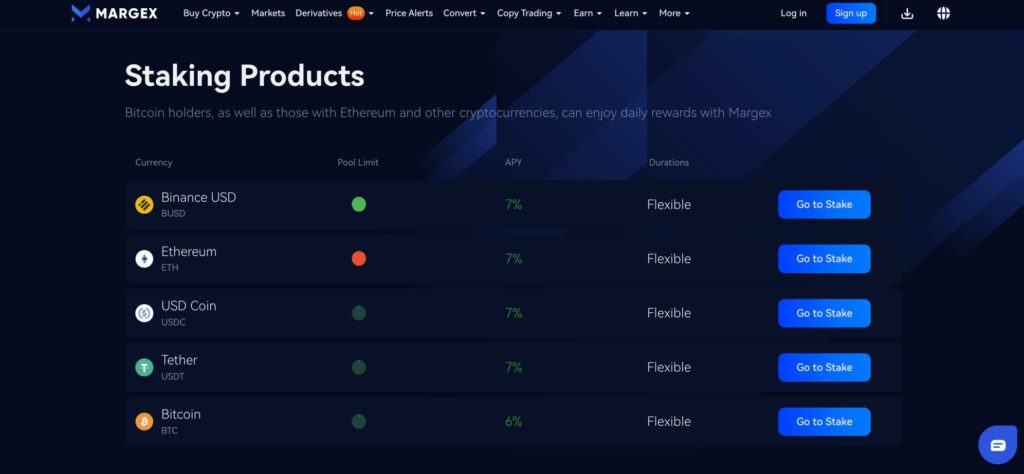
We found that taker fees tend to be less competitive than many margin exchanges, as traders pay 0.06% per side on market orders. Limit orders are cheaper at 0.019%, yet Margex offers no fee reductions on larger monthly volumes. To test Margex before depositing real money, use the free demo platform. The simulated dashboard offers over 5,000 BTC in preloaded capital.
Pros
- Earn up to 7% APYs when you stake crypto balances
- Allocate staking funds to perpetual futures positions
- Margin requirements start at just 1%
- Simulated trading accounts come with over 5,000 BTC
Cons
- Platform users access fewer markets than other margin providers
- Funding rates can be expensive on lower-cap pairs
- No commission discounts for large trading volumes
8. BloFin: A Great Option to Trade Meme Coin Markets on Margin
- Upfront Margin Requirement: 0.67%
- Maximum Leverage Available: 150x
- Supported Margin Trading Markets: 590+
- Margin Trading Commissions: 0.02% (limit orders) and 0.06% (market orders). Fees rise to 0.2% on select markets
- Minimum Fiat Deposit Requirement: $15
- Withdrawal Fees: No fiat withdrawals. Crypto withdrawal fees vary by asset
BloFin offers a wide range of meme coin markets via perpetual futures. Markets include top Solana meme coins such as BONK, dogwifhat (WIF), and OFFICIAL TRUMP (WIF), as well as Ethereum-based projects like SHIB and PEPE. Leverage of up to 150x is available, depending on the pair.
The trading dashboard is suitable for both beginners and experienced traders. It features a simple trading form for placing market orders, and risk-management tools include stop-losses and transparent liquidation prices. Seasoned pros access dozens of drawing tools and indicators, plus custom intervals for chart candlesticks.
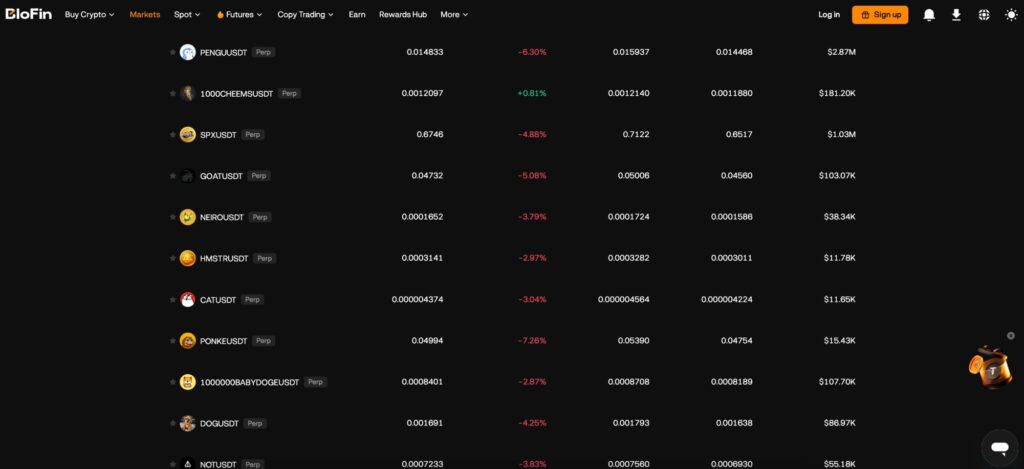
BloFin accepts fiat deposits through SEPA, SWIFT, and other banking networks. To buy cryptocurrencies instantly, use debit/credit cards or Google/Apple Pay. The platform has a small purchase requirement of $15, and no minimums for users who deposit assets from a private wallet. The exchange charges 0.02% and 0.06% on limit and market orders.
Pros
- Trade an extensive selection of meme coins through perpetual futures
- Liquid markets require a minimum margin of about 0.67%
- The proprietary trading dashboard serves all investor profiles
Cons
- The quick buy feature supports BTC, ETH, and USDT only
- Large futures orders receive lower leverage limits
- Users need an account to access demo trading features
9. KCEX: Commission-Free Futures Trading on Limit Order Placement
- Upfront Margin Requirement: 0.8%
- Maximum Leverage Available: 125x
- Supported Margin Trading Markets: 860+
- Margin Trading Commissions: 0% (limit orders) and 0.01% (market orders)
- Minimum Fiat Deposit Requirement: N/A. Crypto deposits only
- Withdrawal Fees: Fee-free withdrawals on all supported assets
We found that KCEX is the lowest-fee margin trading exchange in the market. Account holders avoid trading commissions when they place limit orders, which enables them to long and short derivatives on a spread-only basis. Traders who prefer market orders for instant execution pay a small commission of 0.1% per side.
The futures exchange supports hundreds of cryptocurrencies, including major altcoins and meme coins. Newly launched projects also utilize KCEX for initial exchange listings, which appeals to high-risk traders seeking the next cryptocurrencies to explode. Users explore available markets by the crypto category, recent performance, and market capitalization.
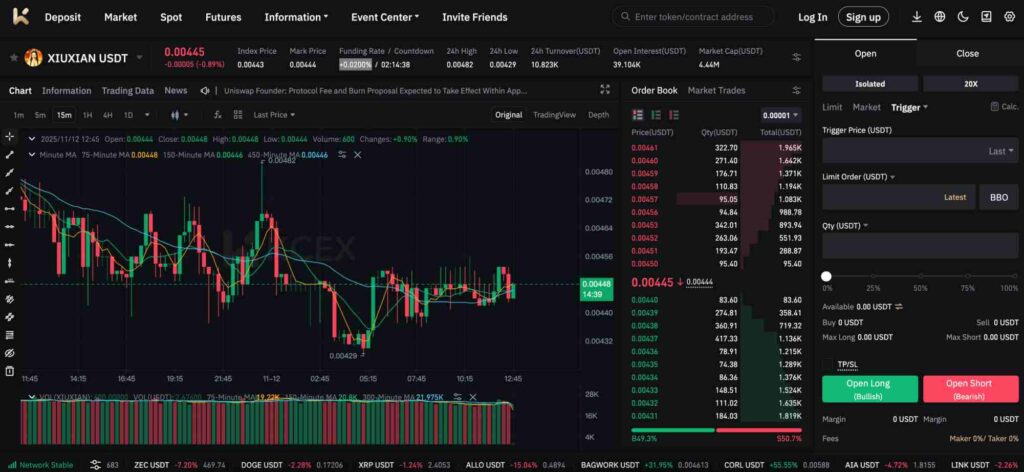
Margin requirements vary widely by the trading pair. BTC and ETH traders receive 125x leverage, while low- and mid-cap tokens offer only 25x. The platform charges competitive funding rates on most markets, and longs or shorts pay them every eight hours. Because KCEX is a crypto-only exchange, it only accepts wallet-to-wallet transfers.
Pros
- Commission-free margin trading when users place limit orders
- Competitive funding rates and fee-free crypto withdrawals
- The futures platform supports over 860 trading pairs
Cons
- Users make crypto deposits and withdrawals only
- Reduced leverage of 25x on low and mid-cap markets
- No reputable licensing bodies regulate the exchange
10. PrimeXBT: Deposit and Withdraw Fiat With Over 100 Convenient Payment Methods
- Upfront Margin Requirement: 0.5%
- Maximum Leverage Available: 200x
- Supported Margin Trading Markets: 100+
- Margin Trading Commissions: 0.01% (limit orders) and 0.045% (market orders)
- Minimum Fiat Deposit Requirement: $5
- Withdrawal Fees: Fee-free fiat withdrawals. Crypto withdrawal fees vary by asset
PrimeXBT is a global trading platform that supports multiple asset classes. Users speculate on cryptocurrencies, index funds, equities, and commodities through contracts-for-differences (CFDs). The platform also supports perpetual futures that track over 100 digital assets. All markets and instruments are available from a unified trading account.
To mitigate risk, PrimeXBT sets margin requirements based on the volatility of each pair. BTC and other large-cap coins offer up to 200x leverage, so a $100 stake provides $20,000 in market exposure. The margin exchange charges a hefty 0.045% commission on market orders, yet limit orders cost just 0.01%. Commissions are in addition to eight-hour funding fees.
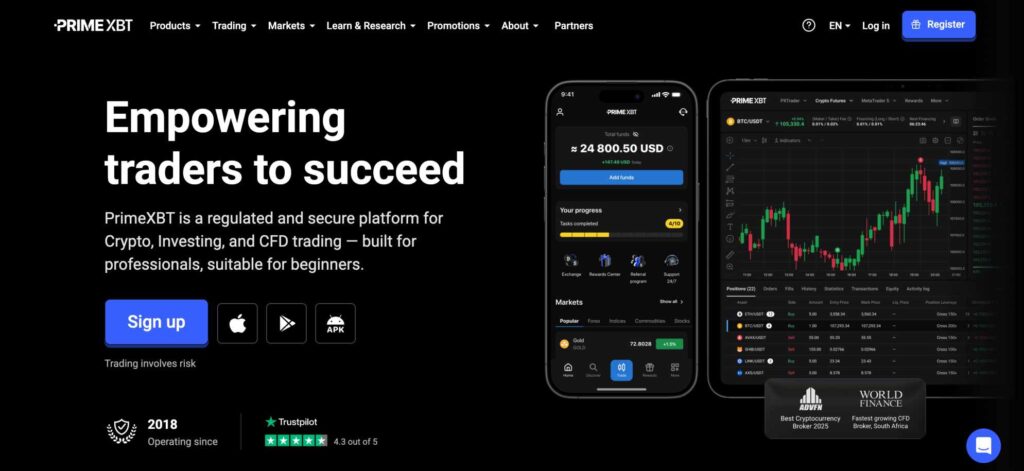
According to our research, PrimeXBT is one of the best crypto margin trading exchanges for fiat payments. It offers free deposits on most payment methods, which include Neteller, SWIFT, local bank transfers, Skrill, and debit/credit cards. Account minimums range from $5 to $15, depending on the deposit method.
Pros
- Free deposits on 100+ fiat payment methods
- Low account minimums and instant withdrawals
- Trade cryptocurrencies alongside traditional asset classes
Cons
- Does not accept clients from the U.S. and Europe
- Some commission-free markets carry wide spreads
- CFD instruments attract overnight financing fees
- In-house analysts publish market insights infrequently
11. Bybit: Employ Long-Term Margin Strategies Without Ongoing Fees
- Upfront Margin Requirement: 0.5%
- Maximum Leverage Available: 200x
- Supported Margin Trading Markets: 850+
- Margin Trading Commissions: Options: 0.02% (limit orders) and 0.03% (market orders). Futures: 0.02% (limit orders) and 0.055% (market orders)
- Minimum Fiat Deposit Requirement: $2
- Withdrawal Fees: €1 on SEPA withdrawals. Crypto withdrawal fees vary by asset
Bybit is the second-largest margin exchange by daily trading volume. We found that the platform offers methods to deploy long-term margin strategies without incurring funding or rollover fees. It lists delivery futures for BTC and ETH with an expiration of almost one year. Contract holders pay entry and exit commissions only, which Bybit caps at 0.02% or 0.055% for limit/maker orders.
Options are another long-term instrument that helps investors eliminate ongoing derivative fees. The furthest maturity is nearly 10 months on BTC and ETH, although other options markets, such as SOL and DOGE, have much shorter expirations. Bybit also offers perpetual futures, yet these incur funding rates every eight hours.
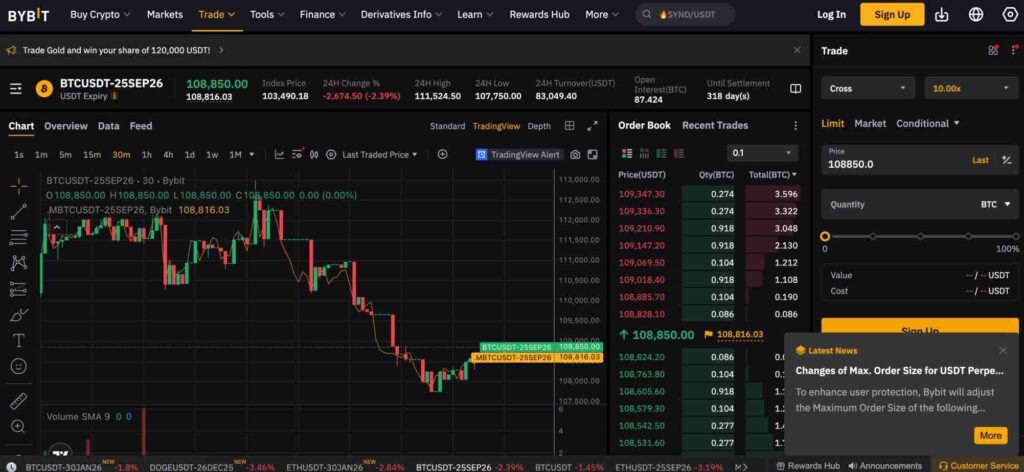
Seasoned traders rate Bybit’s advanced crypto trading tools, which include TradingView integration and candlestick timeframes from just one second. In addition to automated bots, the exchange incorporates AI-powered trading insights and a chat-style assistant to identify new market trends. Platform users also use decentralized finance (DeFi) tools like staking and crypto loans.
Pros
- Hold delivery futures and options trades long-term without ongoing fees
- Use AI-powered insights to find new trading opportunities
- Get up to 200x leverage BTC perpetuals
Cons
- The professional-style trading dashboard is unsuitable for beginners
- SWIFT deposits take up to five business days to clear
- Non-major altcoins have much shorter contract expiration dates
- The exchange prohibits U.S. traders
Our Research Methodology to Rank the Best Crypto Exchanges for Margin Trading
We conducted comprehensive research to identify the best platforms for margin trading crypto.
The research team ranked providers by the following criteria:
- Reputation and Safety: We initially short-listed margin exchanges that offer a safe trading experience, backed by real user testimonials and an established track record. Platforms like CoinFutures, Kraken, and Binance stand out for their licensed framework and transparent proof of reserves.
- Maximum Leverage: Margin traders seek platforms that offer the highest leverage limits across a wide selection of markets. MEXC offers a top-tier rate of 500x on leading cryptocurrencies, but lower limits on non-major markets. CoinFutures provides a fixed 1000x leverage multiplier on all supported pairs.
- Margin Trading Pairs: We prioritized margin exchanges with the biggest range of trading pairs. WEEX lists almost 900 markets, and most are paired with USDT or USDC. Kraken offers about 150 markets through traditional margin accounts, and over 350 when users trade futures.
- Supported Instruments: Traders access margin facilities in various ways, and each trading product suits different investment objectives. When ranking the best crypto margin trading exchanges, we included platforms that offer perpetual and delivery futures, options, and spot margin accounts.
- Platform Fees: Margin traders pay trading commissions to enter and exit positions. Some instruments incur ongoing fees, such as funding rates or interest on borrowed funds. Consider non-trading fees, too. Most platforms charge deposit and withdrawal fees, which vary depending on whether you use cryptocurrency or fiat currency.
- Eligibility and KYC Requirements: Most margin trading providers prohibit traders from specific regions, such as the U.S. and the UK. To ensure global accessibility, we included no-KYC platforms, as they allow users to register and trade anonymously. Always review country eligibility and no-KYC limits before you open an account.
- Trading Experience: We prefer crypto margin exchanges with intuitive interfaces, custom trading dashboards, and analysis tools, including technical indicators. We found Bybit and Binance suit experienced traders seeking an edge in the market, while CoinFutures and Margex tailor their margin products to beginners.
Crypto Margin Trading: An Overview
In cryptocurrency, margin allows traders to borrow funds from online exchanges to increase their market exposure. While the system aligns with traditional stock margin accounts, crypto exchanges offer significantly higher limits.
A simple example is CoinFutures, which enables users to trade cryptocurrencies with a 0.1% margin. Traders who meet the minimum margin requirement amplify positions by 1000x. In contrast, U.S. stock brokerages cap margin facilities to just 50%.
Besides margin accounts, traders also access leverage through crypto derivatives. Perpetual futures are the most common, which reflect traditional futures but without expiration dates. Other margin instruments include options and leveraged tokens.
Please note that all margin products support both long and short trading. Traders place buy or sell orders based on their market predictions. Conservative investors who want to short-sell cryptocurrencies post 100% margin to vastly reduce liquidation risks.
Crypto Margin Trading Explained: Real Example
Traders access crypto margin through different investment products, yet most instruments share core similarities.
Platforms initially require traders to post margin in digital assets. Those funds let users increase their purchasing power by a certain multiplier.
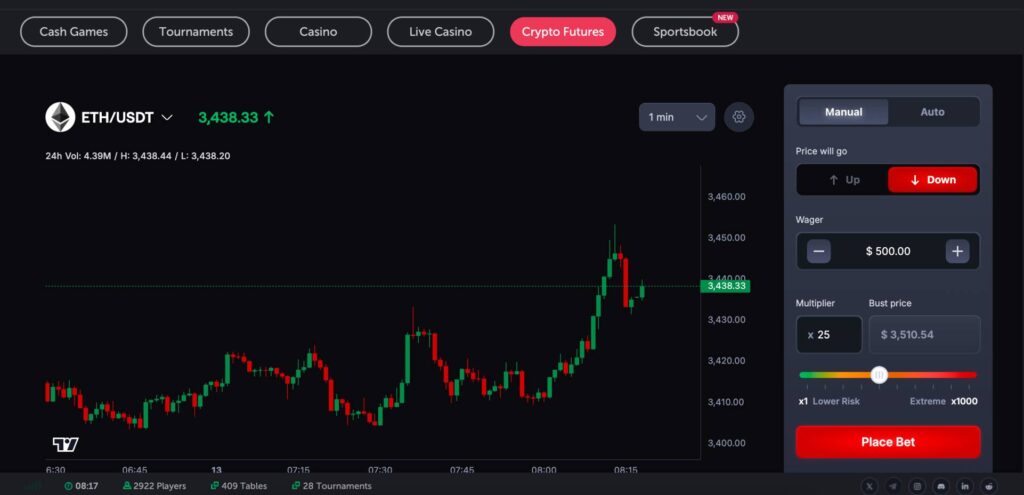
Here is a simplified example of a crypto margin setup:
- A trader posts a $500 margin on an ETH/USDT short-selling order. They apply 25x leverage on that trade, which boosts the position size to $12,500.
- The ETH/USDT price drops by 5%. The trader exits the margin trade to lock in a $625 gain ($12,500 * 5%).
- Without margin, the position generates a profit of just $25, since the 5% gain is based on a $500 stake.
Margin positions magnify profits by the applied multiplier, but they also increase trading losses. Even the best crypto margin trading platforms liquidate losing trades when they decline by the posted margin. On a 25x trade, the trader posts a 4% margin, so a 4% adverse price movement liquidates the position, and they forfeit the initial collateral.
Difference Between Crypto Margin Trading and Traditional Investing
Margin trading services suit traders who speculate on crypto price movements through short-term strategies.
Because most margin products are derivative instruments, traders do not own the underlying cryptocurrencies. While spot margin accounts buy and sell assets from the global spot trading markets, traders cannot withdraw the cryptocurrencies they trade. This framework means margin enables profit speculation without conventional asset ownership.
Crypto margin also appeals to traders who require higher purchasing power. They increase position values by the selected multiplier, enabling them to target much larger profit margins. As margin instruments allow short-selling, short-term day traders can generate returns from declining asset prices.
Crypto investing mirrors traditional financial markets, where investors buy stocks or commodities to secure ownership and profit from long-term appreciation. They place buy orders on spot exchanges, and receive the purchased assets once the platform executes the position. The investor has full control of their coins, which they can withdraw to a private wallet.
Although crypto investors own the underlying asset, they cannot apply leverage. This drawback restricts investors from buying more than they have in the exchange account. Regular investing also lacks support for short-selling. Investors only make money if the asset price increases above the original cost basis.
Crypto Margin Trading: Pros and Cons
Summarized below are the pros and cons of trading digital assets on margin:
Pros
- Crypto traders go long or short to profit from rising and falling markets
- Margin enables traders to magnify market exposure by significant multipliers
- Traders control substantial position sizes without needing to deposit large amounts
- A wide range of leverage products includes spot margin accounts, options, and futures
- Margin improves capital efficiency and lets traders open a greater number of positions
- To mitigate risk on existing asset holdings, traders use margin as a hedging tool
Cons
- Leveraged positions incur high commissions and ongoing fees
- Traders face liquidation risks when they trade on margin
- Margin instruments lack real crypto asset ownership
- Most products suit short-term strategies only
Crypto Margin Trading Fees to Consider
Margin exchanges charge fees for opening, maintaining, and closing trading positions. Consider the following trading costs before you apply leverage.
Commissions Per Side
Similar to regular investing, the best crypto margin trading exchanges charge commissions per side. Exchange users pay a flat commission when they enter the market, based on the total trade value.
A MEXC trader who posts a $200 margin with 100x leverage controls $20,000 in market exposure. MEXC charges 0.04% on market orders, so the trader pays an entry commission of $8. If the trader closes the margin trade at a value of $30,000, they again pay 0.04%, which converts to $12.
MEXC, like other top exchanges, offers lower commissions when users place limit orders. Some platforms also reduce commissions when traders hold the exchange’s native token or increase their VIP tier.
Funding Fees
When traders speculate on derivatives, such as perpetual futures, they may incur funding fees to maintain their positions. The funding mechanism charges one side of the market only, which means longs send payments to shorts or vice versa. The imbalance between long and short positions determines which side pays fees.
Crypto margin trading exchanges use this structure to align derivative and spot prices. We found that most platforms charge funding fees every eight hours, although on Kraken, traders incur them every four hours. Because fees are correlated with the trading pair, large-cap markets typically offer the most competitive rates.
To avoid ongoing funding fees, margin traders use options or delivery futures. Both products allow users to hold contracts until expiration without incurring additional fees.
Margin Interest
Spot margin accounts on Kraken, Binance, and other popular exchanges use an alternative fee structure. As traders borrow capital from the platform, they pay ongoing interest regardless of the market direction. Exchanges deduct those interest fees from the posted margin, which renders positions unsuitable for long-term strategies.
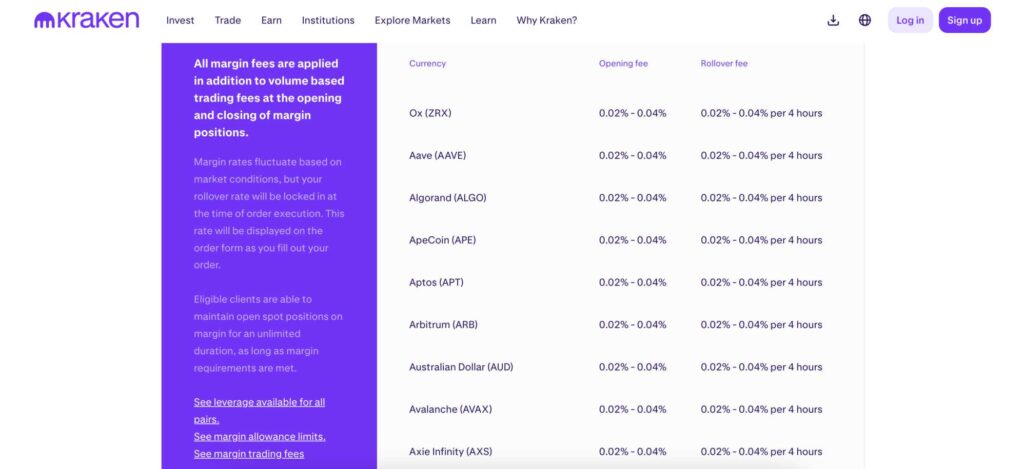
Kraken charges up to 0.04% in margin interest every four hours. The platform calculates fees based on the total position amount. If a Kraken trader places a $1,000 trade with 10x leverage, after four hours (assuming no price movement), that $10,000 exposure incurs a $4 fee.
Crypto Margin Trading Exchanges: Legal Status in 2026
Most countries permit their residents to trade cryptocurrencies on margin, as no specific legislation prohibits it. Some exceptions exist, where financial regulators prohibit retail clients from accessing leveraged crypto products.
The UK’s Financial Conduct Authority (FCA) banned crypto derivatives in 2021. The FCA’s decision imposes an outright ban on futures, options, CFDs, and other leveraged financial products.
In the U.S., retail clients may access crypto margin, but the Commodities Futures Trading Commission (CFTC) must approve exchanges. Similarly, while European clients can trade crypto derivatives, platforms must comply with the Markets in Crypto-Assets Regulation (MiCA).
Our market research shows that regulatory enforcement remains a challenge, as the best no-KYC crypto exchanges offer anonymous margin accounts. Traders register with email addresses or mobile numbers, and deposit and withdraw digital assets without ID verification. As such, traders in prohibited countries use these platforms to access margin facilities.
How to Mitigate Risk When Trading Crypto on Margin
Margin trading instruments are inherently risky. Traders must apply risk management strategies to mitigate potential losses.
Liquidation is the biggest risk, which can result in traders losing their posted margin. These risks decline considerably when traders reduce leverage multipliers. For example, most exchanges liquidate 50x trades when positions see a 2% adverse price movement. On a 4x trade, the liquidation buffer increases to 25%.
Traders avoid liquidation entirely when they place stop-loss orders. They set a price above or below the liquidation price, depending on the direction of the market. Platforms automatically close losing positions when the market triggers the stop-loss price.
Another risk management best practice is to avoid non-major cryptocurrencies, as these markets experience higher volatility. BTC, ETH, BNB, and other top assets are less volatile than meme coins like DOGE and SHIB, so trading these markets mitigates liquidation threats.
Trade Crypto Margin Safely: Step-by-Step Walkthrough
First-time margin traders can follow our step-by-step guide on how to get started. We explain how to create a margin trading account with CoinFutures and place a long or short order with sensible leverage multipliers. Read on to trade cryptocurrencies on margin in under five minutes.
Step 1: Open an Account and Download CoinPoker
Visit the CoinFutures website to register an account. The platform requires an email address, password, and account nickname.
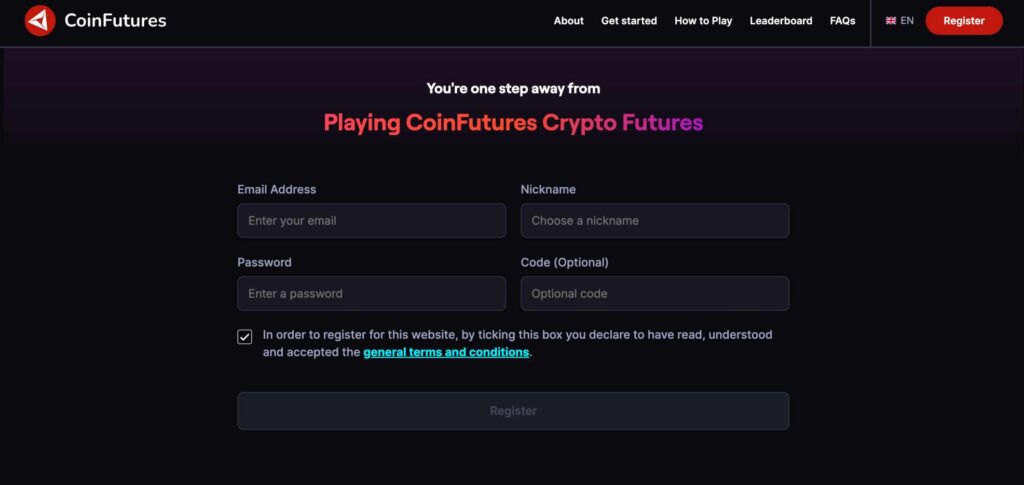
CoinPoker, a licensed poker platform, operates the CoinFutures dashboard on its native interface. Download the CoinPoker software or mobile app, and log in with your account details.
Step 2: Deposit Crypto or Fiat
CoinFutures accepts cryptocurrencies like BTC and USDT, as well as fiat payment methods such as Google Pay, Apple Pay, Visa, and MasterCard.
Traders who prefer crypto transfers select the deposit asset, and CoinFutures automatically generates a new wallet address for them. It credits altcoin payments in seconds, while BTC takes about 10 minutes. No KYC requirements apply to digital asset transfers.
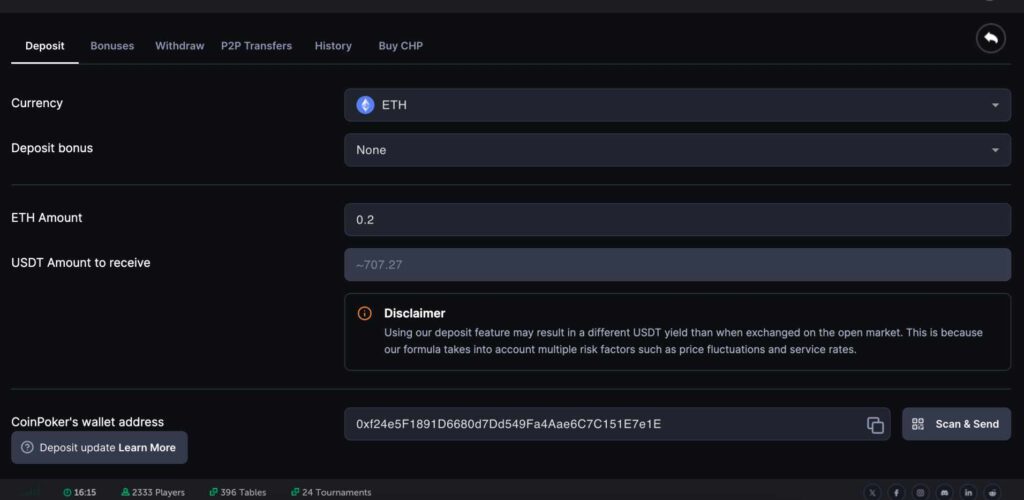
To deposit real money, select “Deposit With Card” and enter your mobile number. Complete the online payment form, which may ask for KYC details depending on your location.
Step 3: Choose a Crypto Futures Market
Select “Crypto Futures” on the CoinPoker interface, which loads the BTC/USDT market.
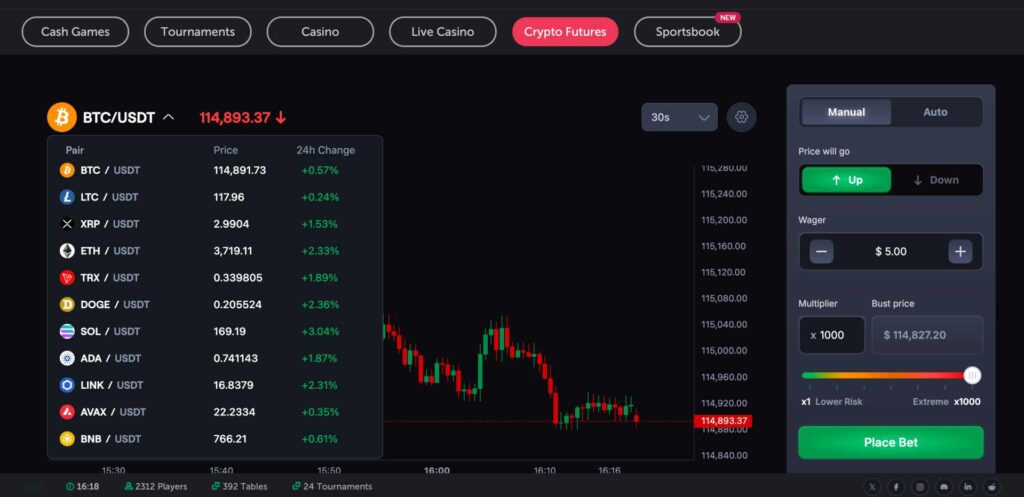
Other supported pairs include XRP/USDT, ETH/USDT, and DOGE/USDT. Click the required pair to access its trading dashboard.
Step 4: Enter Direction, Wager, and Leverage Multiplier to Place a Margin Trade
Located to the right of the pricing chart, CoinFutures offers a beginner-friendly order form. Tap the “Up” or “Down” button to enter a long or short position.
Then input the position size from $1 and select a leverage multiplier. Inexperienced margin traders should cap their market exposure at 5x, as excessive leverage increases the likelihood of liquidation.
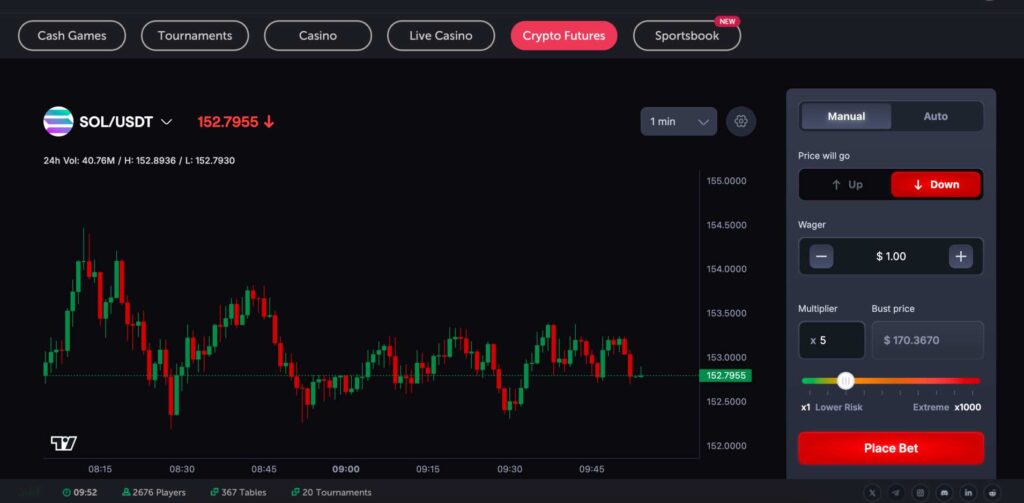
Select the “Auto” button to set stop-loss and take-profit orders. The stop-loss order automatically closes trades based on your specified exit price. The take-profit order instructs CoinFutures to close profitable trades when they reach your target price.
Finally, review the order details and confirm to execute the margin trade.
Note: CoinFutures allows traders to close positions automatically, even if they place stop-loss and take-profit orders.
Conclusion
Margin is a powerful trading tool that helps crypto traders increase market exposure through leverage. It also allows users to short-sell digital assets and protect against market uncertainty. When you begin margin trading, it is advisable to use sensible multipliers to mitigate liquidation risk and place stop-loss orders to limit trading losses.
If you’re ready to trade cryptocurrencies on margin, we found that CoinFutures offers a safe and beginner-friendly experience. Leverage multipliers range from 1x to 1000x, and markets include BTC, BNB, DOGE, ETH, and LTC. It takes minutes to get started, as CoinFutures offers no-KYC accounts with instant deposit methods.
FAQs
What is a margin trade in crypto?
What is a 10% margin in crypto?
Where is the best place to trade crypto on margin?
References
- Basics of Buying on Margin: What’s Margin Trading? (Charles Schwab)
- What is Margin Trading? (Corporate Financial Institute)
- Understanding Leveraged Trading in Cryptocurrencies (Coinbase)
- FCA bans the sale of crypto-derivatives to retail consumers (Financial Conduct Authority)
- Digital Assets Customer Advisories (Commodity Futures Trading Commission)
