






Bitcoin and Global Money Supply: How Strong Is the Connection?
We may earn commissions from affiliate links or include sponsored content, clearly labeled as such. These partnerships do not influence our editorial independence or the accuracy of our reporting. By continuing to use the site you agree to our terms and conditions and privacy policy.


The relationship between Bitcoin and the global money supply (Global M2) has long been debated, with many traders suggesting that monetary expansion directly fuels Bitcoin’s price growth.
A closer look, however, shows that the connection may not be as straightforward as it seems.
The case for correlation
Data from recent cycles highlights a recurring pattern: when global money supply rises, Bitcoin often trends higher. Conversely, periods of stagnation or contraction in M2 appear to coincide with Bitcoin weakness. This has fueled the belief that monetary printing, central banks injecting liquidity into the system, serves as a direct driver of Bitcoin rallies.
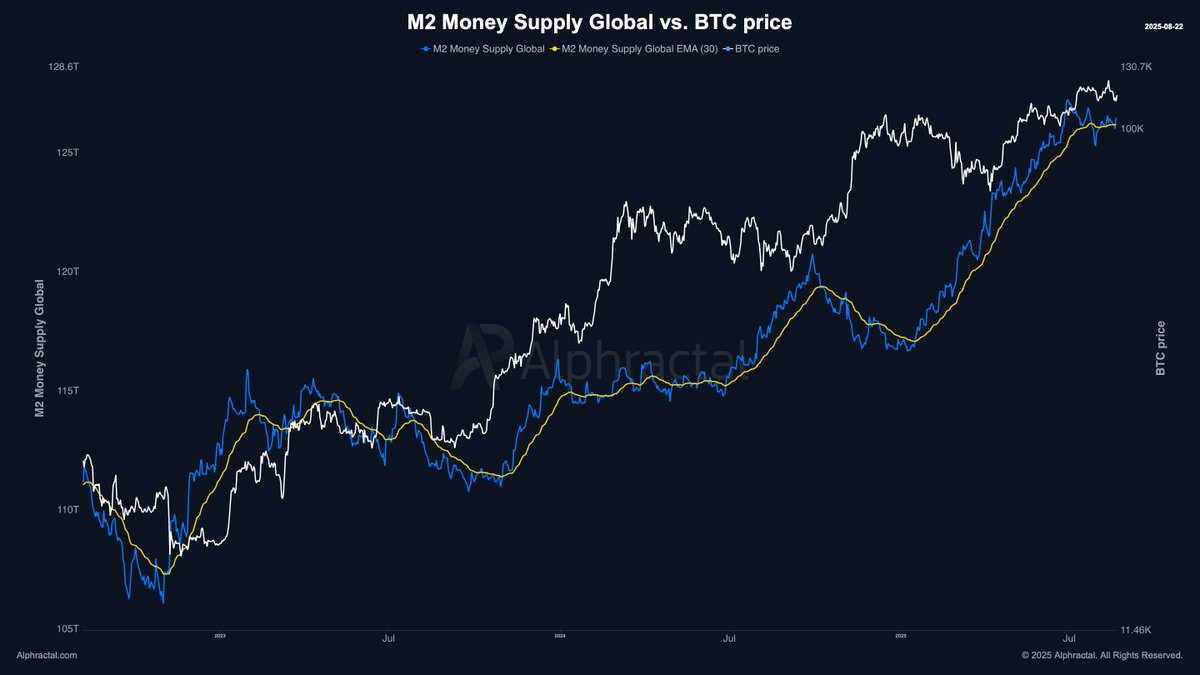
At a surface level, the logic makes sense. More liquidity in the system typically reduces risk aversion, pushing capital into alternative assets such as cryptocurrencies. Investors seeking returns in loose monetary environments may naturally flock to Bitcoin, amplifying the perception of correlation.
When Bitcoin leads instead of follows
Yet, the relationship is not always perfectly aligned. There are instances where Bitcoin’s price begins to rise before M2 expands, and times when money supply growth lags behind Bitcoin rallies. This suggests that while liquidity conditions set the broader environment, Bitcoin’s moves can also be anticipatory, influenced by investor sentiment, adoption milestones, or market-specific catalysts.

An indirect link shaped by macroeconomics
Analysts caution that it may be more accurate to view the connection as indirect. It’s not money printing itself that moves Bitcoin, but the macroeconomic effects surrounding it, confidence in markets, risk appetite, and flows into speculative assets. Monetary expansion helps create favorable conditions, but Bitcoin responds through a web of secondary factors, not a simple one-to-one link.
As global liquidity conditions evolve, traders will likely continue watching this relationship. While correlation exists, understanding its indirect nature may be key to avoiding false assumptions about Bitcoin’s future direction.


 Commentaries










Fill in necessary fields and publish