


Why Bitcoin’s Weakness Looks More Like Consolidation Than Capitulation
We may earn commissions from affiliate links or include sponsored content, clearly labeled as such. These partnerships do not influence our editorial independence or the accuracy of our reporting. By continuing to use the site you agree to our terms and conditions and privacy policy.


Bitcoin is moving through a market period that looks nothing like its earlier cycles, and several on-chain indicators suggest the cryptocurrency may be far more resilient on the downside than many investors assume. Rather than preparing for the deep, months-long corrections that once defined Bitcoin’s history, analysts argue that this cycle is shaped by forces that make such collapses increasingly unlikely.
One of the strongest signals comes from institutional positioning. CryptoQuant CEO Ki Young Ju points to major long-term holders – especially Strategy, which controls around 650,000 BTC – as an anchor keeping the market from slipping into the kind of capitulation zones seen in prior years. When such large pools of capital commit to holding, they remove enormous amounts of supply from circulation, leaving far less room for panic-driven selloffs. That foundational presence didn’t exist in earlier cycles dominated by retail traders.
The shift is clear when looking at drawdown patterns. Bitcoin’s current correction barely resembles the brutal 40% – 80% selloffs that filled previous cycle heatmaps. Instead of extended periods of deep red, this cycle shows brief, moderate pullbacks – the latest around -25%. The structure looks more like controlled cooling than market breakdown, reinforcing the idea that Bitcoin is maturing into a macro asset with stronger long-term hands and higher floor levels.
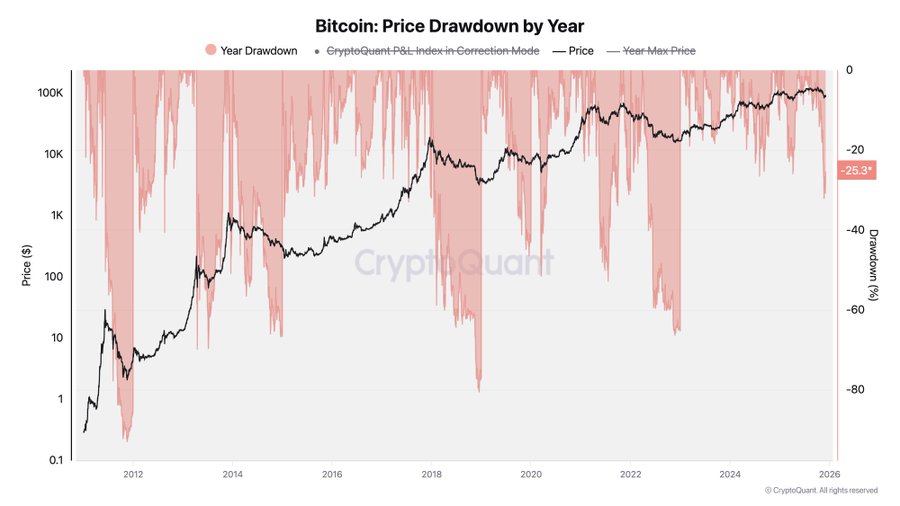
This change in behavior is also tied to how today’s market is built. ETF inflows, corporate treasuries, and entities with multi-year investment horizons now play a major role in liquidity. These participants rarely panic-sell, and many continue accumulating during volatility. Meanwhile, older whales are distributing far more slowly, global liquidity conditions are improving as quantitative tightening fades, and exchange balances keep dropping – all ingredients for a market that prefers drifting sideways over collapsing downward.
Read More:

Bitcoin Emerges as a Global Settlement Giant
CryptoQuant’s models therefore frame the current environment not as the start of a major reset, but as a standard correction within a broader uptrend. With structural selling pressure reduced and supply concentrated in strong hands, the most plausible scenario is a period of consolidation before the next expansion phase. Sharp capitulation appears less likely than in any previous cycle.
Taken together, this suggests Bitcoin may be entering a new era where patience, not panic, defines market behavior. If large institutional holders continue to maintain their long-term positions, the dramatic boom-and-bust cycles of the past decade may be giving way to a more stable – though still volatile – form of growth.
 Commentaries
Fill in necessary fields and publish