


Crypto Market Cap Hits Lowest Level Since 2024 per CoinGecko
We may earn commissions from affiliate links or include sponsored content, clearly labeled as such. These partnerships do not influence our editorial independence or the accuracy of our reporting. By continuing to use the site you agree to our terms and conditions and privacy policy.

The crypto market faces a challenging Q2 2026 as total market cap drops 52% from its peak, while prediction markets hit record volumes.
The cryptocurrency market has reached its lowest level since September 2024, sitting more than 52% below the all-time high recorded in October 2025, according to the latest CoinGecko Q2 2026 Quarterly Report.
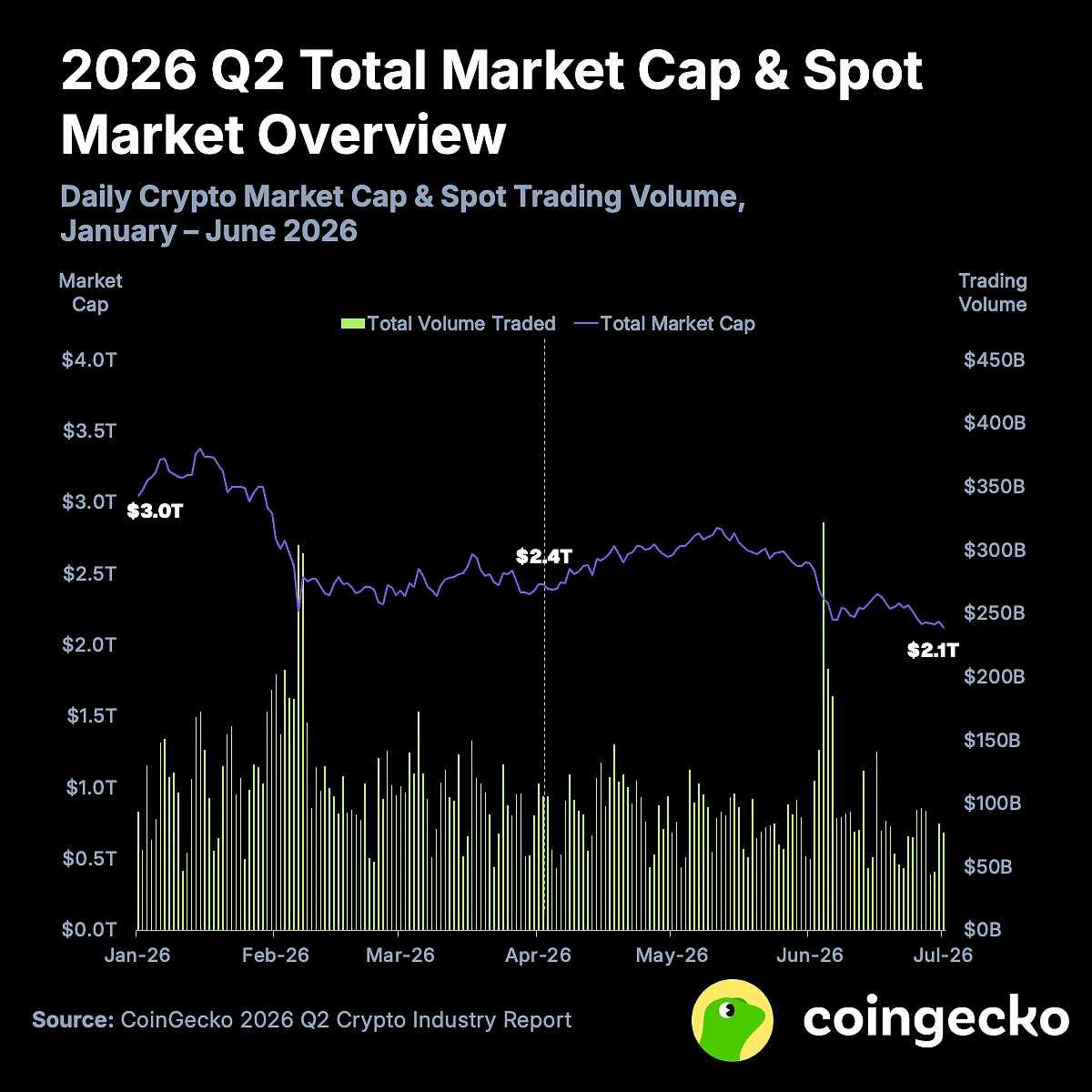
Following a relatively stable April, the market took a sharp downturn in June. Analysts identified several factors driving this pressure on digital assets, including a more hawkish stance from the Federal Reserve, fluctuating tensions between the U.S. and Iran, increased outflows from exchange-traded funds (ETFs), and symbolic BTC sales by Strategy to fund dividends.
Average daily trading volumes also continued their slide, falling 20.9% from the previous quarter to $93.1 billion. This decline points to waning participation from both institutional and retail investors.
Bitcoin and Ethereum Lag Behind Traditional Markets
The two largest cryptocurrencies remained under significant pressure even as U.S. equity markets staged a recovery.
During the second quarter, Bitcoin lost 14.2% of its value, while Ethereum saw a steeper decline of 25.4%. CoinGecko noted that this represents one of the most distinct periods of divergence between the crypto market and traditional risk assets in recent years.
In contrast, specific high-risk projects managed to attract fresh capital. The HYPE token from Hyperliquid stood out, climbing into the top ten crypto assets. This growth was fueled by new ETF launches, the expansion of prediction markets, and a strategic partnership with Coinbase.
Stablecoins Record First Decline Since 2023
One of the most significant shifts during the period was the contraction of the stablecoin market.
Total stablecoin capitalization decreased by 1.6% to $305.1 billion, marking the first quarterly decline since Q3 2023. Analysts view this as an indicator that capital is exiting the crypto ecosystem entirely rather than simply rotating between different assets.
USDC saw the largest absolute outflow, with its market cap dropping by $3.7 billion to $73.5 billion. Meanwhile, Tether’s USDT maintained a stable position and even grew its market share to 60%, reaching $184.4 billion.
More pronounced declines were observed in Sky’s USDS and Ethena’s USDe, as yields for both projects fell below the rates offered by risk-free interest-bearing instruments.
Prediction Markets Hit Record Volumes
While most crypto sectors contracted, prediction platforms emerged as one of the fastest-growing niches.
Nominal trading volume in these markets reached $113.8 billion, a 48.7% increase compared to the first quarter. June alone saw record volumes of $52.8 billion, supported by major sporting events including the Champions League final, the NBA finals, Wimbledon, and the FIFA World Cup.
Kalshi remained the market leader, increasing its share to 58.9%, while Polymarket lost some ground despite the overall growth in sports-related betting markets.
Exchanges Report Sharp Slowdown in Trading
The prevailing downward trend was clearly reflected in centralized exchange activity.
Spot trading volume across the top ten exchanges shrank by 27.9% to $1.95 trillion. May was the weakest month of the year, recording just $619 billion in turnover.
Despite the lower activity, Binance solidified its leadership with a 38.7% market share, while Bybit remained the only other exchange to hold a double-digit share. The most significant declines in activity were reported by MEXC, Crypto.com, and KuCoin.
Perpetual futures trading proved more resilient. Total volume in this segment fell by only 10% to $12.7 trillion, suggesting that professional traders continue to utilize derivative instruments even as spot market activity cools.
According to CoinGecko, the combination of shrinking liquidity, lower demand for stablecoins, and reduced trading volumes made the second quarter one of the most challenging periods for the industry since the 2025 market peak. However, continued interest in segments like prediction markets and tokenized collectibles suggests that capital is becoming more selective rather than leaving the sector altogether.


 Commentaries








Fill in necessary fields and publish