


Iranian Crypto Outflows Surge 700% After US-Israeli Strikes
We may earn commissions from affiliate links or include sponsored content, clearly labeled as such. These partnerships do not influence our editorial independence or the accuracy of our reporting. By continuing to use the site you agree to our terms and conditions and privacy policy.


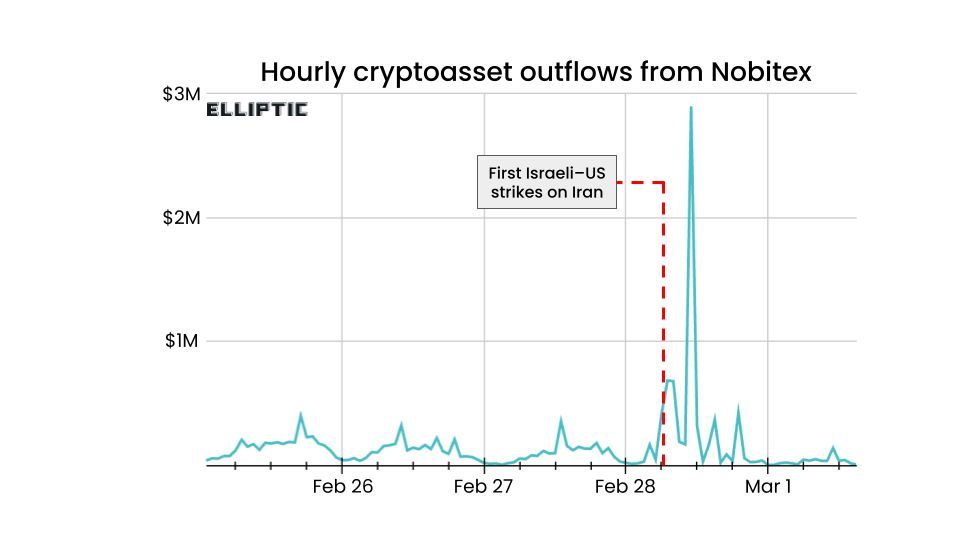
Crypto outflows from Iran surged 700% within minutes of US-Israeli strikes, with Nobitex users moving nearly $3 million in a single hour.
Tracked funds have been directed toward foreign exchanges, a move analysts characterize as real-time capital flight.
What the Charts Reveal
A detailed hourly chart for the period of February 25–27 shows typical outflow levels with limited fluctuations below $500,000 per hour. However, following the announcement of the strikes, these volumes surged sharply, reaching nearly $3 million within a single hour. The temporal correlation between the geopolitical event and the spike in outflows is immediate.
The broader chart spanning January to March places this peak in historical context. An internet blackout in early January led to hourly outflows of approximately $4.5 million—the highest level for the period analyzed. U.S. sanctions against Iranian officials and sanction-evasion networks in mid-January triggered another peak above $2.5 million. A similar rise was recorded in early February. The current spike on February 28 fits this pattern but is distinguished by a direct military trigger.
Nobitex as Critical Financial Infrastructure
The significance of Nobitex within the Iranian financial system reinforces the weight of this data. The exchange processed approximately $7.2 billion in volume during 2025 and serves over 11 million users. In an environment of strict international sanctions and limited access to the global banking system, cryptocurrencies function as an alternative financial channel.
Through such platforms, users can convert rials into crypto assets and transfer funds outside traditional banking corridors. Consequently, a sharp rise in outflows typically does not reflect standard investment decisions, but rather a reaction to perceived risks to financial security.
Capital Flight
Unlike the traditional banking system, where capital flight manifests through currency pressure and movements in foreign reserves with delays of days or weeks, blockchain infrastructure reveals these processes almost instantaneously. The hourly charts reflect user reactions in real time.
The question remains whether the current peak will prove to be a temporary panic reaction or the beginning of a more sustained shift of funds to foreign platforms. Previous instances suggest that outflows have been short-lived and followed by a return to normal levels.
However, the case highlights a broader reality: crypto infrastructure reacts to geopolitical stress with a speed that the traditional financial system can rarely match, as cryptocurrencies remain the only sector traded 24/7.


 Commentaries



Fill in necessary fields and publish