






Is Cardano Worth Buying in 2026? Where $BMIC Fits in the New Crypto Thesis
We may earn commissions from affiliate links or include sponsored content, clearly labeled as such. These partnerships do not influence our editorial independence or the accuracy of our reporting. By continuing to use the site you agree to our terms and conditions and privacy policy.

There was a time when Cardano was seen as one of the highest-potential projects in crypto. Strong academic roots, peer-reviewed research, and a slow-but-deliberate development approach made ADA a favorite among long-term holders. Many expected that patience to pay off in the last bull run.
Instead, the 2025 cycle left many Cardano holders disappointed. While Bitcoin pushed to new all-time highs as early as 2024 and followed through again in 2025, and while Ethereum, Solana, and XRP all reached fresh cycle peaks in 2025, ADA failed to do the same. It never came close to reclaiming its previous highs, even as the broader market offered multiple opportunities.
As the market now moves deeper into a bear phase and looks ahead to 2026, that underperformance is forcing a reassessment. At the same time, new projects are entering the market with a very different focus. One of them is BMIC ($BMIC), which is launching its presale with a product-led approach centered on security infrastructure.
Why Cardano Struggles to Make the 2026 Case
From a price perspective, ADA’s recent history is hard to ignore. Throughout 2025, Cardano’s token showed persistent weakness. By late December, ADA was down roughly 56% year-to-date, with drawdowns reaching close to 70% from earlier highs. Prices hovered around the $0.35–$0.36 range, far below levels seen earlier in the year near $0.67–$0.80.
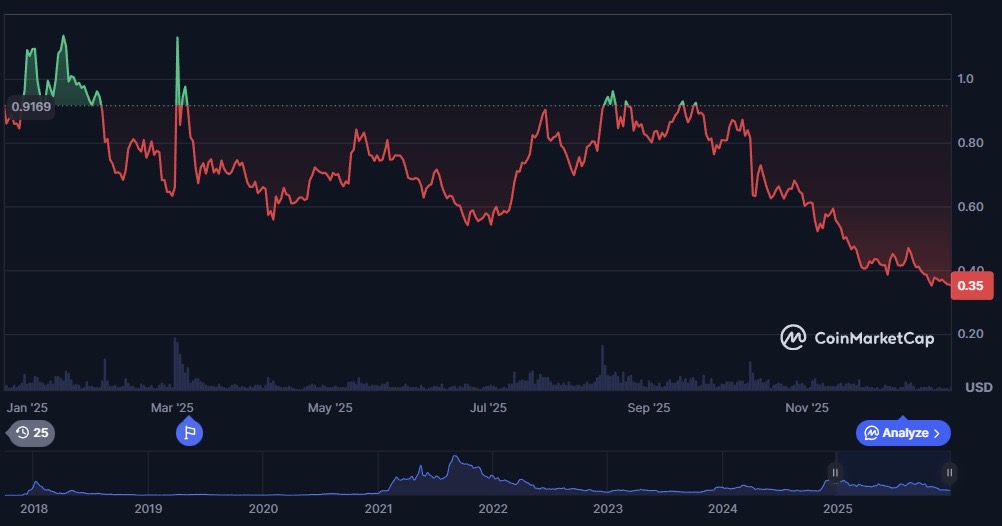
Source: CoinMarketCap/ADA-1 year performance
Derivatives data told a similar story. Futures open interest collapsed from around $1.95 billion in September to roughly $641 million by November, a clear signal that trader participation and conviction had dried up. Funding rates remained flat, reflecting a lack of directional appetite rather than aggressive positioning.
Technically, the picture stayed heavy. ADA traded below its key moving averages for extended periods, while momentum indicators such as RSI lingered near oversold territory around 32. Instead of building a base for recovery, price action reinforced a broader downtrend. For many investors, this raised a simple question going into 2026: if ADA could not perform during a favorable macro environment, what changes in the next cycle?
Investors are becoming less forgiving of long development timelines that do not translate into capital efficiency or clear demand.
BMIC and the Shift Toward Security Infrastructure
BMIC enters this environment with a fundamentally different angle. Rather than competing as another smart-contract platform, it is building a complete quantum-secure finance stack. That includes a wallet, staking system, and payment layer, all designed to operate without exposing public keys on-chain.
This design directly addresses a structural weakness present in most wallets today. Traditional EOAs, hardware wallets, and even many newer solutions still leak public keys, creating a future risk as quantum computing advances. BMIC removes that exposure through signature-hiding smart accounts and post-quantum cryptography, changing the threat model entirely.
Staking and payments follow the same logic. BMIC’s staking system avoids classical key exposure, protecting long-term participants who are most vulnerable in a future quantum scenario. Its payment layer uses protected authentication and private routing, reducing risks tied to cloning, interception, and delayed decryption attacks.
The Parts of BMIC Most Crypto Projects Are Not Addressing Yet
Beyond user-facing security, BMIC is also built with institutions and long-term infrastructure in mind. Its Quantum Security-as-a-Service layer allows banks, fintech platforms, and large organizations to integrate quantum-secure custody, key management, and encrypted communications without rebuilding their existing systems. This matters as regulated capital and tokenized real-world assets begin interacting with DeFi at scale.
Under the hood, BMIC relies on hybrid post-quantum cryptographic models that can evolve as global standards change. Instead of locking users into a fixed algorithm, the system is designed to upgrade seamlessly as NIST and other authorities finalize and update post-quantum frameworks. That removes the need for disruptive migrations that legacy platforms are likely to face.
AI plays a deeper role here as well. It is not limited to monitoring activity, but actively optimizes cryptographic performance, balances workloads, and adapts security parameters as conditions change. This allows the platform to remain efficient while operating with heavier post-quantum protections.
Why BMIC’s Presale Stands Out Going Into 2026
The BMIC presale is launching during a bear market, but with a product that aligns closely with where crypto is heading rather than where it has been. Total supply is fixed at 1,500,000,000 tokens, with 750,000,000 allocated to the ICO.
Pricing starts at $0.048485 and increases gradually to $0.058182 by the final presale tier, keeping early and late participation clearly defined. The planned launch price is set above the last presale phase which is also a rare thing among crypto ICOs right now.
As the market looks toward 2026, the contrast is clear. Cardano is a legacy thesis that struggled to deliver when conditions were favorable. BMIC means a security-first approach built around problems the industry can no longer ignore. In a cycle where infrastructure matters more than promises, low presale pricing is unlikely to last.
Discover the future of quantum-secure Web3 with BMIC:
Presale: https://bmic.ai
X (Twitter): https://x.com/BMIC_ai
Telegram: https://t.me/+6d1dX_uwKKdhZDFk


This publication is sponsored. CryptoDnes does not endorse and is not responsible for the content, accuracy, quality, advertising, products or other materials on this page. Readers should do their own research before taking any action related to cryptocurrencies. CryptoDnes shall not be liable, directly or indirectly, for any damage or loss caused or alleged to be caused by or in connection with use of or reliance on any content, goods or services mentioned.
 Commentaries










Fill in necessary fields and publish