


Bitcoin’s Risk Profile Shifts as Ownership Quietly Changes
We may earn commissions from affiliate links or include sponsored content, clearly labeled as such. These partnerships do not influence our editorial independence or the accuracy of our reporting. By continuing to use the site you agree to our terms and conditions and privacy policy.


Bitcoin’s current market risk is no longer primarily defined by price levels, but by who is holding the economic weight of the network.
New on-chain data suggests that a quiet redistribution of capital has taken place, altering how the market may respond to volatility going forward.
An analysis from CryptoQuant shows that realized capitalization – a measure that reflects the price at which coins last moved — has shifted decisively away from long-term holders. For years, Bitcoin’s realized value was dominated by early whales who accumulated at much lower prices and historically absorbed drawdowns without aggressive selling. That dynamic has changed.
Ownership, not price, is reshaping market behavior
Today, a much larger share of Bitcoin’s realized cap is held by newer whales with higher entry points and shorter holding histories. This marks a structural change in market ownership rather than a cyclical fluctuation. Instead of deeply entrenched capital anchoring the network, value is increasingly concentrated among participants who are more exposed to downside risk.
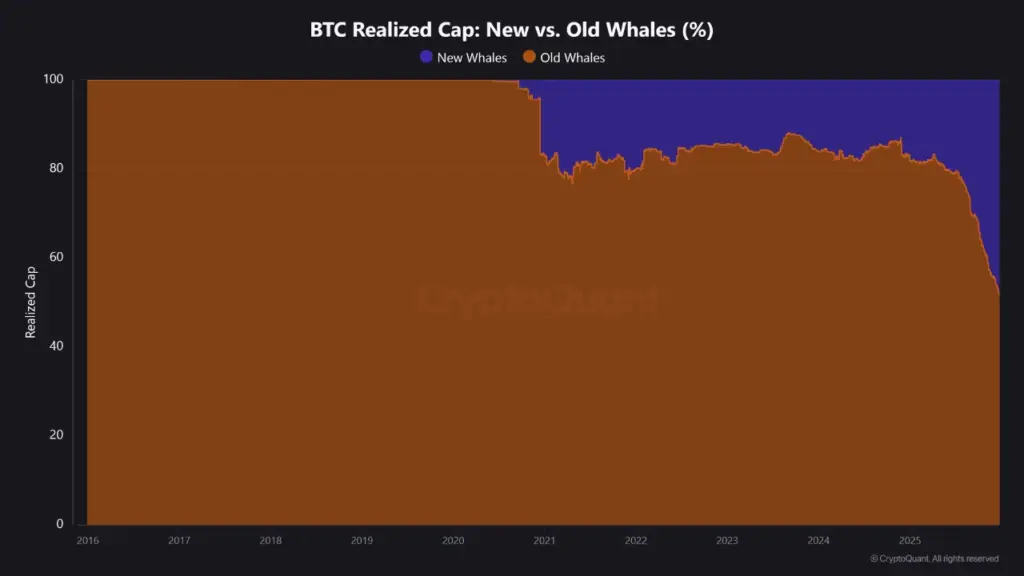
This matters because holder behavior shapes volatility. Long-term whales have typically been indifferent to short-term price swings, while newer large holders tend to be more reactive, particularly when prices approach their cost basis. As a result, the market becomes more sensitive to negative shocks, with a higher likelihood of defensive selling during periods of stress.
In practical terms, Bitcoin is now operating in a less forgiving structure than during phases dominated by legacy holders. The growing influence of newer capital raises near-term fragility, even if broader fundamentals remain intact. Sharp moves – both up and down – become more likely when ownership is concentrated among participants still validating their positions.
That said, the shift is not inherently bearish over the long run. If price stability persists or accumulation continues, today’s new whales may eventually evolve into long-term holders themselves, restoring structural resilience. Until that transition becomes visible in the data, however, Bitcoin remains in an intermediate phase – one defined less by conviction and more by sensitivity.
In short, CryptoQuant’s realized cap data suggests Bitcoin is not weakening, but changing hands. The outcome will depend not on where price goes next, but on whether this new cohort of large holders proves capable of absorbing volatility the way their predecessors once did.


 Commentaries










Fill in necessary fields and publish