






Bitcoin ETF Flows Suggest Maturing Investor Behavior
We may earn commissions from affiliate links or include sponsored content, clearly labeled as such. These partnerships do not influence our editorial independence or the accuracy of our reporting. By continuing to use the site you agree to our terms and conditions and privacy policy.


BlackRock’s spot Bitcoin ETF is drawing attention for an unusual reason: it continues to attract massive capital even while delivering losses this year.
Despite a negative annual return, the fund has ranked among the top ETF products by inflows in 2025 – a dynamic that analysts interpret as a sign of deep, long-term investor confidence rather than short-term speculation.
So far this year, the iShares Bitcoin Trust has accumulated roughly $25 billion in net inflows, placing it sixth among all ETFs. What makes that figure stand out is that most funds ranked above it are traditional equity or bond products enjoying strong gains. Even gold-backed ETFs, which have significantly outperformed Bitcoin this year, have attracted less capital than BlackRock’s Bitcoin vehicle.
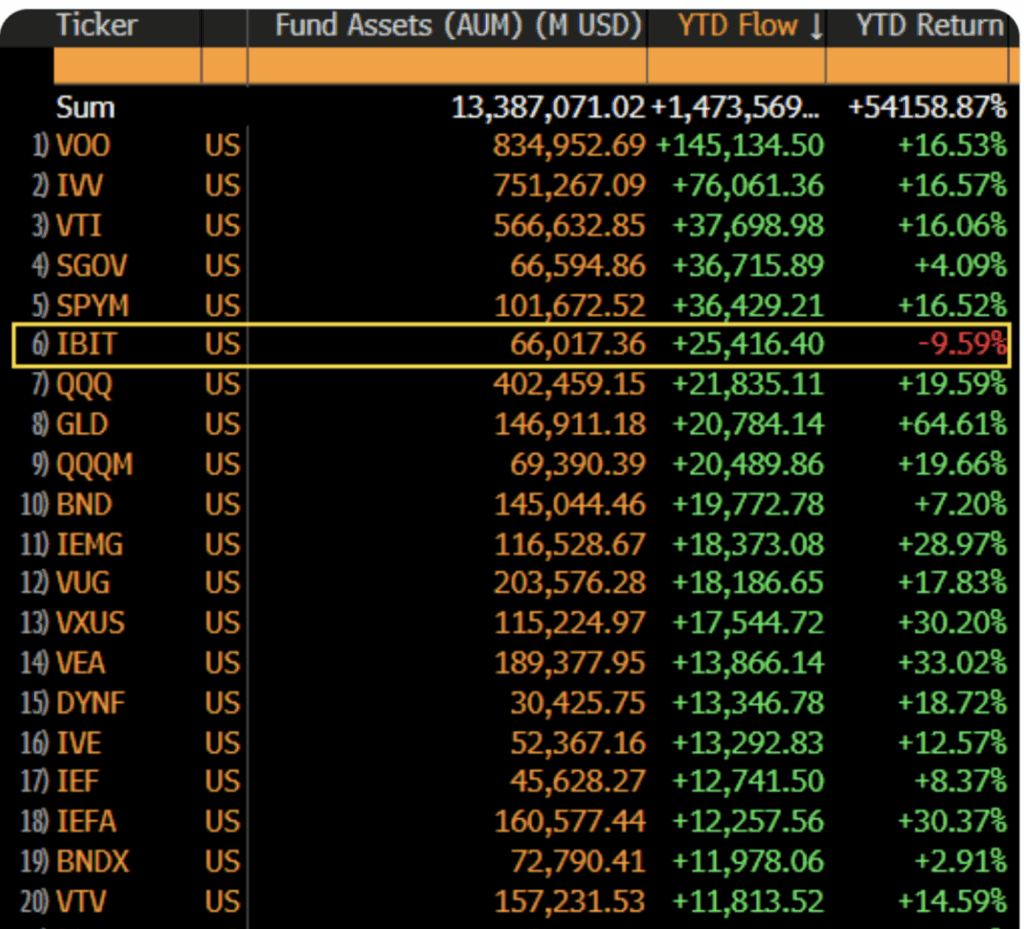
Market analysts argue this pattern reveals how investors are using Bitcoin ETFs. Rather than chasing immediate performance, many buyers appear willing to accumulate exposure during drawdowns. From that perspective, sustained inflows during a weak year may be more telling than inflows during a rally, suggesting conviction that extends beyond short-term price cycles.
Why Flows Matter More Than Performance
The disconnect between ETF demand and Bitcoin’s recent price action has also raised questions. Some observers have wondered why heavy institutional buying has not translated into a stronger market. Analysts counter that Bitcoin is increasingly behaving like a mature asset, where earlier holders take profits, hedge positions, or generate income through options strategies instead of simply holding for price appreciation.
That maturity may also explain the recent volatility in flows. While long-term inflows remain strong, shorter-term movements have been mixed. Recent sessions have seen net outflows across U.S. spot Bitcoin ETFs, with only a handful of issuers recording daily gains. Ethereum-linked ETFs, meanwhile, have experienced persistent withdrawals, extending a multi-day outflow streak.
BlackRock has largely dismissed concerns around these fluctuations. Company executives say periods of inflows and outflows are a normal feature of large, liquid ETF products, especially those used for portfolio rebalancing and cash management. They also note that Bitcoin-related ETFs have quickly become meaningful contributors to the firm’s revenue, reinforcing their strategic importance regardless of short-term market swings.
Taken together, the data suggests that Bitcoin’s ETF era is entering a new phase. Capital is no longer flowing solely on momentum, but increasingly reflects allocation decisions by investors with longer time horizons. If inflows remain resilient during downturns, analysts argue the upside potential during more favorable market conditions could be far greater than what has already been observed.


 Commentaries










Fill in necessary fields and publish