


Solana Faces a Different Kind of Selloff as Institutions Reposition
We may earn commissions from affiliate links or include sponsored content, clearly labeled as such. These partnerships do not influence our editorial independence or the accuracy of our reporting. By continuing to use the site you agree to our terms and conditions and privacy policy.


Solana has weathered violent corrections in the past, but the current downturn carries a different tone.
This time, the pressure appears to be driven less by panic and more by a measured shift in institutional behavior.
Recent data from investment products tied to SOL suggests a cooling in risk appetite rather than a mass retreat. Some vehicles are seeing capital step aside, while others continue to attract inflows. That split points to repositioning, not rejection.
A Cautious Signal From a Flagship ETF
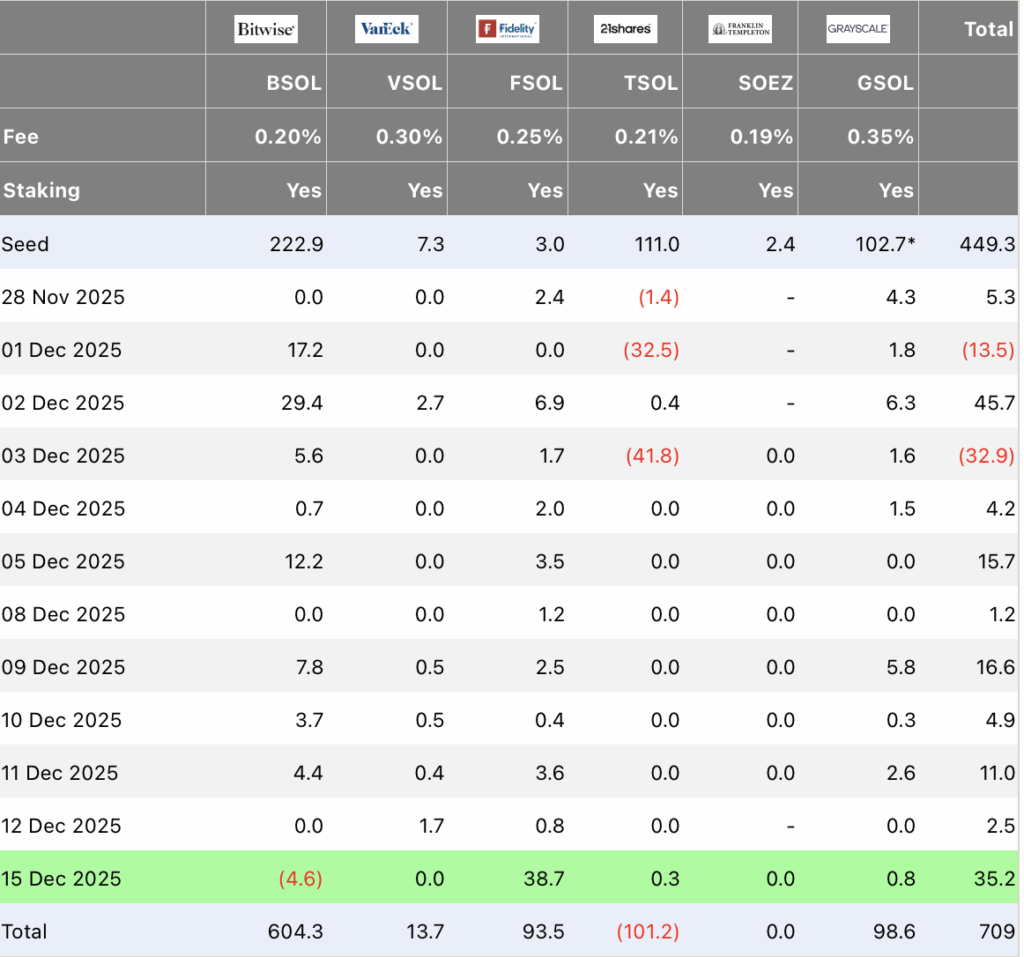
The most notable development came from Bitwise’s Solana staking ETF, which recorded its first net outflow since launch. While the withdrawal was modest in size, it broke a months-long streak of uninterrupted inflows and coincided with unusually low trading activity. Together, those signals suggest investors pausing exposure rather than scrambling to exit.
That nuance matters. The product was designed for longer-term holders seeking both price exposure and staking yield. A slowdown in participation implies that even yield-generating structures face scrutiny when broader market confidence weakens.
Capital Rotates Instead of Leaving
Crucially, the pullback was not echoed across the entire Solana ETF landscape. On the same day, other SOL-linked funds attracted fresh capital, with at least one recording a standout inflow. This divergence highlights a familiar institutional pattern: reallocating exposure across instruments instead of abandoning the underlying asset.
In uncertain conditions, investors often gravitate toward vehicles that offer greater flexibility, liquidity, or operational simplicity. Yield optimization can take a back seat when balance-sheet efficiency becomes the priority.
Market Pressure Without Forced Selling
Solana’s price reacted swiftly, sliding toward the lower boundary of its recent trading range. However, the move lacked signs of distress typically associated with capitulation. Spot market volumes rose, indicating active participation rather than liquidity evaporation or panic-driven selling.
The more pronounced adjustment occurred in derivatives markets. Open interest declined across major platforms, signaling that leveraged positions were being unwound. Historically, such deleveraging can either extend downside moves or help reset conditions for stabilization, depending on how spot demand responds.
Macro Forces Take Center Stage
The broader environment provides important context. Global markets are increasingly sensitive to potential policy shifts from the Bank of Japan, developments that have previously triggered selloffs across risk assets, including crypto. Seasonal factors are also in play, with thinner year-end liquidity magnifying price swings.
In that setting, even assets with strong internal narratives struggle to escape macro-driven caution.
Ecosystem Progress Continues Beneath the Surface
Despite market volatility, Solana’s underlying development remains active. New derivatives products, tokenization efforts, and network upgrades continue to move forward, suggesting that the ecosystem itself is not losing momentum.
This contrast between advancing fundamentals and hesitant capital flows highlights the nature of the current phase. Solana appears to be moving through a macro-induced stress test rather than facing a breakdown in confidence.
For now, the first outflow from Bitwise’s staking ETF looks more like a probe of risk tolerance than a signal of surrender. Whether pressure builds or eases from here will depend less on Solana-specific developments and more on how global risk conditions evolve in the weeks ahead.


 Commentaries










Fill in necessary fields and publish