


Bitcoin Whales Are Staying Put as Exchange Activity Hits Cycle Lows
We may earn commissions from affiliate links or include sponsored content, clearly labeled as such. These partnerships do not influence our editorial independence or the accuracy of our reporting. By continuing to use the site you agree to our terms and conditions and privacy policy.


Bitcoin’s latest onchain data reveals a quiet but important change in how larger holders are behaving.
Wallets containing at least one full BTC are sending fewer coins to Binance than at any other point in the current market cycle, a signal that sell-side urgency has notably faded.
Transfers from long-term or higher-balance holders into exchanges have historically played a key role in market turning points. When these movements accelerate, they usually reflect preparation for selling and often appear near local or cycle highs. At present, that pattern is missing. Even as Bitcoin trades far above levels seen in previous years, large holders are choosing not to increase their exchange activity.
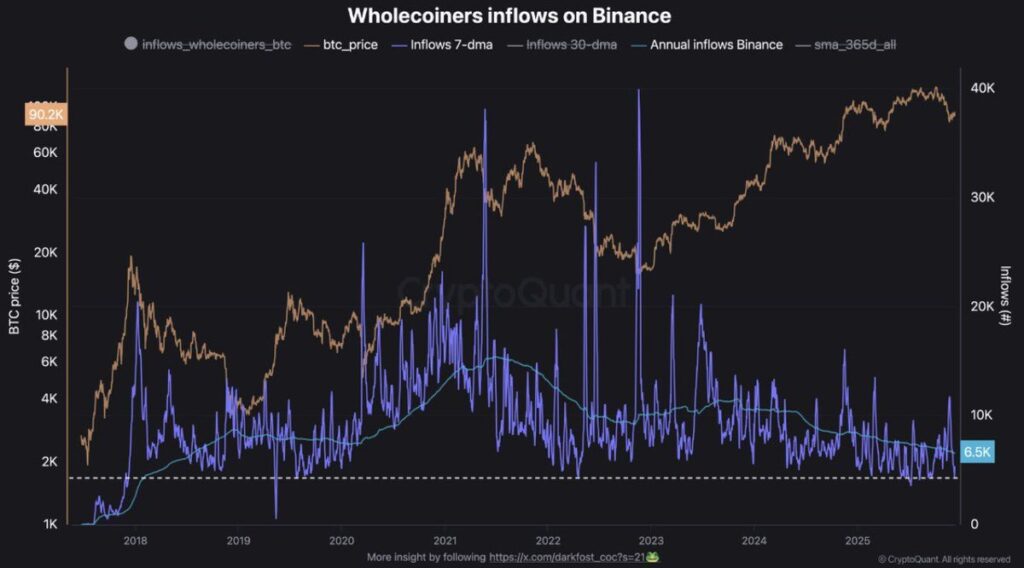
This shift stands out when compared with earlier cycles. In the past, rising prices were frequently met with sharp increases in exchange deposits from wholecoiners, a dynamic that added supply to the market and amplified volatility. Today, inflows remain compressed, suggesting that these participants are not eager to reduce exposure at current prices.
From a supply perspective, this behavior matters. Bitcoin that stays off exchanges is less likely to be sold in the spot market, reducing immediate downward pressure. When demand remains stable, or improves, limited liquid supply can act as a cushion during pullbacks and help prevent deeper corrections. Long-term trends in the data reinforce this view, showing inflows holding well below historical averages rather than reverting higher.
While subdued exchange activity from large holders does not automatically translate into further upside, it removes a familiar headwind. Rallies in the past often stalled when large wallets began distributing aggressively. With that source of pressure currently absent, price movements are more likely to be driven by shifts in demand instead of large-scale selling.
Overall, the data suggests that major Bitcoin holders are comfortable maintaining their positions rather than rushing to lock in profits. This type of environment has historically been associated with milder drawdowns and a market that reacts less violently to negative headlines, placing greater emphasis on demand as the key driver of the next major move.


 Commentaries








Fill in necessary fields and publish