






Michael Saylor Says Strategy Can Survive Major Crash as Price Hovers Around $90K
We may earn commissions from affiliate links or include sponsored content, clearly labeled as such. These partnerships do not influence our editorial independence or the accuracy of our reporting. By continuing to use the site you agree to our terms and conditions and privacy policy.


Bitcoin’s slide toward the low-$90,000 region has sparked fresh anxiety across the market, but Michael Saylor appears unfazed.
While traders obsess over the latest red candles, he is focusing on something else entirely: whether the system he designed for Strategy performs during the hardest possible phase of the Bitcoin cycle.
Panic in the Market, Calm in the Treasury
Bitcoin briefly dipped to $89,954 before rebounding toward $91,269, marking one of its most dramatic selloffs in recent months.
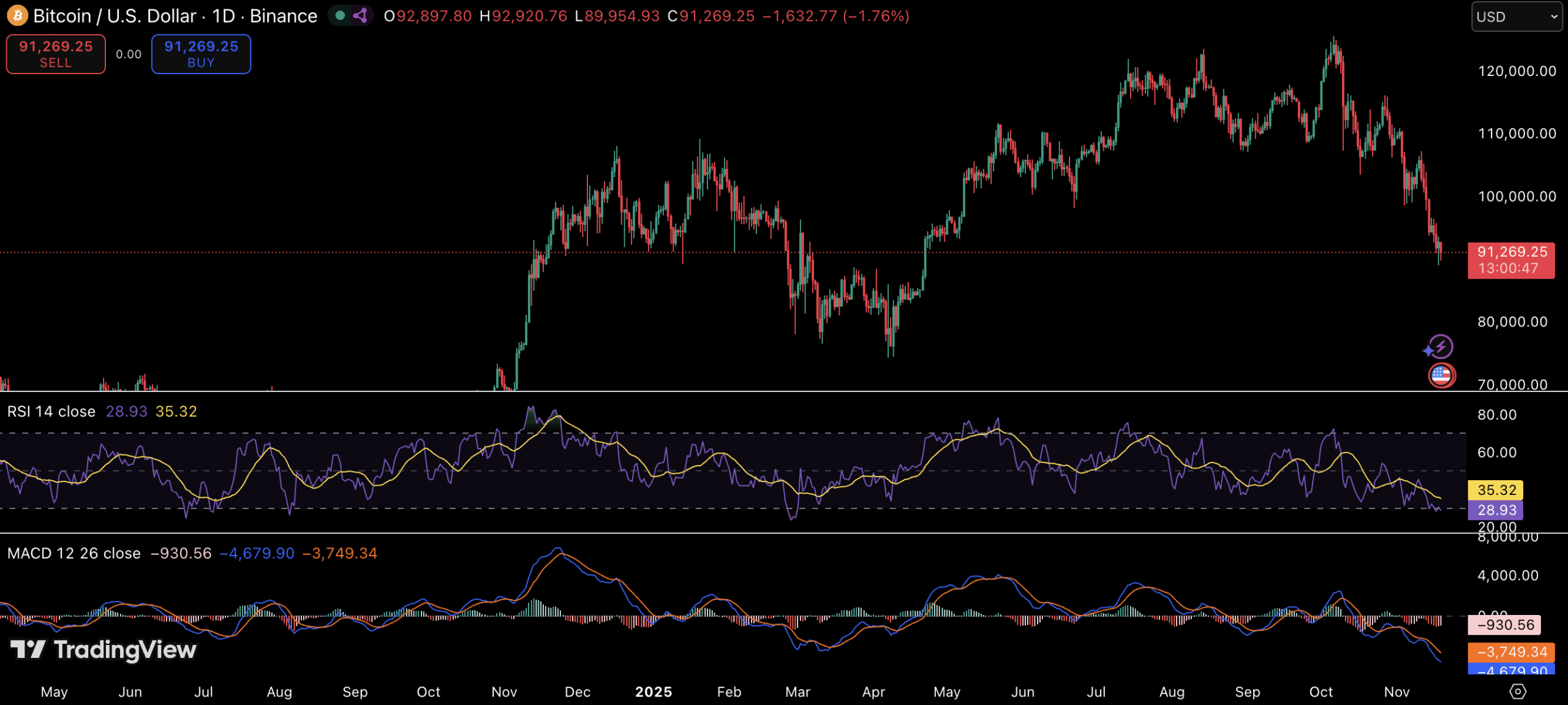
The RSI has collapsed to 28.93, confirming oversold conditions, while the MACD is deeply negative with widening histogram bars, signalling that momentum remains bearish for now.
Most corporate Bitcoin holders would normally be worried. Saylor insists he isn’t one of them.
Instead of scaling back, he wanted to remind investors that Strategy’s corporate treasury structure wasn’t designed for bull markets — it was intentionally engineered to keep functioning through violent collapses.
₿etter than Ever. Today I was the warm-up act for @natbrunell as we both talked Bitcoin with @cvpayne. You’ll want to hear what she had to say. pic.twitter.com/vDaFceyeza
— Michael Saylor (@saylor) November 18, 2025
A Company Built Around Surviving, Not Guessing
According to Saylor, Strategy didn’t build its balance sheet with hopes and forecasts in mind. It built around the assumption that Bitcoin could crash far harder and far faster than the average investor can psychologically handle.
Whether that crash ever arrives — and we are currently nowhere close to the scenario he described — Saylor claims the firm can continue operating even in the event of an 80% to 90% drawdown.

Where most firms try to avoid the storm, Strategy was built to function in the middle of it.
Sticking to Accumulation Despite Market Fear
This sharp correction revived a wave of rumors that the company had begun liquidating part of its holdings. The speculation didn’t last long. Strategy actually bought more Bitcoin earlier this week, directly contradicting the narrative of panic selling.
The only number that changed was the mNAV multiple sliding to 1.11x, which reflects price movement rather than a strategy pivot.
The Long Game: Volatility Shrinking Over the Years
One of Saylor’s most unconventional arguments is that volatility — despite being high in the short term — is structurally declining. When Strategy entered Bitcoin in 2020, volatility hovered close to 80% per year. Today, by his estimate, Bitcoin trades around 50% annualized volatility, and he expects that figure to keep drifting downward until Bitcoin stabilizes at roughly 1.5× the S&P 500.
In that framework, market turbulence today is noise, not narrative.
Forget the Halving Playbook
Saylor also dismissed the idea that the traditional four-year halving cycle still governs Bitcoin’s price. The next halving removes roughly 225 BTC per day, and in his view that amount is too small to meaningfully steer price the way it did in 2016 or 2020. Bitcoin, he believes, has graduated from that phase.
What matters to Strategy is the multidecade trajectory — one he estimates at a 30% annual appreciation rate for the next twenty years.
If that projection plays out, a painful correction in 2025 is simply an uncomfortable chapter — not a threat to survival.
A Competing Voice Warns of a Much Darker Path
Trader Peter Brandt views the chart completely differently. Based on the current pattern, he thinks Bitcoin could break toward $50,000 if selling continues unchecked. The most extreme version of his outlook involves a market echo of the 1977 soybean crash, which would push Bitcoin even lower and potentially expose Strategy’s cost basis.
For now, the two visions couldn’t be further apart: Saylor talks generational cycles, while Brandt talks technical risk.
What happens next depends on which of them the market decides to reward.
For more Bitcoin insights and predictions, read our full BTC forecast next.


 Commentaries










Fill in necessary fields and publish