


Chainlink Emerges as the Operating Layer for Global Tokenized Markets
We may earn commissions from affiliate links or include sponsored content, clearly labeled as such. These partnerships do not influence our editorial independence or the accuracy of our reporting. By continuing to use the site you agree to our terms and conditions and privacy policy.

Chainlink’s role in the digital asset ecosystem is expanding rapidly as it shifts from an oracle provider into a foundational layer that underpins the growing world of onchain finance.
With real-world asset (RWA) tokenization hitting new records and major financial institutions adopting blockchain technology at scale, the network is increasingly positioned at the center of this transformation.
What was once a tool designed to feed external data into smart contracts has become a comprehensive stack supporting everything from cross-chain settlement to identity, privacy, and automated compliance. Messari’s newest report underscores this evolution, describing Chainlink as the behind-the-scenes framework connecting fragmented blockchains to traditional financial infrastructure.
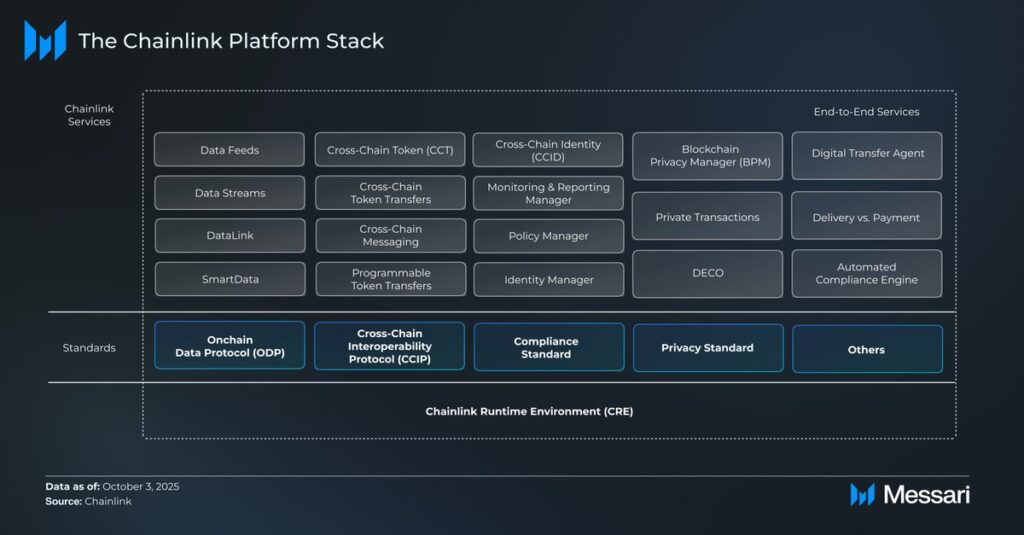
At the heart of the expansion is a suite of emerging standards – CCIP for interoperability, the Onchain Data Protocol for data movement, and new privacy and compliance layers – all operating within the Chainlink Runtime Environment. These components are quickly becoming essential for institutions that need secure, uniform connectivity across multiple chains.
Recent activity shows this trend accelerating. Over the past two days, European asset managers launched cross-chain settlement pilots using Chainlink standards, while banks across Asia continued trials involving tokenized collateral. The momentum coincides with record volumes in tokenized treasury assets, a significant portion of which rely on Chainlink’s data and interoperability rails. Leading global players—including J.P. Morgan, Swift, UBS, and Fidelity – are now using the network for experiments ranging from interbank token movement to programmable structured products.
Chainlink’s influence, however, extends far beyond institutional finance. DeFi platforms remain deeply dependent on its infrastructure. Lending markets, decentralized exchanges, stablecoin issuers, derivatives protocols, and RWA platforms all use Chainlink not only for pricing but also for cross-chain messaging, asset transfers, private computation, and compliance automation. As modular rollups and app-specific chains proliferate, demand for CCIP as the connective layer between ecosystems continues to climb.
Messari’s analysis frames Chainlink as something much larger than an oracle network: it is becoming the operating system for blockchain-based finance. With RWAs expanding, ETFs moving onchain, and banks shifting from testing phases to real deployment, Chainlink’s integrated stack is increasingly defining the infrastructure that supports the next generation of global financial networks.


 Commentaries








Fill in necessary fields and publish