


Massive Outflows Slam Bitcoin ETFs in Second-Worst Day on Record
We may earn commissions from affiliate links or include sponsored content, clearly labeled as such. These partnerships do not influence our editorial independence or the accuracy of our reporting. By continuing to use the site you agree to our terms and conditions and privacy policy.


U.S. spot Bitcoin ETFs faced intense selling pressure on Thursday, with the group recording nearly $870 million in net outflows - their second-largest withdrawal day since launching.
The wave of exits coincided with a sharp downturn in crypto markets, underscoring a broad shift toward risk aversion.
According to data from FarsideInvestors, the biggest hit came from Grayscale’s Bitcoin Mini Trust, which saw more than $318 million leave in a single session. Large redemptions also swept through BlackRock’s IBIT and Fidelity’s FBTC, which shed roughly $256 million and $120 million, respectively. Funds from Ark/21Shares, Bitwise, VanEck, Invesco, Valkyrie and Franklin Templeton all reported outflows as well.
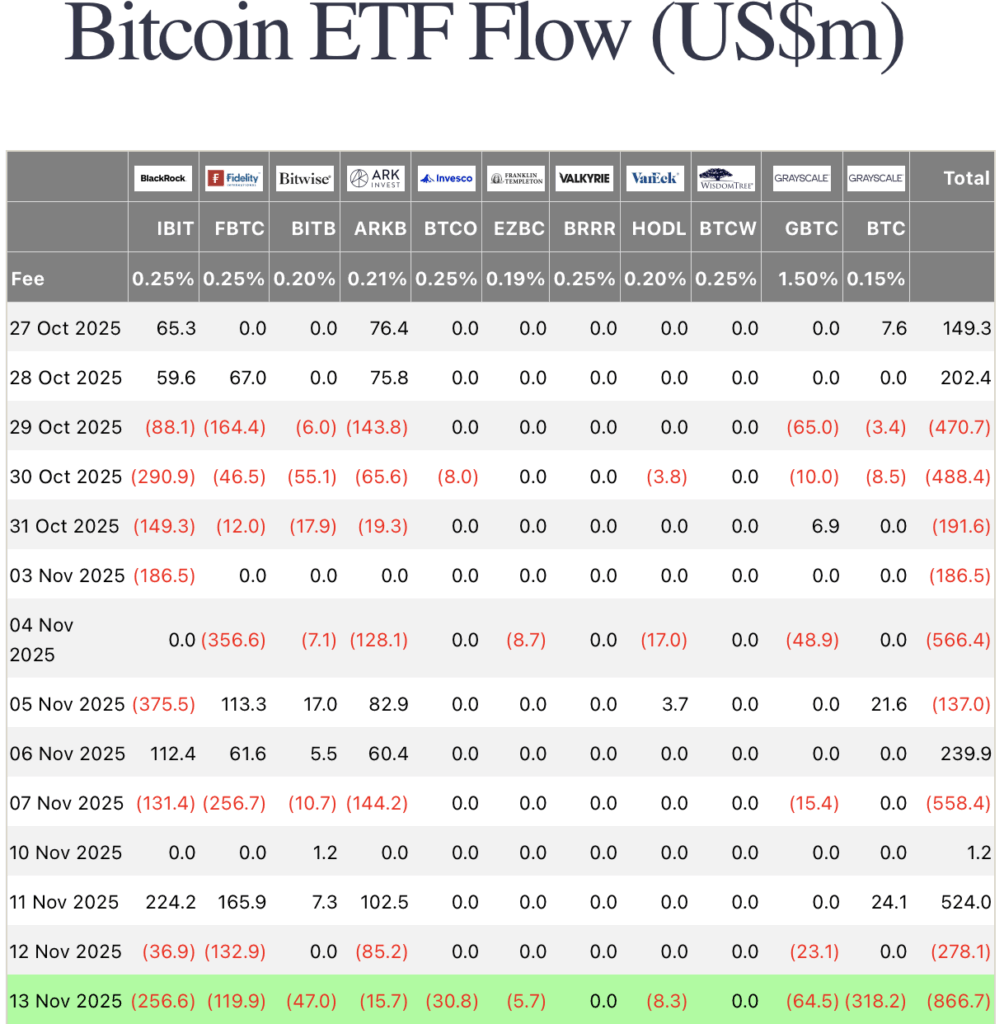
The selloff marks the second-worst day on record for the category. The only larger outflow event occurred on Feb. 25, 2025, when redemptions topped $1.14 billion.
Market analysts said the scale of withdrawals reflects investors backing away from high-beta assets amid growing macro uncertainty. Kronos Research CIO Vincent Liu described the moves as a “risk-off reset,” noting that institutions often trim exposure when liquidity thins and volatility rises. He added that while the withdrawals dampen near-term momentum, the structural demand for bitcoin remains intact.
Min Jung of Presto Research echoed that sentiment, pointing to concerns around the Federal Reserve’s policy path and weakening economic signals. “It’s a broad de-risking across markets,” she said, citing investors’ preference for safer positioning as labor and business data hint at a cooling U.S. economy.

Bitcoin’s price dropped sharply alongside the ETF outflows, sliding 6.4% over 24 hours and falling to around $96,956 early Friday morning. Analysts attributed the decline to a cascade of forced liquidations meeting thin buy-side liquidity. Liu noted that buyers seem to be defending the $92,000 to $95,000 area, but warned that until deeper liquidity returns, elevated volatility is likely to persist.
Arctic Digital’s Justin d’Anethan said the current region is a “logical support,” but if it breaks, Bitcoin could test the lower $90,000s – levels he believes sidelined investors may view as attractive long-term entry points.
Jung added that the downward move did not stem from a single news trigger. Instead, she said, a blend of softening macro indicators and shifting rate-cut expectations has eroded risk appetite. Odds of a December Federal Reserve cut have dropped to 52.1%, according to CME FedWatch, adding another layer of uncertainty to market positioning.


 Commentaries










Fill in necessary fields and publish