


Binance Review 2026: Deep Liquidity, Ultra-Low Fees, and a Full-Stack Web3 Platform
We may earn commissions from affiliate links or include sponsored content, clearly labeled as such. These partnerships do not influence our editorial independence or the accuracy of our reporting. By continuing to use the site you agree to our terms and conditions and privacy policy.

The Binance exchange is the largest crypto exchange by daily trading volume, often tripling the volume of its closest competitors. The platform offers low fees and a wide range of trading tools, while also contributing to the broader crypto ecosystem through additional projects, such as the BNB Smart Chain and the Trust Wallet app.
In this Binance review, we’ll examine the pros and cons of the Binance platform as well as what’s ahead for this icon in the industry.
Our review of Binance covers the top features and the overall user experience. We’ll also discuss the exchange’s history and regulatory challenges. Let’s begin with an overview of the platform and some key takeaways.
Binance Overview
Binance offers a full-featured crypto exchange with trading tools that far surpass many well-known competitors. The addition of expiration futures (and coin-settled futures), as well as options, trading bots, and copy trading, makes Binance one of the most powerful crypto trading platforms in the industry.
That complexity can be intimidating for new Binance users. However, patience pays dividends; Binance offers several ways for newer users to learn how to use Binance’s suite of tools. An updated menu makes it easier to find training guides and a wealth of trading tools, making Binance a capable, low-cost, all-purpose platform that’s powerful enough for traders of any experience level.
| Name | Binance |
| Native Token Name | BNB (Binance Coin) |
| Launched | July 14, 2017 |
| Supported Coins | 500+ cryptocurrencies and 1,500+ trading pairs (global) |
| Trading Fees | Spot: 0.10% maker/taker at VIP 0, with BNB discounts available; USDⓈ-M Futures: 0.02% maker / 0.05% taker at VIP 0 (tiered by volume) |
| Main Features | Deep liquidity spot, margin, and derivatives; Launchpad; Launchpool; Megadrop; Simple Earn; Web3 Wallet; Pay; Academy; Research |
| Staking/Yield | Simple Earn (flexible and locked) with principal-protected products; eligible BNB in Simple Earn participates in Launchpool and Megadrop rewards |
| Security | zk-SNARKs Proof-of-Reserves (1:1 backing plus reserves); multi-layer protections including 2FA, device controls, withdrawal allowlists, anti-phishing code, and SAFU fund |
| KYC | Identity verification required to access full services; process includes government ID, liveness selfie, and proof of address via the KYC center |
Pros:
✅ Binance offers a curated selection of more than 500 cryptocurrencies for spot trading.
✅ The platform supports futures trading with up to 125x leverage on leading assets.
✅ As the largest crypto exchange by trading volume, Binance offers outstanding liquidity for smooth trading.
✅ Competitive fees of 0.10% or less on spot trades makes Binance one of the most affordable trading platforms.
✅ Web3 integration through the Web3 Wallet makes DEX trading easy.
✅ Binance’s $1 billion SAFU fund safeguards user balances against breaches and hacks.
Cons:
❌ A spotty regulatory history makes Binance unavailable in key markets (U.S., UK, Canada).
❌ Binance’s massive selection of trading tools can make the platform intimidating for new traders.
❌ Automated customer service tools frustrate some users.
What is Binance?
The Binance exchange was founded in 2017 during the Initial Coin Offering (ICO) Boom by Changpeng “CZ” Zhao and co-founder Yi He. The pair launched the BNB token as a fundraising tool to finance what would later become the world’s largest crypto exchange. The BNB token was also a massive success in its own right, powering the BNB Smart Chain and acting as a valuable currency on the Binance exchange, offering trading fee discounts and access to exclusive token launches.
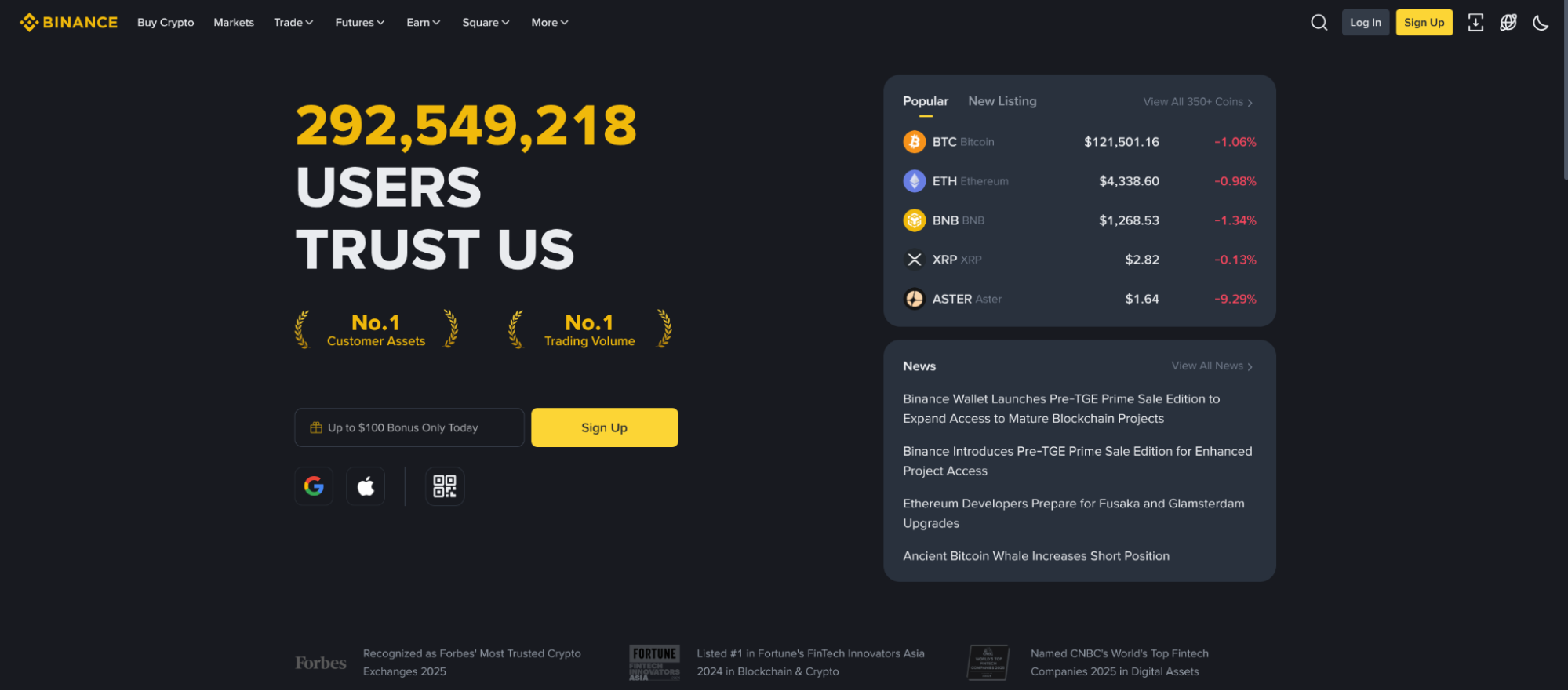
The centralized platform lists over 500 cryptocurrencies, featuring more than 1,500 trading pairs. Although centralized, meaning one company controls access and development of the exchange, Binance began as a somewhat decentralized organization, with no single physical headquarters. However, regulatory pressure is forcing Binance to consider establishing a global headquarters.
The Binance exchange is part of Binance Holdings, Ltd., registered in the Cayman Islands, and is working towards establishing regional compliance hubs to obtain licenses and registrations in key markets. Famously, Binance and its CEO Changpeng Zhao pleaded guilty to several charges brought by the U.S. Department of Justice (DOJ), stemming from Binance’s offering of trading access to U.S. traders without registering the exchange entity with the U.S. government.
Now, under a new management structure and with monitoring in place, the exchange continues to operate and expand its services, albeit with stricter identification verification requirements and tighter geographical restrictions.
Products & Services Available at Binance
Binance owes part of its success to the platform’s wide range of crypto-related services. Alongside standard trading tools, such as spot trading and derivatives, Binance offers a newly launched Web3 Wallet, a large peer-to-peer (P2P) marketplace, a token launchpad, and an NFT marketplace.
- Spot Trading: Binance spot trading offers access to over 500 cryptocurrencies, paired with popular tokens such as USDT, FDUSD, USDC, and BTC. The platform also offers margin trading, allowing access to leverage trading with lower risk compared to futures contracts.
- Futures Trading: Binance offers both expiration futures (BTC and ETH) and perpetual futures trading for about 550 pairs. Traders can access up to 125x leverage on BTC and ETH, with available leverage ranging from 20x to 75x for more volatile altcoin pairs.
- Crypto Options: The Binance platform is one of the few exchanges to offer crypto options, making it a popular choice for advanced traders who trade BTC, ETH, SOL, BNB, DOGE, or XRP.
- Trading Bots: Choose from an assortment of automated trading bots that utilize spot or futures markets on Binance.
- Copy Trading: Follow the moves of proven Lead Traders on the platform. Copy traders choose the lead trader, the investment amount, and their risk management settings.
In addition, Binance also offers P2P trading, a new token launchpad, and a non-fungible token (NFT) marketplace for secure transactions. We’ll cover the Binance Web3 Wallet (2023 launch date), which supports decentralized (DEX) trading in a later section.
Available Cryptocurrencies
As on other exchanges, most of the trading activity centers on larger assets, including BTC, ETH, and SOL. However, Binance has been steadily increasing its support for other altcoins, adding about 150 new tokens in recent months. In total, the platform now supports over 500 coins for spot trading, making it more attractive for altcoin bargain hunters and memcoin traders.
That said, Binance remains cautiously selective, and many of the newest coins still appear on decentralized exchanges (DEXs), other exchanges, or Binance’s own launchpad platforms before reaching spot trading markets.
Here are some of the highlights.
| Asset Type | Coins/Tokens | Comments |
| Top Markets (Blue Chip) | Bitcoin (BTC), Ethereum (ETH), BNB, Solana (SOL) | Binance offers industry-leading liquidity on top assets. |
| Top Altcoins & Layer 1 | Cardano (ADA), Polygon (MATIC), Avalanche (AVAX), XRP, Dogecoin (DOGE) | Expect broader support for established Layer 1 tokens compared to competing platforms. |
| Emerging/Low-Cap | Plasma (XPL), PancakeSwap (CAKE), PudgyPenguins (PENGU), Bonk (BONK) | Although still not as complete as KuCoin or MEXC, Binance now offers a much wider selection of altcoins and memecoins. |
Binance’s growing selection provides ample variety, but we did notice some gaps in the offering. For example, Kaspa (KAS) was still unavailable on Binance at the time of writing, despite being listed on well-established exchanges such as MEXC, KuCoin, and Kraken.
Fees & Costs
Binance fees for trading spot and futures markets follow a tiered structure. Binance calls these tiers VIP Levels, a structure also used by several competing platforms. Traders can earn additional trading fee discounts based on 30-day trading volume or average BNB holdings. VIP 0 refers to the standard fee structure, whereas VIP 1 through VIP 9 represent additional discounts based on BNB holdings or reaching higher trading volume thresholds.
At VIP 0, Binance’s trading fees compare favorably with those of competing platforms, such as Coinbase Pro and Kraken Pro. Other platforms, such as OKX and MEXC, compete more directly with Binance regarding trading fees. Let’s quickly compare spot trading fees for each.
- MEXC: 0.00% Maker, 0.10% Taker
- OKX: 0.08% Maker, 0.10% Taker
- Binance: 0.10% Maker, 0.10% Taker
- Kraken Pro: 0.25% Maker, 0.40% Taker
- Coinbase Advanced: 0.40% Maker, 0.60% Taker
Note that fees change periodically, and platforms often use promotional fee pricing for specific pairs or for a limited time. Binance also offers a discount on trading fees for users who pay fees with the BNB token (10% spot discount and 25% futures discount).
Overall, the highest percentage costs on the Binance platform are associated with debit card-funded purchases and spreads (markups) on “instant buy” purchases. Below, we outline the fees to be aware of on the Binance exchange.
Binance Fees Overview
| Category | Fees |
| Spot Trading (standard rate) | 0.10% Maker / 0.10% Taker; 25% discount for paying with BNB. |
| Futures (standard rate) | 0.02% Maker / 0.05% Taker (USDT); promotional rate on USDC futures (0.0000%/0.0275%); 10% discount for paying with BNB. |
| Binance Wallet | No fees charged by Binance; network gas fees apply. |
| Debit Card Purchases | Varies by region, typically 2.0% to 4.5% fee on purchase/deposit. |
| Crypto Deposits | No Binance fees; network gas fees apply. |
| Withdrawals | Crypto network fees (gas) apply, adjusted based on asset and network congestion. Fiat withdrawal fees vary by currency and method. |
| Crypto Conversion | No fees, but spreads affect conversion costs. |
| Instant Buy/Sell | Debit card fees (2% to 4.5%), plus spread. |
User Experience: Desktop & Binance Mobile App
The overall user experience on Binance primarily caters to intermediate and advanced users. While the platform offers several tools to help new traders get started (instant buy, demo trading, Learn & Earn, tutorials), beginners may feel overwhelmed by the numerous trading and yield options available, many of which can lead to costly mistakes for first-time traders.
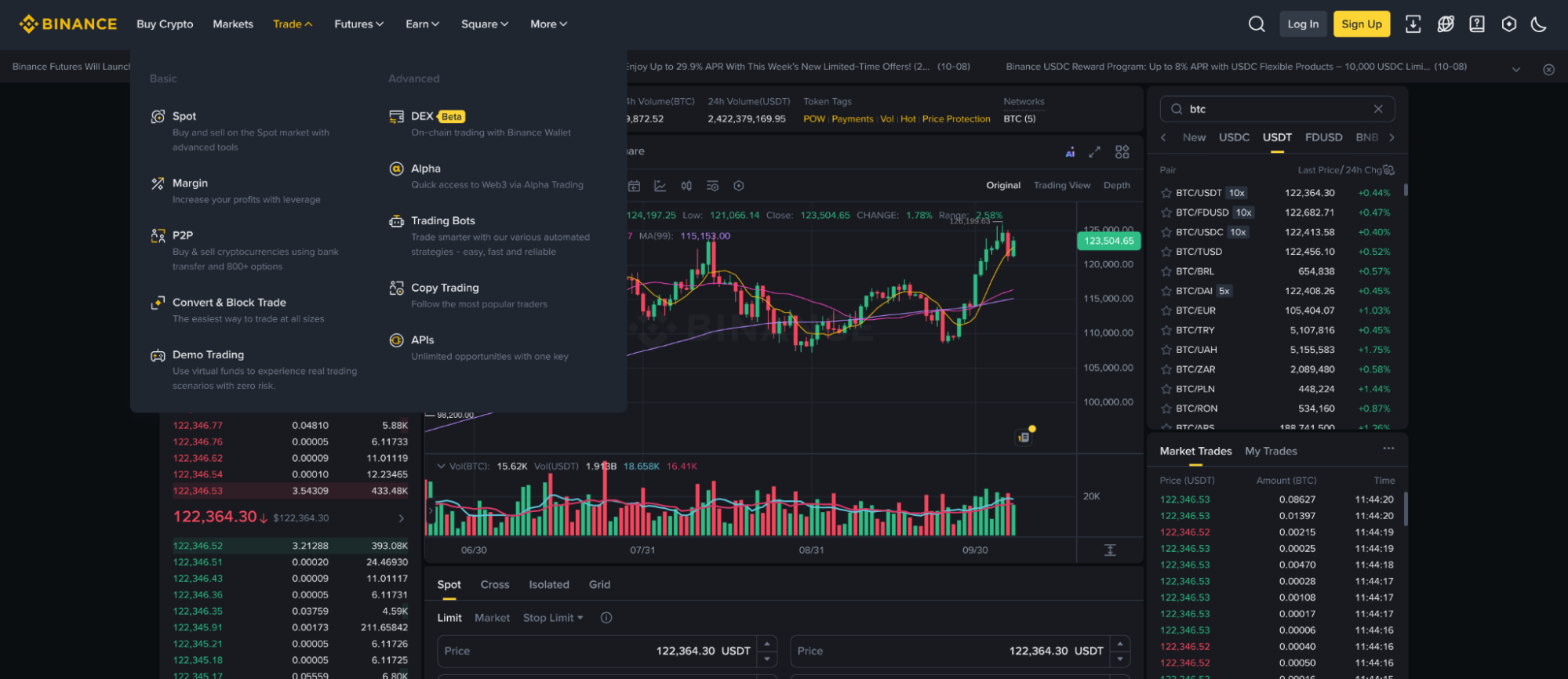
While feature-packed, Binance has significantly improved the web user interface, particularly in terms of the menu structure, and we had no issues navigating the application. Each menu item launches a submenu that makes it easy to find specific features, some of which were previously well-hidden on the platform. A clean, responsive design makes Binance usable on most screen sizes.
The Binance exchange trading screens deserve special mention. Binance now incorporates several new features, including community sentiment, an AI-powered overview of the token, and trading data, such as money flow analysis. Charts feature Binance’s own charts, TradingView charts, and depth charts that can guide short-term trading strategies.
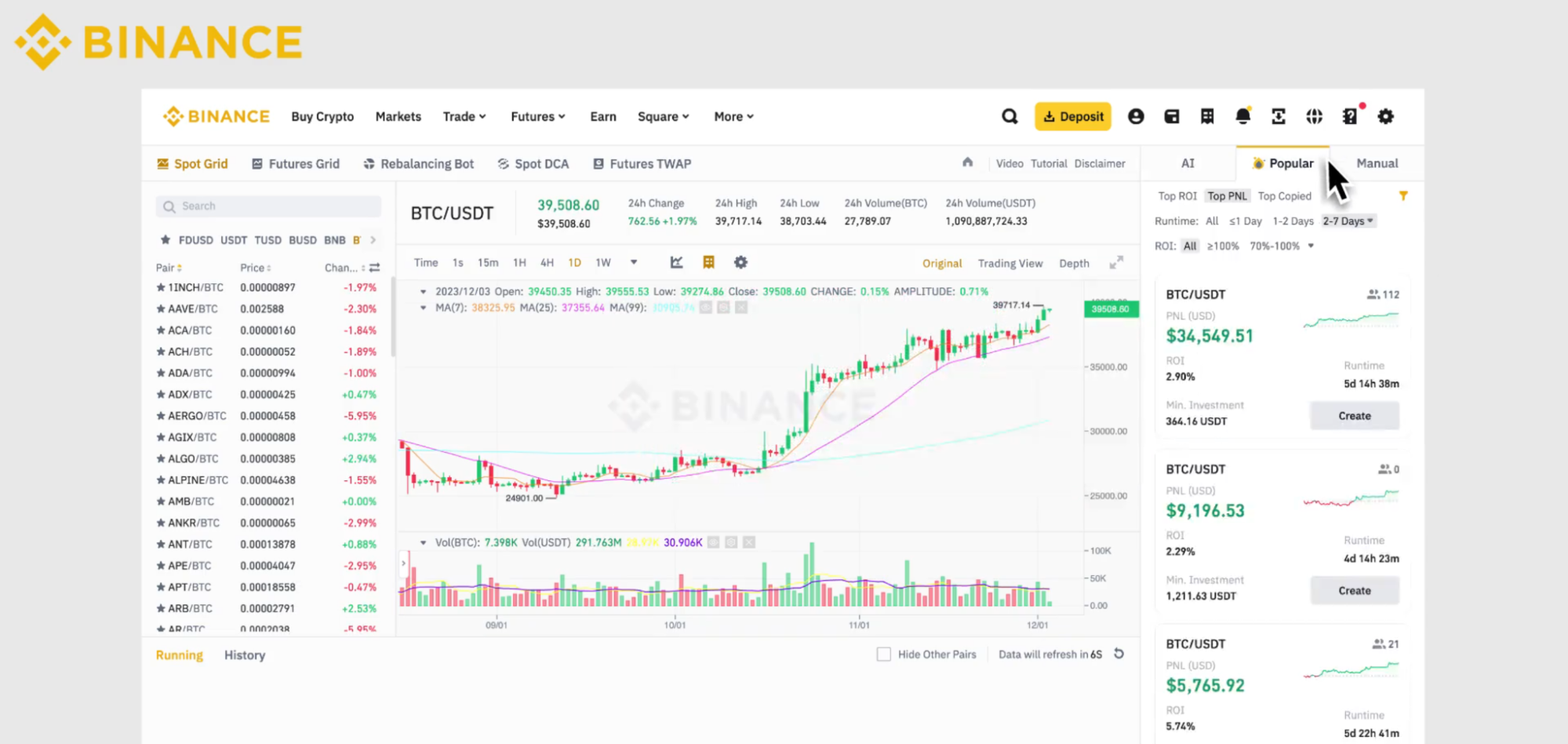
While the trading screen offers less customization than institutional trading platforms like Bybit, it’s tough to think of a piece of data that wasn’t a click or two away on Binance. The emphasis on trading data makes the platform well-suited to technical traders and additional research. However, newer traders may still struggle with the UI complexity, such as margin trades and grid bots nestled alongside simpler spot trades.
An inline how-to video provides basic guidance on trading bots, but no similar inline instructional tool was available for margin trading, which may put newbies at risk.
Binance Mobile App
Binance offers mobile apps for both Android and iOS in addition to the desktop web application. While the Binance app for mobile offers all the same features and functionality as the web app, the addition of a Lite Mode for mobile users makes the app much easier to navigate. Pro Mode brings feature parity with the web app, but can be more challenging to use on a smaller screen. Lite Mode caters to beginners, with simple buy, sell, and convert functionality.
Notably, Binance reviews by mobile users rate the mobile app highly, with a 4.7 out of 5-star rating on Google Play and a 4.6 out of 5-star rating on the App Store.
Top Features of Binance Exchange
Next in our Binance review, we’ll explore the top features of the platform, including derivatives and leverage trading (margin), as well as crypto-related services, such as staking and the Binance card. The platform also provides additional services, including Binance Pay (for spending or sending crypto) and an NFT marketplace that supports collections on Ethereum and BNB Smart Chain. Let’s start with trading-related features.
Derivatives
The bulk of trading on the Binance exchange centers on derivatives, including expiration futures, perpetual futures contracts, and options. Derivatives typically represent triple the trading volume seen on spot markets on the platform. Tools like expiration futures and options have become increasingly rare on crypto exchanges, but Binance still caters to traders in these markets.
- Expiration Futures: Binance offers traditional futures for five assets (BTC, ETH, SOL, XRP, BNB), using quarterly COIN-M Delivery Contracts. These contracts allow investors to build their long-term HODL position through futures trading; the contracts settle in the respective underlying coin (e.g., BTC, ETH, BNB, etc.). Max leverage is capped at 125x, with a 20x cap for new users.
- Perpetual Futures: Most derivatives traders on Binance use perpetual futures contracts (perps), which do not have an expiration date and offer better liquidity as well as a wider selection of trading pairs. Binance caps leverage at 125x for BTC and ETH, with lower max leverage caps for altcoins, typically between 20x and 75x. Again, new users may have lower leverage caps. Perps settle in USDC or USDT.
- Crypto Options: Binance offers options trading for six assets (BTC, ETH, BNB, SOL, XRP, DOGE), using USDT for settlement. The platform uses European-style options, which limit the ability to exercise options to the expiration date. Settlement is automatic if the contract is in the money.
Margin Trading
Binance offers margin trading alongside spot trading, with leverage of 3x to 10x, depending on the trading pair. This offering allows traders to go long or short with conservative leverage and with less complexity than perpetual futures, which use a variable funding fee. However, margin trading comes with an hourly interest rate (reduced by 5% when using the BNB token to pay interest). Both isolated margin and cross margin are supported.
Trading Bots
Binance also offers trading bots that utilize spot or futures markets to trade automatically on your behalf. A selection of pre-made bots assist with various trading strategies, including dollar-cost averaging (DCA), grid trading, arbitrage, and rebalancing. Users can customize bots according to their trading goals.
Binance Earn
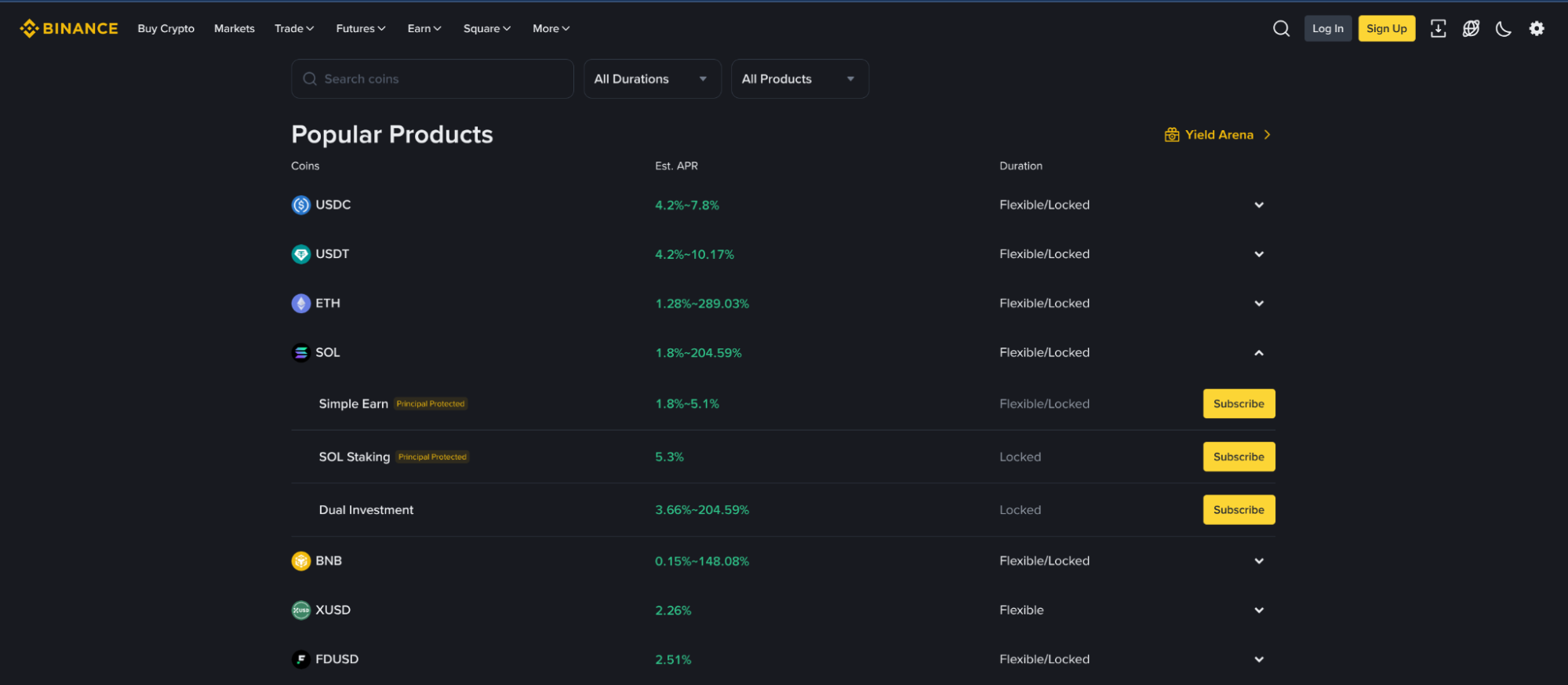
The Binance Earn hub brings several yield products together under one roof, featuring more than 300 assets. Binance Earn offers a range of locked or flexible yield products, including promotional (Yield Arena) offerings that typically provide higher-than-average yields for a limited period.
The platform offers competitive staking yields for leading Proof-of-Stake (PoS) assets, including SOL and ETH. These typically require locking commitments, although Binance also offers its own liquid staking tokens for Ethereum (WBETH) and Solana (BNSOL), which can be purchased on the spot market. Staking yields for Binance outperform rival Coinbase due to a lower validator commission on staking.
The balance of Binance Earn products focuses on yields from lending or “dual investment” products, which utilize European options to create income opportunities.
Binance Card
Users from Brazil can apply for the Binance card, a Mastercard debit card that pays 2% cash back and allows users to spend crypto like cash. While the card was available in other countries, regulatory pressure forced Binance to restrict wider availability.
Binance Launchpool and Megadrop
Oftentimes, the best profit opportunities in crypto come from buying early. Binance offers two ways to get in at the ground floor.
- Launchpool allows users to lock tokens to receive airdrops of newly launched tokens. The easiest way to participate in Launchpool is to subscribe to BNB Simple Earn, which earns a yield and automatically subscribes to new Launchpool listings.
- Megadrop puts a Web3 twist on rewards, combining BNB staking with Web3 quests to earn crypto rewards. We’ll discuss Binance’s Web3 wallet in the section.
Binance Wallet Options
Exchanges like Binance offer a custodial crypto wallet, which provides a way to store your crypto assets on the platform. This type of wallet is secured by your login credentials and any additional 2FA options you enable.
However, Binance also provides a Web3 Wallet that integrates with your Binance account but uses a different security strategy. The Binance Web3 Wallet utilizes Multi-Party Computation (MPC) technology to secure the wallet’s private keys. In simple terms, the app computes the key as needed using shards from three sources, and the user maintains control over the majority of these shares. This makes the Web3 Wallet non-custodial (Binance does not control access).
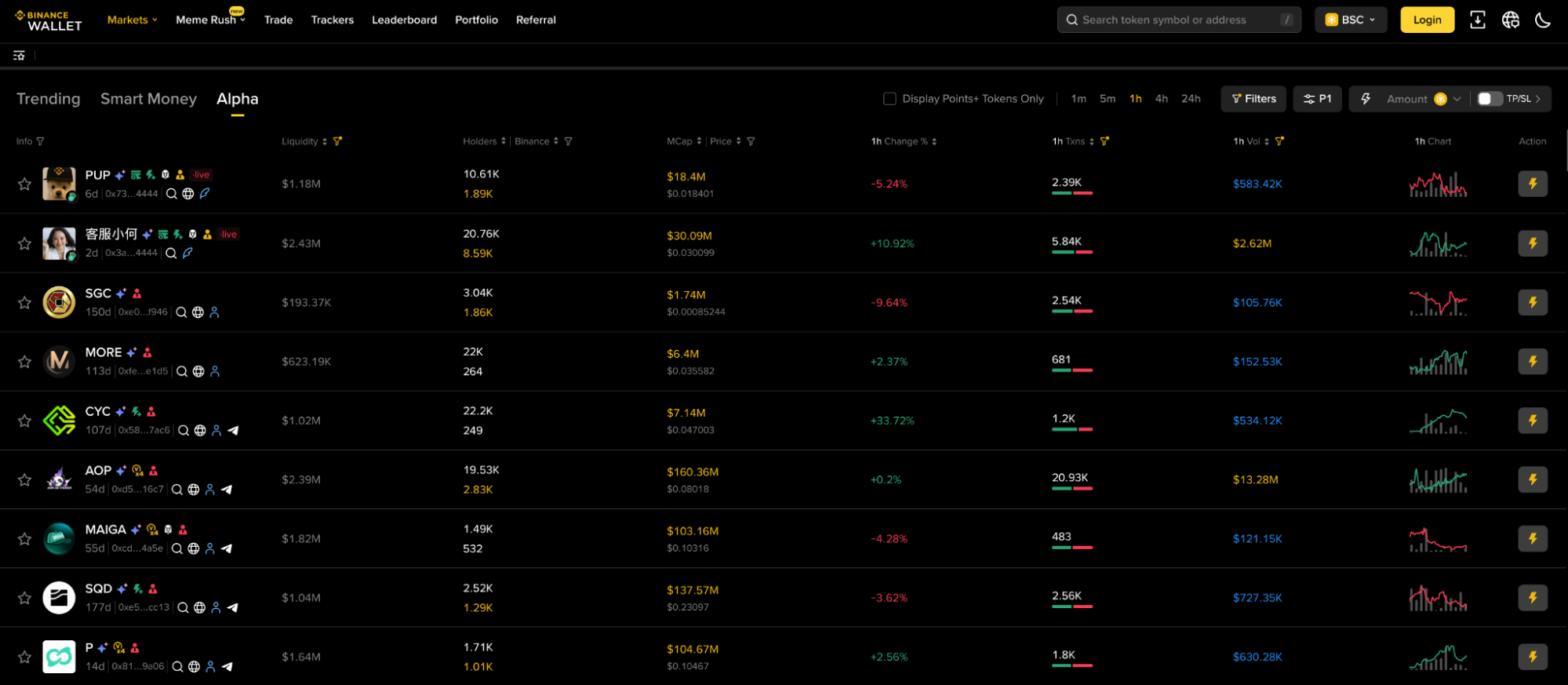
Binance’s Web3 Wallet provides a more secure method of crypto storage that’s less vulnerable to platform risk. Use it to store BTC, ETH, BNB, and dozens of other popular crypto assets. However, the Web3 wallet supports a wide range of decentralized finance (DeFi) activities, including cross-chain swaps and DEX access. The latter of these is where many traders will see the most utility because it allows users to access tokens that aren’t yet supported on Binance’s spot platform.
The Web3 trading interface offers a significantly more comprehensive platform than traditional DEXs like Uniswap or PancakeSwap. Sort by Trending, Smart Money (see where crypto whales are moving funds), and Alpha (curated early-stage Web3 projects). Additional filters let you drill down further.
The wallet you choose largely depends on your trading preferences. Let’s say you expect to use the spot and futures platforms exclusively. In that case, you can consider storing your assets with Binance’s custodial wallet and removing your assets to the Web3 wallet or another non-custodial wallet when you’ve finished trading. However, if you want to use the Binance DEX features (as well as Megadrop), it makes sense to store some of your assets using the Binance Web3 Wallet.
Payments & Withdrawals at Binance
Another key aspect of our Binance review centered on payments and withdrawals. While trading tools on the platform are among the best available in the industry, payment options vary widely based on location. The platform also restricts withdrawal amounts based on the user’s KYC identity verification level. Fully verified users can withdraw up to 100 BTC or equivalent value per day.
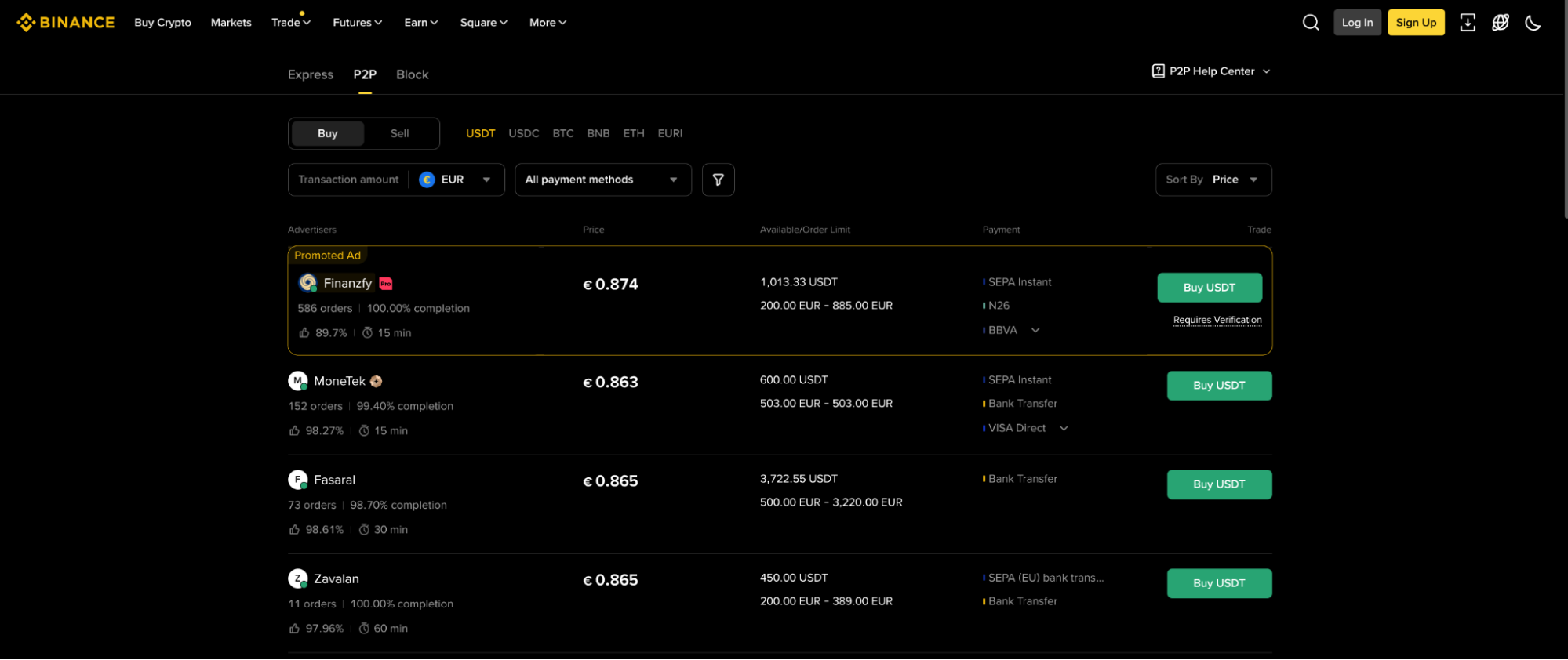
In supported regions, users can deposit or withdraw in more than a dozen traditional fiat currencies, including USD, EUR, BRL, and AUD. However, supported payment gateways vary by region, i.e., SEPA in Europe or PIX in Brazil. Generally, direct bank-funded deposits do not incur a fee (wire transfers excepted). Expect to pay a fee of 2% to 4.5% on card-funded deposits (purchases), which utilizes a third-party processor.
Additional payment methods are available when using the platform’s P2P exchange, which offers a rating system and searchable payment method filters.
The platform also supports crypto deposits and withdrawals, neither of which incur a fee from Binance directly. You’ll pay network gas fees, similar to transferring to any other wallet address.
While deposits do not incur a fee in most cases, withdrawals may incur an additional fixed fee as shown in the examples below.
| Currency | Method | Verified Fee (Binance Side) |
| EUR (Euro) | SEPA Transfer | €0.80 – €1.00 |
| GBP (Pound) | Faster Payments (FPS) | ~£1.50 – £1.95 |
| USD (US Dollar) | SWIFT/Wire Transfer | $15 – $25 |
Notably, Binance does not support users in the U.S. or Canada. The platform has also halted support for new UK users. U.S. traders can access Binance.US. However, the U.S.-only platform is largely crypto-only, with limited fiat on-ramp support in select states.
Is Binance Safe & Trustworthy in 2026?
While Binance has had a famously spotty history with regulators, the exchange is working toward regulatory compliance and provides several safeguards to protect users and the health of the exchange overall. First, let’s discuss the history, which puts many of the later changes in perspective.
The crypto industry as a whole is largely unregulated in regard to daily trading activity. However, to solicit business in specific markets, exchanges need to register with regulators in those markets and comply with rules that govern money service businesses. This is where Binance ran afoul of U.S. regulators, resulting in charges in 2023 related to AML (anti-money laundering) and sanctions violations. Binance was forced to pay a $4.3 billion fine and became subject to mandatory monitoring by the U.S. DOJ and FinCEN, the latter of which will continue through 2028.
The resulting shakeup also led to new management, with the former CEO and co-founder (CZ) stepping down. Under the new CEO, Rishard Teng, Binance has invested millions in strengthening its KYC/AML compliance and is seeking additional licenses and registrations throughout the world. In the interim, the platform remains unavailable to new users in several large markets, including the U.S., UK, and Canada.

Current Binance licenses and registrations include the following:
- France
- Italy
- Spain
- Poland
- Sweden
- Abu Dhabi Global Market
- Australia
- India
- Japan
- Mexico
- El Salvador
- Brazil
Platform and User Safety
Binance also employs several safety measures to protect user accounts, as well as features that protect the platform itself.
- Secure Asset Fund for Users (SAFU): Binance holds over $1 billion worth of crypto assets that serve as an insurance fund, protecting against losses due to hacks.
- Futures Insurance Funds: Binance also maintains a separate set of funds that protect against market volatility in highly leveraged markets. If the exchange cannot liquidate positions fast enough during dramatic price moves, these funds can help cover the shortfall.
- Proof of Reserves (PoR): Users can verify that assets are backed 1:1 at an individual account level using Merkle Tree-based PoR reports. The platform also employs zk-SNARKs (zero-knowledge proofs) to verify overall backing without revealing individual account balances.
- User Security Features: Mandatory KYC compliance and 2FA help keep the platform safe. Additional features, including Withdrawal Whitelisting (authorized withdrawal addresses) and Anti-Phishing Codes, help prevent unauthorized withdrawals.
- Cold Storage: Binance stores the majority of the assets held on the platform in cold storage wallets, which keep the wallet’s private keys offline.
Customer Service & Support Options
Crypto exchanges often fall short of consumer expectations in terms of support, particularly when compared to traditional finance services. Binance suffers a similar fate, as seen in Binance reviews on platforms like Trustpilot (1.4 out of 5 stars).
However, in fairness, the platform offers some of the most comprehensive online help documents in the industry, as well as Binance Academy, which helps users learn all things crypto. Additional support options include a 24/7 AI-assisted chat that connects you to a live agent if the AI agent can’t resolve the issue. Binance also offers an email-ticketing system to help customers resolve problems that may require screenshots or other documentation.
Several additional self-assistance tools help customers perform 2FA resets, file KYC appeals, or change passwords. Traders who qualify for higher VIP levels may have access to dedicated account managers.
In comparison to other exchanges, the Binance support team holds up well. However, users should be prepared to use automated solutions and utilize the support center help pages.
How to Get Started with Binance
Getting started with Binance follows a straightforward process. Let’s look at a step-by-step guide for starting an account and making trades.
1) Create a Binance Account
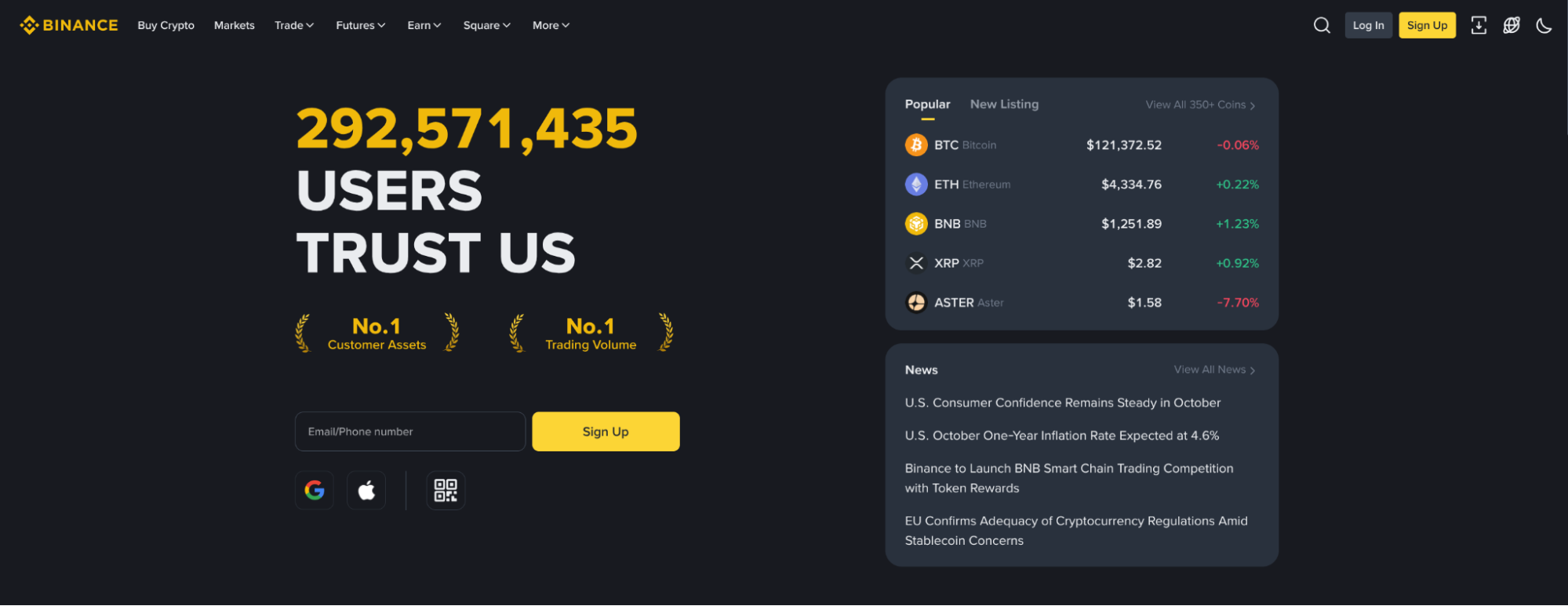
Visit Binance to create a new account login. You can use an email address or phone number. Alternatively, Binance supports social logins using Google or Apple accounts.
Next, create a unique password and follow the instructions to confirm your account via email or SMS code. This would be a good time to set up 2FA for your account. You can find the setting under Account/Security. Look for the user icon on the top right of the main menu to get started with 2FA. Using an authenticator app like Binance Authenticator or Google Authenticator provides a more secure solution than SMS authentication.
2) Verify Your Identity
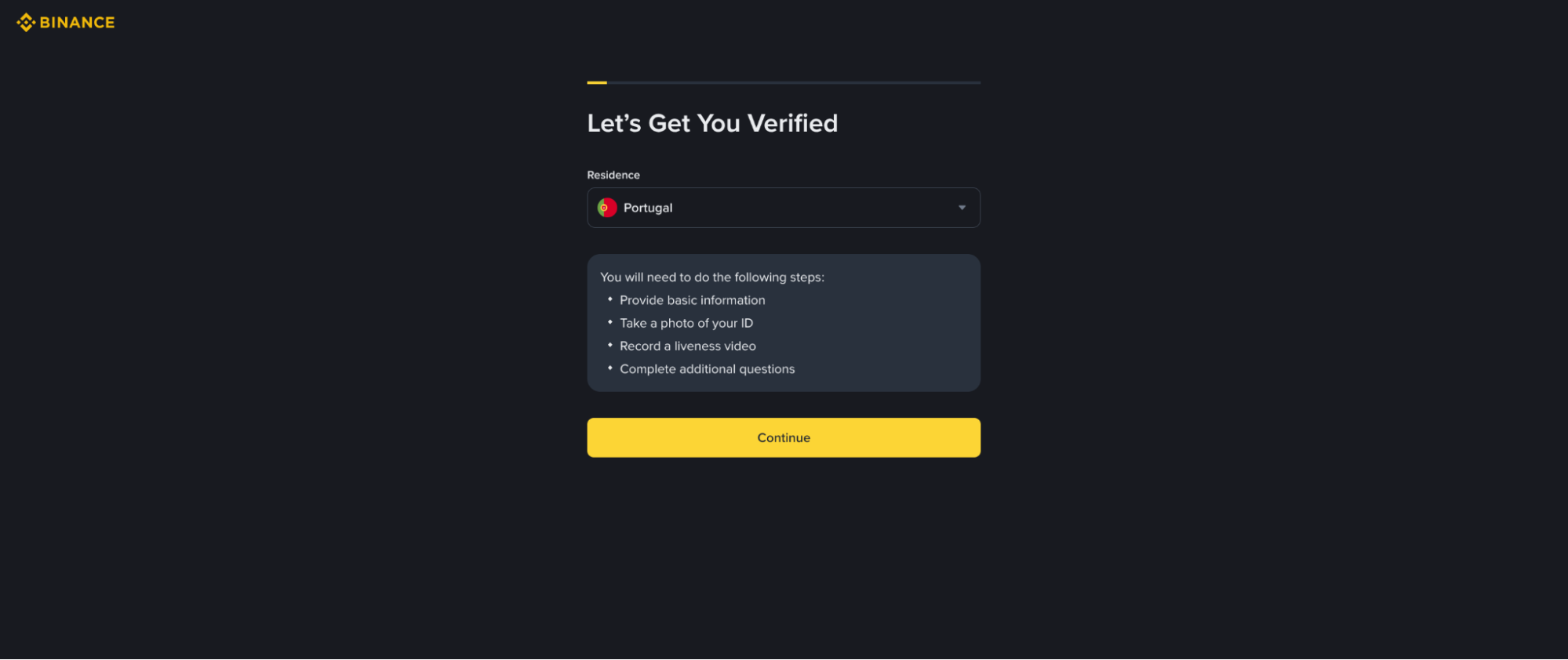
To gain full access to Binance, you’ll need to verify your identity. You’ll see pop-up prompts for verification during the sign up process. If you dismissed these the first time, you can find the verification page under the user account menu. Follow the on-screen instructions to get your account verified. You’ll need to answer some questions about yourself, provide a photo ID, and complete a liveness check. These steps help reduce fraud on the platform and are required for compliance with regulators.
3) Deposit Funds
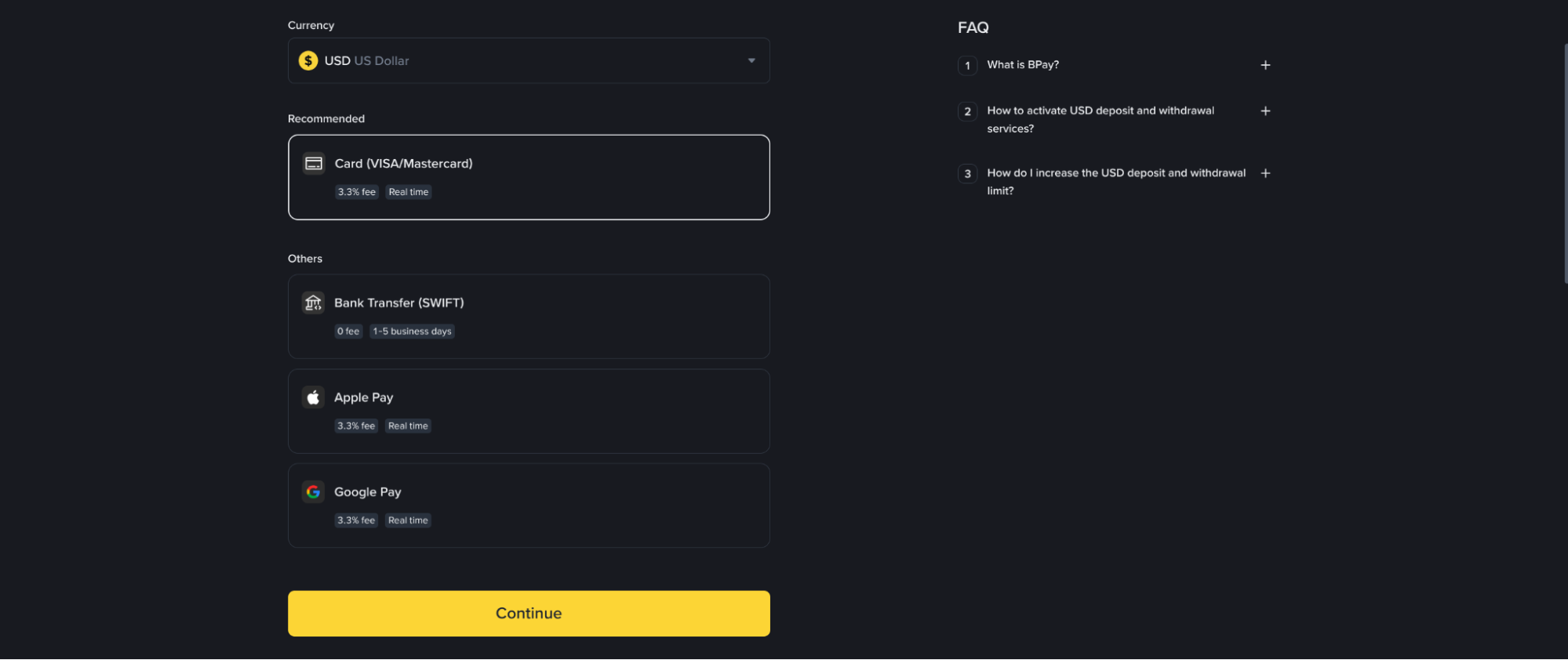
Once you’ve completed the verification process, it’s time to fund your account. Look for the yellow deposit button on the top right of the main menu. Next, choose your deposit method.
Binance recommends using VISA/Mastercard to make a first deposit because this method makes the funds available immediately. However, transaction costs are higher (3.3% in the example below).
Select the deposit method that works best for you and follow the on-screen instructions to make a deposit.
4) Make a Trade
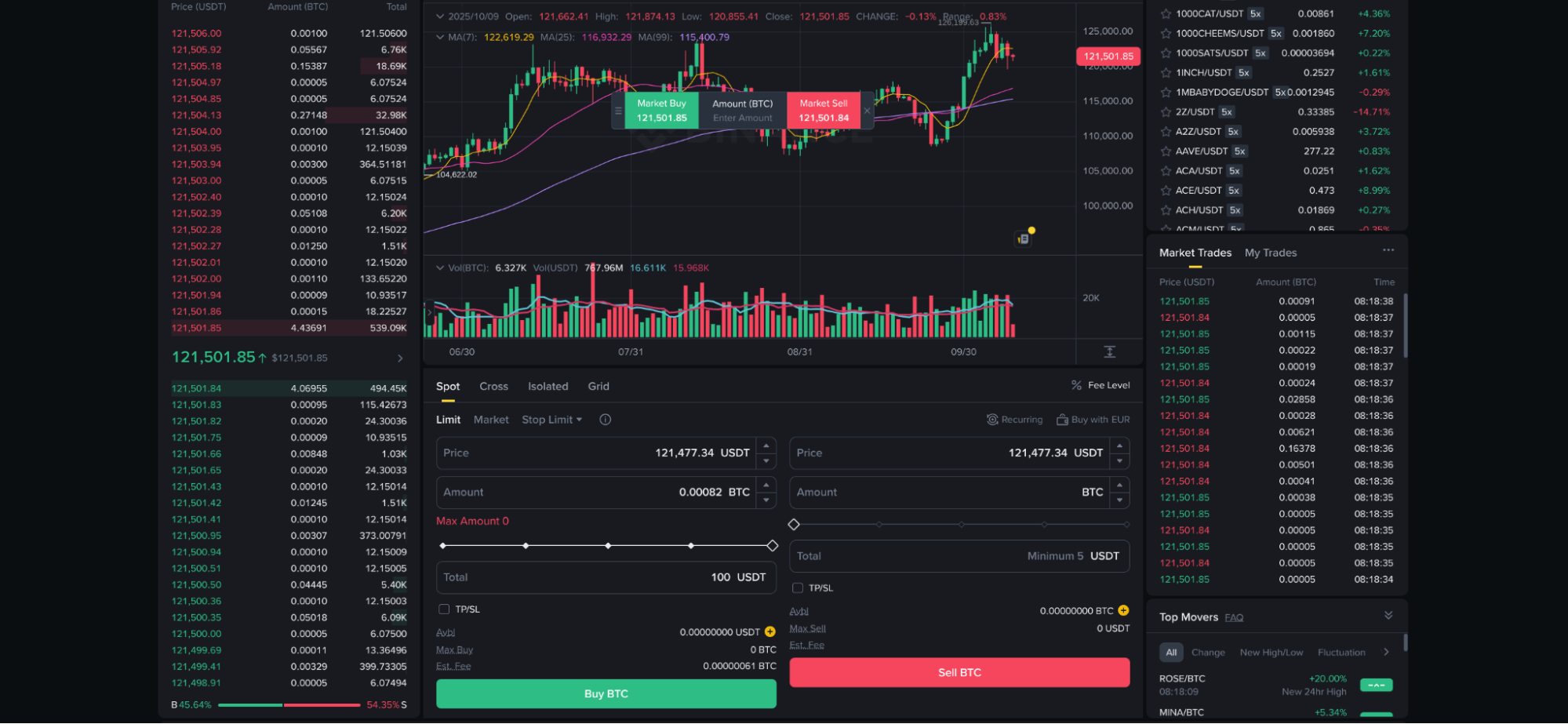
Once you’ve funded your account, it’s time to make your first trade. Let’s buy Bitcoin on Binance.
Click on Trade on the main menu (top left). Then, select Spot. Next, confirm the trading pair. It should be BTC/USDT.
Enter your trade details in the bottom left under the chart. In the example below, we set a limit order for $100 worth of BTC. Limit orders let you set your price, but won’t execute until the market reaches your price.
Verify the trade details. If everything looks right, click on Buy BTC.
For short-term trades, you can consider leaving your assets on the platform. For longer-term trades, best practices suggest moving your crypto to a non-custodial wallet.
5) Closing Your Trade
When it’s time to close your trade, selling follows a similar process. Navigate to spot trading from the main menu and search for the asset you want to sell. Choose an amount you want to sell and select a price if you want to use a limit order. Alternatively, a market order lets you sell right away at the market price.
Once your trade completes, you can withdraw cash from the platform. Click on the user account icon on the top right and scroll down to Assets. From the Assets page, you can withdraw by following the on-screen instructions.
What is BNB Coin?
Earlier, we discussed the BNB coin’s ICO, which provided initial funding for the Binance exchange. Although BNB began as a token on the Ethereum network, it later became the gas and governance token for the BNB Smart Chain (BSC), an Ethereum Virtual Machine (EVM) compatible blockchain network initially developed by Binance.
Adoption on the Binance chain has been impressive over the years, making BNB a more compelling investment than similar “exchange tokens” used on other platforms. Price performance has been assisted by a built-in deflationary structure that limits the supply. Binance automatically burns BNB tokens quarterly, sending BNB to an unrecoverable address on the blockchain. The BSC protocol also burns a percentage of the fees collected by network validators.
In addition to its blockchain role, BNB also serves as a gateway to specific services on the Binance exchange, including token launch access. The BNB token also helps users earn discounts on the platform, with BNB holdings helping users to reach higher VIP levels (with lower fees) and discounts on fees or margin interest for paying with BNB.
New Developments & Binance News for 2026
The crypto industry is constantly evolving, and Binance is taking steps to stay at the forefront. Let’s review some of the key initiatives the platform is acting on to reinforce its leadership position.
- Institutional and Ecosystem Capital Inflow: YZi Labs (formerly Binance Labs) has committed to a $1 billion builder fund to fund and develop DeFi, AI, and other projects on the BNB chain. The BNB chain reached all-time highs in monthly active users in 2025.
- Regulatory and Compliance Milestones: Binance is preparing for Markets in Crypto-Assets (MiCA) compliance, potentially broadening its reach in Europe beyond the existing licenses it holds in Spain, France, Italy, and other parts of Europe.
- Product Upgrades and Integrations: Binance continues to develop its Web3 wallet with enhancements like Binance Alpha. Third-party projects, such as Krystal, have integrated the Binance Alpha feed, increasing liquidity for these budding projects curated by Binance.
Binance is also in talks with the U.S. government to shorten the compliance monitoring period. Whether this paves the way for U.S.-regulated trading remains to be seen. However, the KYC and regional restriction changes the platform has enacted demonstrate a willingness to comply with regulations in multiple jurisdictions.
Our Methodology for Reviewing Binance
To complete our review of Binance, we created a new account and explored the platform’s features with an eye toward usability. We evaluated the platform’s security and regulatory status, as well as its suite of trading tools and crypto selection.
We also tested additional features, including the Web3 Wallet, which gives users access to tokens not yet listed on the platform’s spot markets. In all of our testing, we evaluated the ease of use and the availability of training tools or help screens to assist users before they enter a trade. Our testing included comparisons to competing trading platforms.
The Verdict: Is Binance the Best Crypto Exchange?
Overall, Binance demonstrates why it has become the world’s largest crypto exchange. A wealth of trading tools caters to users of all skill levels, though newer users may need to use training guides to become comfortable with the more powerful features.
From a wide selection of spot trading assets, carefully curated by Binance, to highly liquid futures markets for leverage traders, Binance has something for everyone. The addition of yield products offers another way to put your crypto assets to work between trades.
FAQs
Who owns Binance?
What year was Binance founded?
Is Binance legit?
Can you use Binance in the U.S.?
Which countries does Binance accept?
How long does it take to receive a withdrawal on Binance?
What are the benefits of using Binance?
What are the disadvantages of Binance?
References
- Initial Coin Offering (ICO) Mania and Its Implications for Technology-Led Social Enterprise (cgdev.org)
- Binance will finally establish a global HQ as regulatory pressure mounts (binance.com)
- Binance: Buy Bitcoin & Crypto (play.google.com)
- Binance: Buy Bitcoin & Crypto (apps.apple.com)
- Binance and CEO Plead Guilty to Federal Charges in $4B Resolution (justice.gov)
- SAFU Wallet (etherscan.io)
- Introduction to Futures Insurance Funds (binance.com)
- Proof of Reserves (binance.com)
- Binance Reviews (trustpilot.com)
- Binance Help Center (binance.com)
- BLOCKCHAIN & CRYPTO EDUCATION (binance.com)
- How to Create a Secure Binance Account (binance.com)
- All in one BNB (bnbchain.org)
- Introducing BEP-95 With a Real-Time Burning Mechanism (bnbchain.org)
- CZ’s YZi Labs launches $1B BNB fund as token hits new highs (cointelegraph.com)
- Binance exits at least 3 European markets, prepares for MiCA (blockworks.co)
- Hot Pools – Binance Alpha (krystal.app)
- Binance Nears Deal to Escape Compliance Monitor Imposed by DOJ (bloomberg.com)
