






How Many Hours of Work Will It Take to Earn 1 Bitcoin by 2030?
We may earn commissions from affiliate links or include sponsored content, clearly labeled as such. These partnerships do not influence our editorial independence or the accuracy of our reporting. By continuing to use the site you agree to our terms and conditions and privacy policy.


Bitcoin’s meteoric rise over the past decade has made it increasingly harder for the average worker to earn one full coin through wages alone.
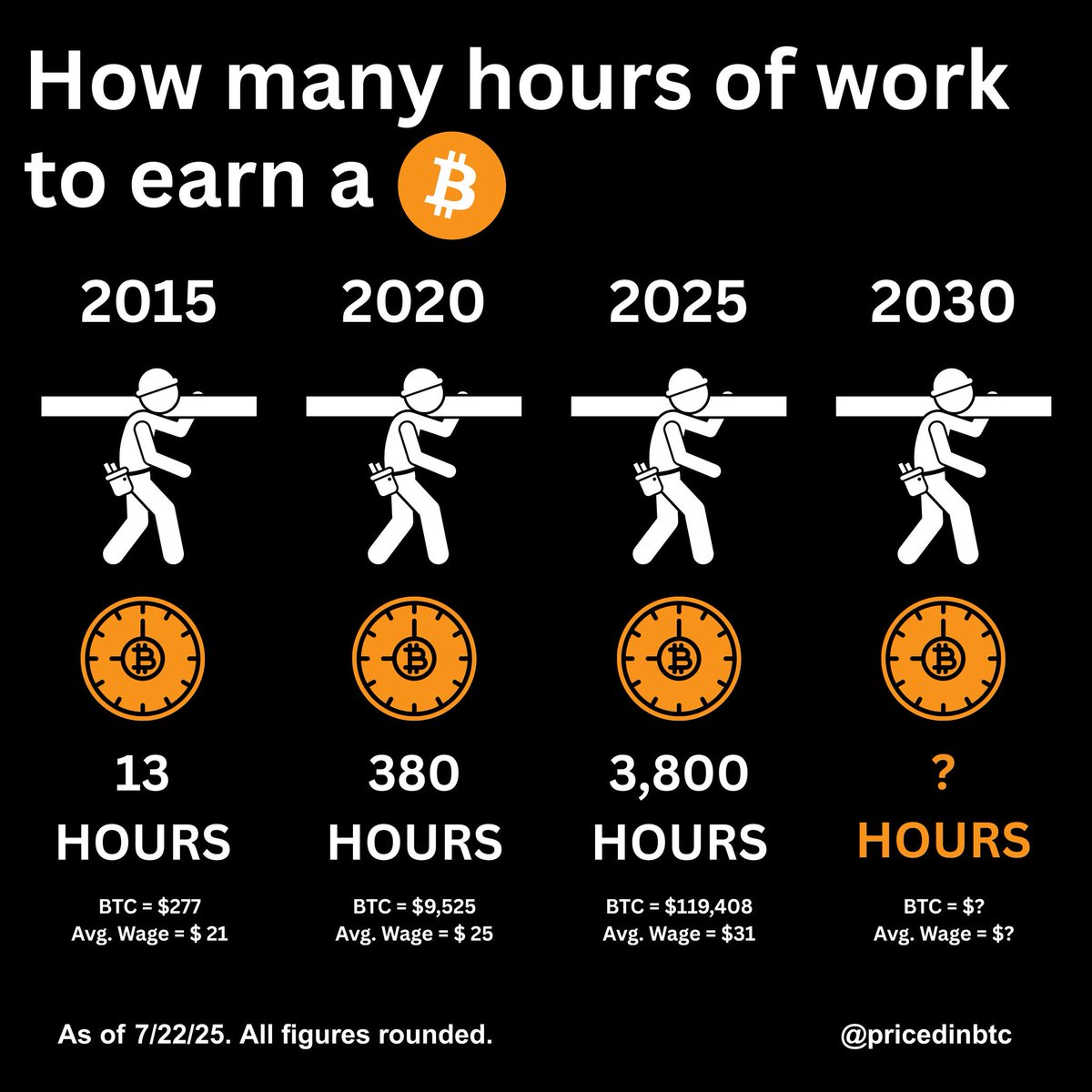
A new chart from Priced in Bitcoin highlights just how dramatic that shift has become — and leaves the community speculating what the next five years could bring.
From 13 hours to nearly 4,000 hours
Back in 2015, when Bitcoin traded near $277, an average U.S. worker earning about $21 per hour could earn 1 BTC in just 13 hours. By 2020, as Bitcoin surged to $9,525, that number ballooned to 380 hours, assuming an average wage of $25 per hour.
Fast forward to July 2025, and the picture is even more daunting. With Bitcoin valued at $119,408 and average wages climbing to just $31 per hour, it now takes roughly 3,800 hours – the equivalent of nearly two years of full-time work – to earn one Bitcoin.
What about 2030?
The chart stops at 2025 and leaves the question open: How many hours will it take in 2030? That depends on two variables — Bitcoin’s future price and the trajectory of global wages. If Bitcoin climbs to $500,000 while wages only rise modestly, workers may be looking at 15,000–20,000 hours of labor for a single coin.
On the other hand, if wage growth accelerates or Bitcoin enters a prolonged consolidation, the gap could narrow. Yet history has shown that Bitcoin’s scarcity-driven price cycles tend to outpace wage inflation.

Why this matters
This visualization underscores Bitcoin’s growing role as a store of value – increasingly out of reach for those who hope to “earn” one through traditional labor. Instead, fractional ownership via sats stacking has become the default strategy for most retail participants.
As we head toward 2030, the central question is not just “how many hours of work will buy a Bitcoin,” but whether Bitcoin will continue to redefine the very concept of wealth accumulation in a digitized global economy.


 Commentaries










Fill in necessary fields and publish