






Solana Governance Vote Rejects Inflation Cut
We may earn commissions from affiliate links or include sponsored content, clearly labeled as such. These partnerships do not influence our editorial independence or the accuracy of our reporting. By continuing to use the site you agree to our terms and conditions and privacy policy.

Solana’s latest governance votes have reshaped the network’s economic model, with mixed results for SOL holders.
A proposal to reduce inflation was rejected, while a plan to distribute validator revenue to stakers gained strong approval.
With 74.3% voter participation—the highest in Solana’s history—the attempt to move from a fixed inflation schedule to a market-driven approach failed, securing only 61.4% of the required 66.67% approval.
Proponents argued that lowering inflation would make SOL more scarce and valuable, but critics feared it would hurt smaller stakers relying on rewards.
Read More:
Meanwhile, a separate proposal to establish an on-chain revenue-sharing system for validators passed with nearly 75% support. This change aims to create a more transparent mechanism for distributing staking rewards, replacing informal off-chain incentives.
Solana co-founder Anatoly Yakovenko acknowledged the complexities behind these decisions, highlighting the network’s evolving governance.
Solaxy Gains Traction
Solaxy ($SOLX) is revolutionizing blockchain technology by offering the first Layer-2 solution on Solana. This project significantly improves speed and reduces transaction fees, solving network congestion problems.
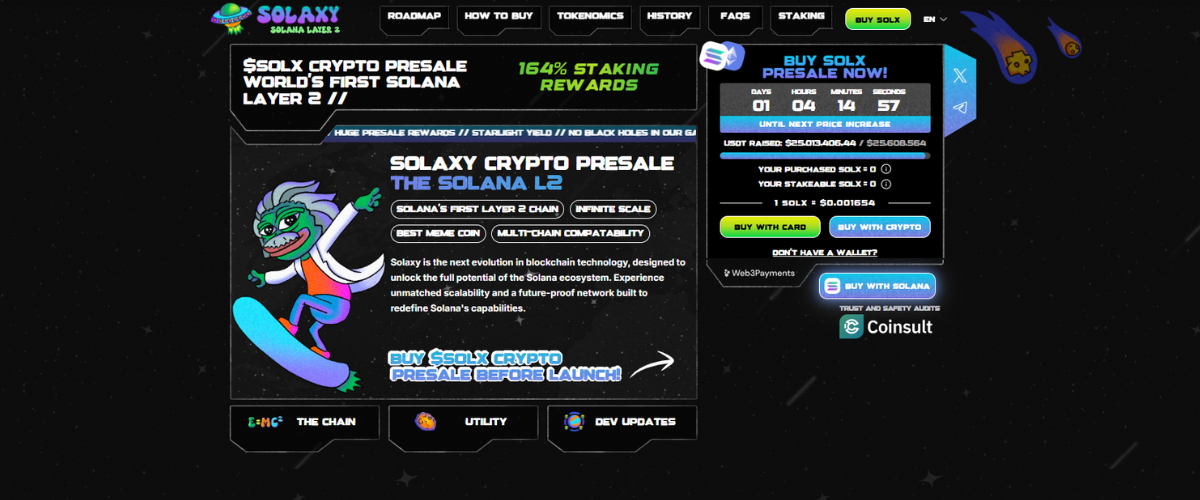
Solaxy’s advanced rollup architecture shows strong potential to optimize transaction speeds and reduce congestion-related inefficiencies on Solana. The project’s approach reduces congestion and ensures smooth execution, even during peak activity. For traders, this means faster and more reliable transactions, preventing failed swaps.
Beyond improving transaction efficiency, Solaxy is expanding interoperability between Solana and Ethereum. The $SOLX token functions as a multi-chain asset, allowing users to engage across both ecosystems. This provides access to Ethereum’s liquidity while benefiting from Solana’s speed and cost efficiency.


 Commentaries






Fill in necessary fields and publish