


How Hacks Destroy Crypto Projects Long After Funds Are Recovered
We may earn commissions from affiliate links or include sponsored content, clearly labeled as such. These partnerships do not influence our editorial independence or the accuracy of our reporting. By continuing to use the site you agree to our terms and conditions and privacy policy.


In crypto, a major hack is rarely just a financial setback - it is often an existential one.
According to Mitchell Amador, chief executive of Immunefi, close to 80% of crypto projects that experience a serious exploit fail to fully recover.
The problem, he argues, is not the initial loss of funds. It is what happens immediately afterward.
The collapse usually begins in the first hours
When an exploit is discovered, many teams freeze. Amador says most protocols lack a predefined incident-response plan and underestimate how exposed they are until it is too late. Instead of acting decisively, teams debate next steps, delay critical decisions, and struggle to understand the true scope of the breach.
That hesitation is costly. As response time stretches, attackers often continue extracting value, while users are left in the dark. Some teams avoid pausing smart contracts out of fear that doing so will signal weakness. In practice, Amador says, silence and inaction amplify panic far more than transparency ever could.
“The damage usually comes from operational failure and loss of trust,” he said, not from the exploit itself.
Fixing the code rarely fixes the project
Even when vulnerabilities are patched, recovery is far from guaranteed. Alex Katz, co-founder and CEO of Kerberus, says that for most projects, a major hack marks the beginning of irreversible decline. Users leave. Liquidity evaporates. Reputations never fully recover.
Katz notes that the nature of crypto exploits has also shifted. While smart contract bugs once dominated losses, today’s biggest failures increasingly stem from human and operational weaknesses. Users are tricked into signing malicious transactions, interacting with fake interfaces, or exposing private keys – mistakes that no audit can fully prevent.
One recent case underscored the scale of the problem: a single victim lost more than $282 million in Bitcoin and Litecoin after attackers impersonated customer support and obtained a hardware wallet seed phrase.
Losses surge as attacks become more sophisticated
Crypto-related theft accelerated sharply in 2025, with total losses reaching roughly $3.4 billion – the highest level since 2022. A small number of incidents accounted for the majority of damage, including the $1.4 billion exploit at Bybit, which alone represented nearly half of the year’s losses.
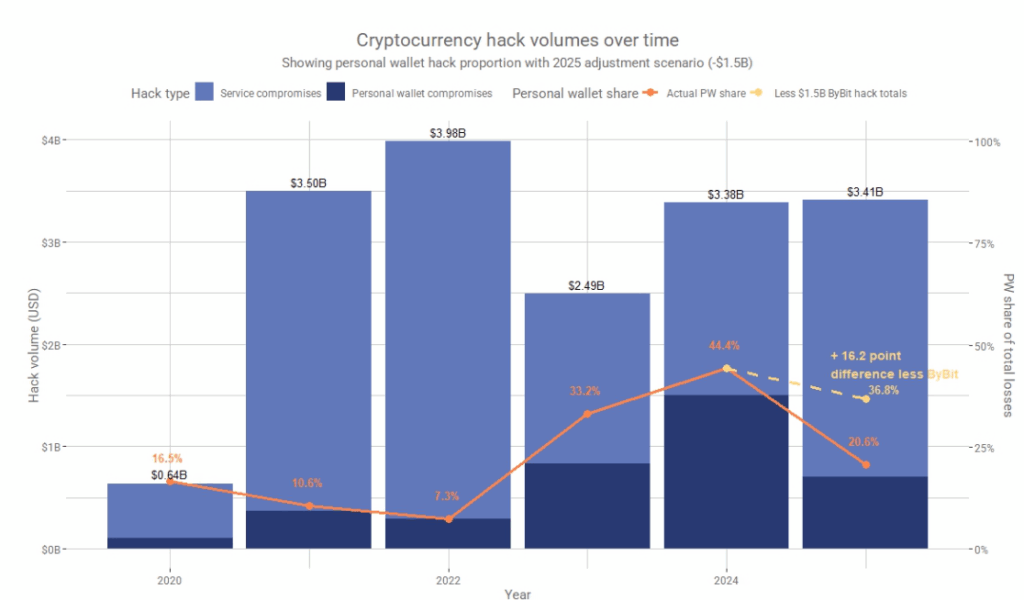
Amador points out that attackers are no longer limited by scale. Advances in artificial intelligence have made social engineering campaigns faster, cheaper, and far more targeted, allowing thousands of tailored phishing attempts to be deployed daily.
In many cases, smart contracts are bypassed entirely. The weakest link is no longer the code – it is the human layer around it.
A stronger future depends on response, not just security
Despite the bleak statistics, Amador remains cautiously optimistic. He believes smart contract security itself is improving rapidly, driven by better tooling, more rigorous audits, and widespread adoption of onchain monitoring and threat detection.
He expects 2026 to mark a turning point for contract-level security. The unresolved challenge, however, is preparedness.
According to Amador, projects that survive hacks share one trait: decisive action. Immediate communication, early protocol pauses, and clear leadership matter more than perfect information. Waiting for certainty, he warns, is often the most damaging choice a team can make.
In crypto, trust is the hardest asset to rebuild – and once it breaks, most projects never get a second chance.
Read our full guide to the best crypto airdrops for this year.


 Commentaries










Fill in necessary fields and publish