






Digital Yuan Infrastructure Quietly Grows Outside Dollar System
We may earn commissions from affiliate links or include sponsored content, clearly labeled as such. These partnerships do not influence our editorial independence or the accuracy of our reporting. By continuing to use the site you agree to our terms and conditions and privacy policy.


A cross-border digital currency network backed by China is rapidly scaling, offering a glimpse into how global payments could function beyond traditional dollar-dominated systems.
The platform, known as mBridge, has now processed more than $55 billion in cross-border settlements, signaling accelerating adoption of central bank digital currency infrastructure.
Data compiled by the Atlantic Council shows the platform has handled over 4,000 international transactions, a dramatic leap from its experimental phase just a few years ago. Since early pilot testing in 2022, total settlement value on the network has expanded by roughly 2,500 times.
mBridge operates as a multi-central bank digital currency platform, linking monetary authorities rather than commercial intermediaries. Active participants currently include central banks from mainland China, Hong Kong, Thailand, the United Arab Emirates, and Saudi Arabia. Despite the multinational structure, settlement activity is overwhelmingly driven by China’s digital yuan, which accounts for an estimated 95 percent of total volume.
Domestic scale feeds cross-border reach
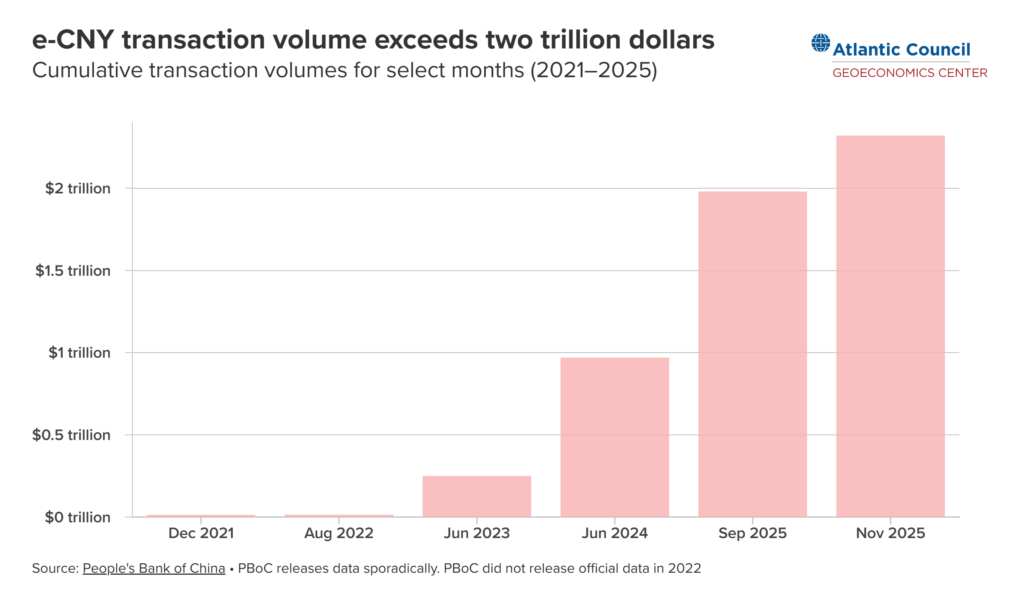
The surge in cross-border usage mirrors the rapid expansion of China’s domestic digital currency ecosystem. According to the People’s Bank of China, the digital yuan — known as e-CNY — has now been used in more than 3.4 billion transactions, with a cumulative value of approximately 16.7 trillion yuan, or about $2.4 trillion. That figure represents growth of more than 800 percent compared with 2023.
China is also moving to deepen the digital yuan’s role within the banking system. Under a newly announced framework, commercial banks will be permitted to pay interest on e-CNY wallet balances. Lu Lei has described the shift as a transition from a cash-like instrument toward a “digital deposit currency,” allowing the digital yuan to function as a store of value alongside its payment role.
The change would integrate the e-CNY directly into banks’ asset and liability management, potentially making it more attractive for larger balances and institutional use – including in cross-border contexts.
Parallel rails, not a dollar replacement
Analysts see these developments as incremental rather than confrontational. Alisha Chhangani notes that China’s strategy is not to displace the US dollar outright, but to construct alternative settlement channels that reduce reliance on existing dollar-centric infrastructure. Over time, such parallel systems could offer countries more flexibility in how they move value across borders.
That geopolitical undertone has not gone unnoticed. In 2024, the Bank for International Settlements stepped away from direct involvement in mBridge, framing its exit as a project “graduation.” BIS General Manager Agustín Carstens rejected claims that the platform could be used to evade sanctions, emphasizing that BIS-linked systems cannot be accessed by sanctioned jurisdictions.
Still, the overlap between mBridge participants and BRICS countries has kept the project under scrutiny, particularly as global payment systems become increasingly entangled with geopolitics.
For now, mBridge’s growth highlights a broader shift underway: digital currency infrastructure is moving from theory to scale. While the dollar remains dominant, the architecture for alternative settlement pathways is no longer hypothetical – it is already processing tens of billions of dollars in real transactions.
Looking for more ideas? Read our full guide to the best meme coins to invest in this year.


 Commentaries










Fill in necessary fields and publish