


Bitcoin’s Next Phase Looks More Like Consolidation Than Collapse
We may earn commissions from affiliate links or include sponsored content, clearly labeled as such. These partnerships do not influence our editorial independence or the accuracy of our reporting. By continuing to use the site you agree to our terms and conditions and privacy policy.


Rather than a sudden crash or panic-driven selloff, the data points to something more subtle: a slow slide into bearish territory that began late in 2025 and has yet to reverse.
Julio Moreno, CryptoQuant’s head of research, argues that many of the signals typically associated with healthy bull markets faded as early as November. Metrics tracking network usage, investor profitability, liquidity conditions, and demand have weakened in tandem, producing a broad deterioration rather than an isolated warning sign. For Moreno, the decisive moment came when Bitcoin lost its one-year moving average – a level he views as a long-term dividing line between expansion and contraction phases.
Bitcoin’s price action over 2025 supports that interpretation. After opening the year near $90,000, the asset surged to a peak above $126,000 in October before rolling over and finishing the year below where it began, based on data from TradingView. That reversal clashes with expectations that post-halving periods typically favor sustained upside.
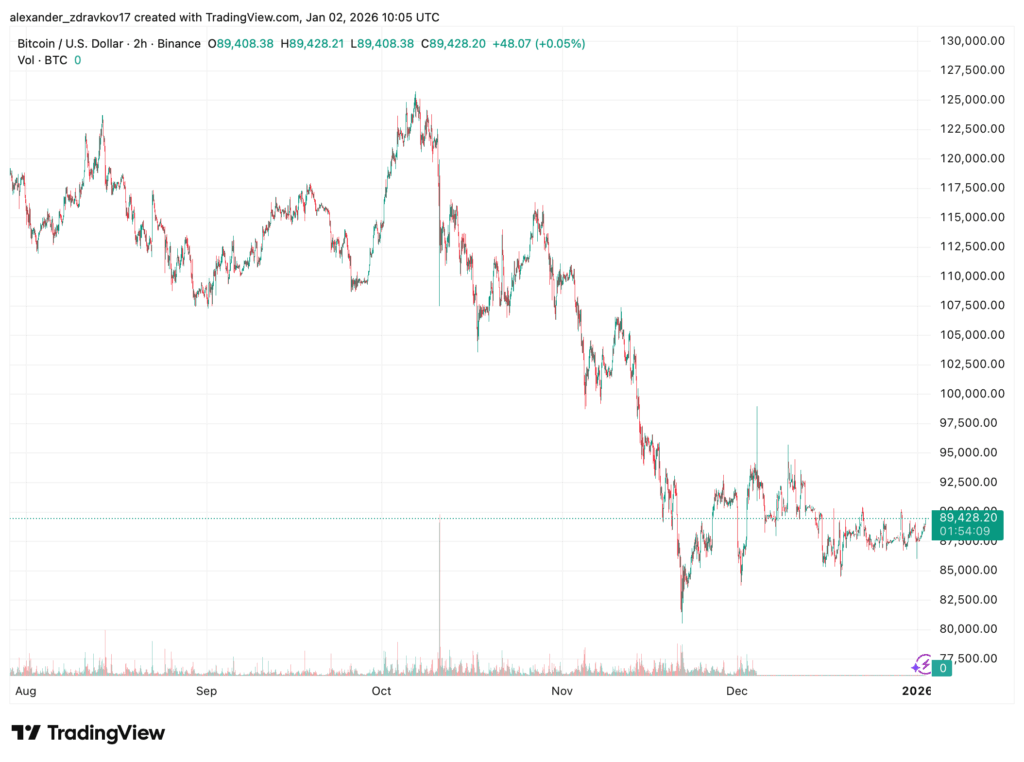
A Different Kind of Bear Market
If this is a bear market, Moreno believes it will look very different from previous cycles. Instead of violent collapses and cascading failures, the current downturn appears more orderly. He estimates that a realistic downside target over the next year sits between $56,000 and $60,000 – a zone tied to Bitcoin’s realized price, or the average cost basis of current holders.
Reaching that range would imply a drawdown of roughly 55% from the all-time high. Historically, that would be considered relatively shallow. Earlier bear markets regularly erased 70% to 80% of peak valuations, often amid high-profile bankruptcies and systemic shocks.
Why This Cycle Looks More Stable
What sets this phase apart is the absence of major structural failures. Unlike 2022, there have been no Terra-style implosions, lender collapses, or exchange blowups to accelerate downside momentum. At the same time, the buyer base has evolved. Institutional participants and exchange-traded products now provide a layer of steady, periodic demand that did not exist in earlier downturns.
Rather than demand disappearing entirely, Moreno sees it rotating and thinning – a pattern more consistent with consolidation than capitulation. That dynamic helps explain why selling pressure has increased without triggering a full breakdown.
If Bitcoin is already in a bear market, it may not announce itself with chaos.
Instead, the defining feature of this cycle could be time: a prolonged period of sideways-to-lower prices as the market digests past gains and resets expectations. In that sense, the story heading into 2026 may not be about collapse or explosive recovery, but about how a more mature market learns to endure contraction without imploding.
 Commentaries
Fill in necessary fields and publish